Where to eat a real Florentine steak in Florence
What defines the dish
The bistecca fiorentina has more technical constraints than almost any other Italian dish. The breed of cattle must be Chianina, or, less commonly, Maremmana or Podolica, raised in Tuscany. The cut is the lombata, the loin section that includes both the sirloin and the tenderloin separated by the T-bone. The steak must weigh at least 600 grams, though most restaurants serve pieces between 800 grams and 1.2 kilograms. The thickness must be no less than three fingers, meaning roughly four centimetres; most serious establishments cut theirs at five to six centimetres.
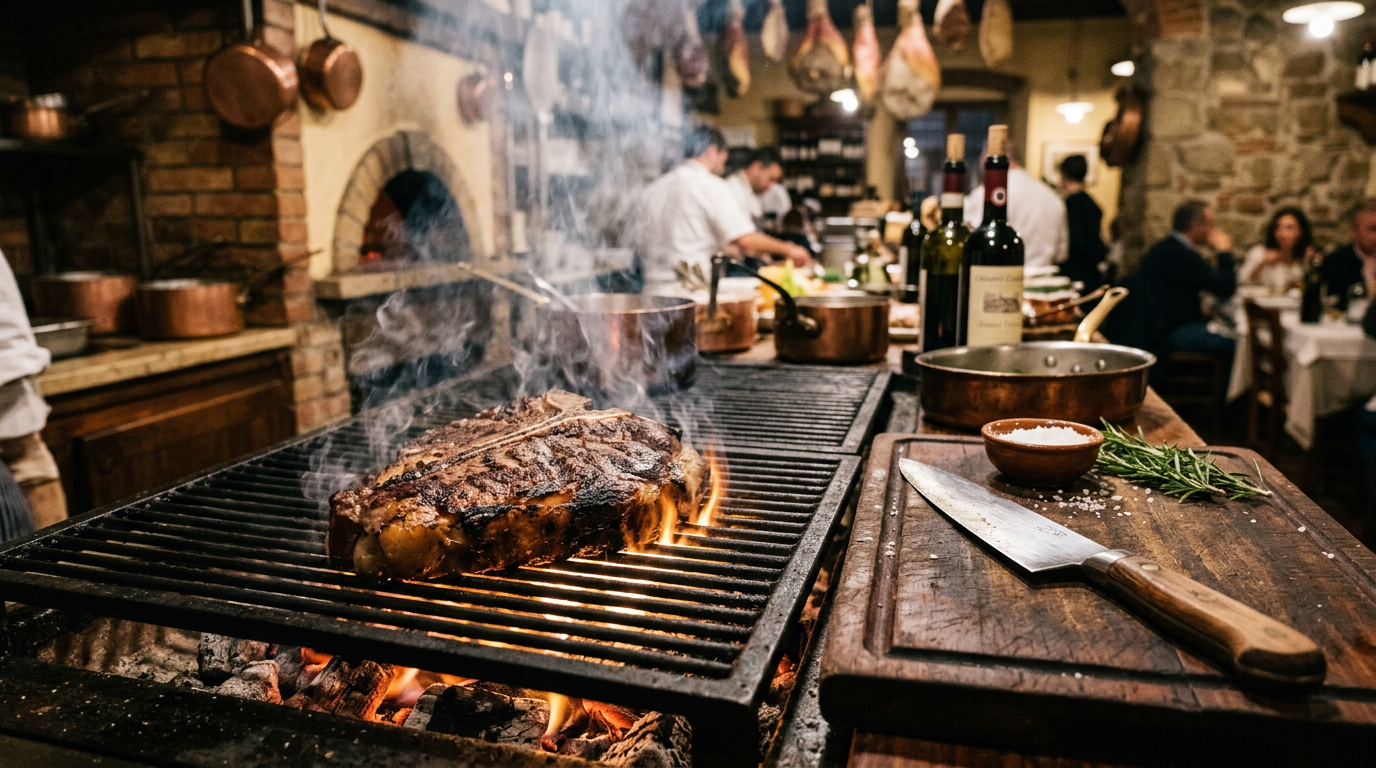
Cooking is done over live fire, wood or charcoal, never gas. The steak is placed on the grill at high heat for three to four minutes per side, then stood upright on the bone for another two minutes. The result is a deep crust on the exterior and a red, warm interior. It is served without sauce. Salt is added after cooking. Pepper is optional. Rosemary is acceptable. Olive oil from Tuscany is poured over at the table.
Ordering medium or well done at a traditional trattoria is not a preference the kitchen is required to accommodate. Several well-known establishments in Florence will refuse the order or explain that the dish cannot be prepared that way. This is not rudeness. It is consistency with a defined product.
How to recognise genuine Chianina
The Chianina breed is one of the oldest in the world, with a documented history in the Val di Chiana dating back to Roman agricultural writings. The animals are white-coated, large-framed, and slow-growing. Their meat is lean relative to commercial breeds, darker in colour, closer to deep ruby than bright red, and has a clean, mineral flavour without excess intramuscular fat.
When you look at a raw bistecca fiorentina at the butcher or on the plate, the muscle should be compact and dark. Marbling will be present but not excessive. The fat cap on the outside should be white to cream-coloured and firm. If the meat is bright red and very fatty, it is likely not Chianina. Some butchers in Florence now display certificates of origin alongside the cut, and several require you to request and read the provenance card before purchasing.
Age matters as well. Chianina steaks are typically dry-aged for twenty-one to thirty days before service. Shorter ageing produces a tighter, less developed flavour. You can ask at the restaurant how long their current cut has been aged. Established places will tell you precisely. If the response is vague, that is useful information.
Where to eat it in Florence
Buca Mario, in Via delle Romane near Piazza Santa Croce, has been operating since 1886 and is considered one of the oldest restaurants in the city. Their bistecca is sourced from Fattoria di Vaiano and is available at around €65 per kilogram in 2026. They do not accept table modifications after the cut is committed.
Trattoria Mario in Via Rosina, near the Mercato Centrale, is simpler and cheaper. They serve bistecca at communal tables, and portions are shared. The atmosphere is working-class Florentine, unchanged since the 1950s. Lunch only. Expect to pay around €45 per kilogram.
Buca dell’Orafo, in Vicolo dei Girolami near Ponte Vecchio, targets a higher-end clientele but maintains strict sourcing standards. Their Chianina comes from the Valdarno and is cut to order. At around €70 per kilogram in 2026, it is not the cheapest option, but the quality control is consistent.
For a less formal setting, Il Latini in Via dei Palchetti, about 700 metres from Via Pisana 191, serves shared tables at fixed prices with wine included. The bistecca is rotated by season based on available cuts.
Butchers for buying at home
If you are staying in a self-catering apartment and want to cook your own bistecca, the Mercato Centrale on Piazza del Mercato Centrale has at least three butchers who stock Chianina cuts. Macelleria Baragli is the most established, with prices around €28–€34 per kilogram for loin cuts in 2026. They will cut to your specified thickness and can advise on resting time.
Macelleria Falomi in Greve in Chianti, about 28 kilometres south of Florence on the Chiantigiana road, is a benchmark operation with fifty years of history. They dry-age on-site and supply several Florence restaurants. You can buy directly from the retail counter. The drive from Via Pisana 191 takes approximately thirty-five minutes without traffic.
The Mercato di Sant’Ambrogio, about two kilometres from Ponte Vecchio, also has reliable butchers with Chianina stock, particularly on Saturday mornings. Prices there tend to be slightly lower than the Mercato Centrale, and the market has been serving the Florentine residential population since 1873.
Prices and portions in 2026
The bistecca fiorentina is priced by weight at virtually every restaurant in Florence. In 2026, the range runs from approximately €42 per kilogram at informal trattorias to €80 per kilogram at upscale restaurants with extensive wine lists. A standard portion for two people weighing one kilogram will therefore cost between €42 and €80 for the steak alone, before sides, wine, and cover charge.
Sides are ordered separately. Fagioli all’uccelletto, cannellini beans in tomato and sage, are the canonical accompaniment, usually €5–€8. Roasted potatoes or spinach sautéed in garlic and oil are equally common. A bottle of Chianti Classico Riserva at a mid-range restaurant in Florence costs €28–€45, which is the appropriate pairing.
Cover charges (coperto) run from €2 to €4 per person. Service is usually included in Florence, but this varies by restaurant. Always check before adding a tip.
Avoiding common mistakes
The most frequent error visitors make is ordering at a restaurant that claims to serve bistecca fiorentina but does not follow the breed or cut standards. Look for the menu to explicitly state Chianina or IGP Vitellone Bianco dell’Appennino Centrale. The latter is a protected geographical indication that covers several central Italian white cattle breeds under EU law, enacted in 1998, and is a reliable marker of authenticity.
A second common mistake is ordering a single portion for one person. The dish is designed for sharing. A 600-gram minimum steak is already filling for two people who are also eating a first course and wine. Ordering one per person unless you are very hungry and not eating antipasti or pasta is both expensive and usually wasteful.
Finally, do not arrive without a booking at any of the better-known establishments on a weekend evening. Friday and Saturday dinner service in Florence fills from around 7:30 PM. Reservations even a day in advance are sufficient for most places during the week, but weekends in high season (April through October) require three to five days’ notice.
Where to stay
Staying in Oltrarno puts you within walking distance of the best traditional trattorias and butchers. The neighbourhood has remained more residential than the centre north of the Arno, and the street-level food culture reflects this. A base at De’ Medici on Via Pisana 191 places you 700 metres from Il Latini and under two kilometres from the Mercato Centrale, making the logistics of eating and shopping for real Florentine food straightforward.