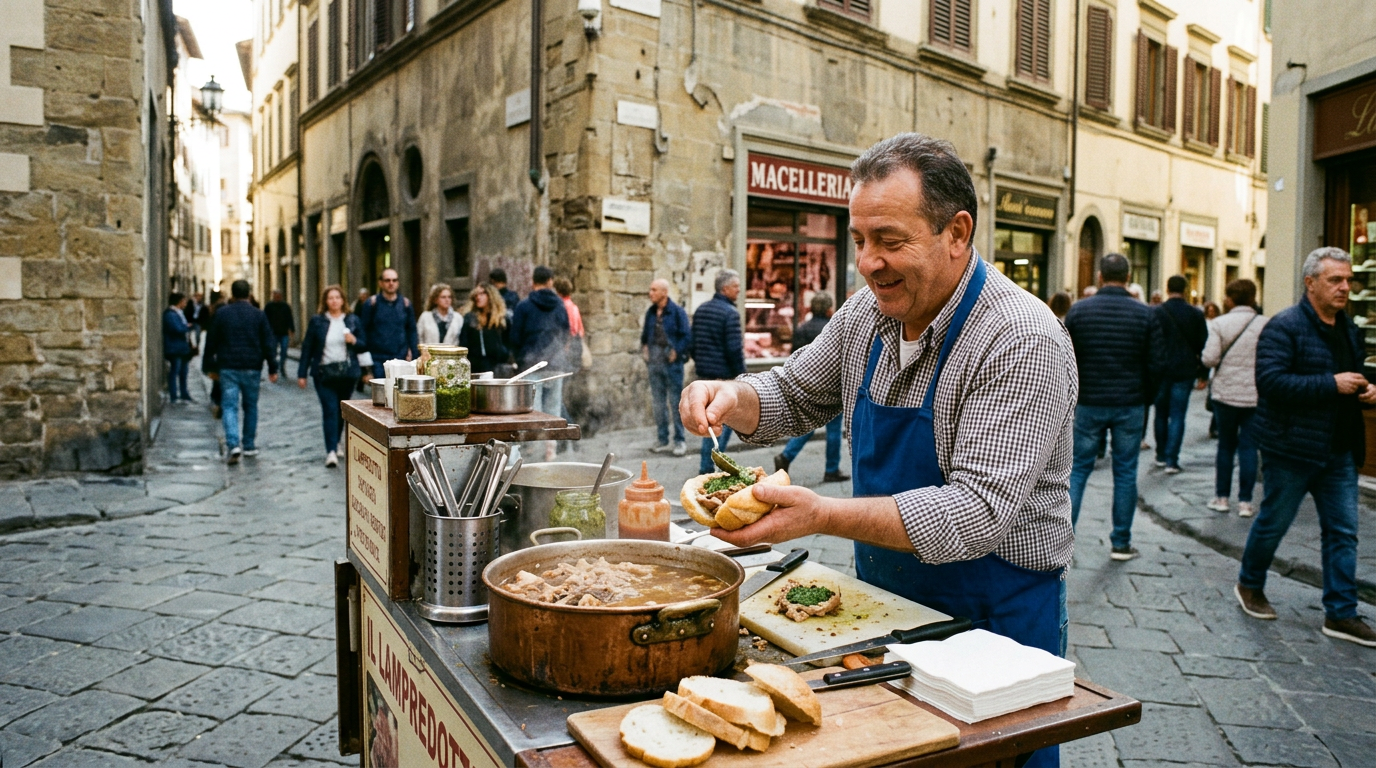
History of lampredotto in Florence: a working-class food
The medieval origins of offal eating in Florence
To understand lampredotto you need to understand the economic structure of the medieval Florentine city. Florence was one of the most densely populated cities in Europe by the 13th century, with an estimated 90,000 to 100,000 inhabitants before the Black Death of 1348 reduced the population by roughly half. The city ran on a textile economy: wool merchants, weavers, dyers, and the vast supporting workforce of porters, carriers, and manual workers who kept the mills and workshops operating.
These workers needed to eat cheaply and quickly. The meat trade in medieval Florence operated under guild regulations that separated the prime cuts, haunches, loins, and ribs, from the offal, which was sold at a fraction of the price. Butchers were required by statute to sell offal separately and at controlled prices so that the working population could afford animal protein. This regulatory context created the conditions for a durable street food culture based on the parts of the animal that the wealthy did not want.
Lampredotto specifically, the fourth stomach of the cow, the abomasum, was the cheapest of the cheap. Its dark, complex flavour, its rubbery initial texture before cooking, and the extended preparation it required made it unappealing to anyone who could afford an alternative. But properly cooked, slowly simmered for two to three hours in a seasoned broth, it transforms into something with a deep, meaty richness that is difficult to replicate with any other ingredient.
The south bank of the Arno, Oltrarno, was the centre of this food culture. The neighbourhood’s workshops and small manufacturers employed the type of worker who relied on street stalls for daily meals. The lampredottaio, the specialised vendor who cooked and sold lampredotto from a fitted cart, became a figure inseparable from the visual landscape of the neighbourhood. Archival references to offal vendors in Oltrarno go back to at least the 15th century.
How lampredotto is prepared and served
The preparation begins at the market, specifically at the central Mercato Centrale in San Lorenzo or at the wholesale meat market at Novoli on the city’s periphery. Lampredotto is sourced from certified Tuscan cattle where possible, though the regulations on provenance are less strict than for bistecca. The stomach is cleaned, trimmed of excess fat, and cut into sections.
The cooking is done in a large pot of broth. The standard broth for lampredotto uses onion, carrot, celery, canned tomatoes, fresh parsley, and salt. Some vendors add a chilli pepper or a bay leaf, but the recipe is conservative by design, the goal is to enhance the lampredotto’s flavour, not mask it. The stomach simmers for two to three hours until completely tender. A good lampredottaio keeps the broth active throughout the day, adding water as it reduces and adjusting the seasoning.
The sandwich is constructed from a semelle, a white bread roll with a soft interior and a slightly chewy crust. The lampredotto is sliced at the counter, placed inside the roll, and then dressed. The two standard dressings are salsa verde, a thick paste of parsley, capers, anchovies, garlic, and olive oil, and a red sauce made from peperoncino, tomatoes, and vinegar. Most customers order both. The final step, which distinguishes a properly made lampredotto sandwich from an inferior one, is bagnatura: the top half of the roll is briefly dipped into the hot broth before the sandwich is closed. This soaks the bread and integrates the flavour throughout.
In 2026, a lampredotto sandwich from a street stall costs between €4 and €6. This price has increased from around €3 to €4 five years ago, reflecting general food inflation, but remains significantly cheaper than any sit-down restaurant alternative.
Where to find lampredotto in Florence
The most historically significant lampredotto stalls are at the Mercato Centrale in San Lorenzo and at the Mercato di Sant’Ambrogio in the east of the city. Both markets have fixed indoor or covered stalls that operate from morning until early afternoon. The San Lorenzo market stalls are open from approximately 8:00 to 14:00. The Sant’Ambrogio stalls run similar hours but tend to close slightly earlier, around 13:00.
Street-level kiosks operating from fitted vans or fixed carts are found at several locations outside the main markets. The intersection of Via dei Macci and Borgo la Croce in the Sant’Ambrogio area typically has a cart operating at lunch hours on weekdays. In Oltrarno, several kiosks operate in the streets around Piazza Santo Spirito, particularly on market days (Tuesday and Saturday mornings).
The Mercato delle Pulci (flea market) at Piazza dei Ciompi on Sunday mornings has historically been accompanied by lampredotto vendors. The atmosphere is informal and the food is eaten standing at the cart or perched on nearby steps.
Some sit-down trattorias in Florence serve lampredotto as a starter or a secondo, typically in a more elaborate preparation: braised lampredotto in tomato sauce, or lampredotto with white beans and sage. These versions cost between €10 and €14 as a starter. The street-stall version and the trattoria version are genuinely different dishes, the stall version is faster, simpler, and more directly connected to the historical tradition.
Lampredotto’s current cultural status
Lampredotto has undergone a significant reappraisal over the past twenty years. In the 1990s, it was associated primarily with an older generation of Florentines and with lower-income neighbourhoods. Young Florentines of the time, influenced by the general shift toward international food culture, largely ignored it.
The reassessment began with the rise of food journalism that focused on regional specificity and authenticity. Lampredotto began appearing in international food media as an example of the “fifth quarter” cooking tradition, the use of offal and organ meats in working-class food cultures, alongside similar dishes in Rome (pajata, coda alla vaccinara) and other Italian cities. This coverage brought curious visitors and reintroduced the dish to younger Florentines who had grown up without eating it.
The civic dimension of lampredotto pride is now substantial. There are annual festivals, including events associated with the Festa di San Giovanni in June and smaller neighbourhood events in Oltrarno and Sant’Ambrogio. The Association of Lampredottai Fiorentini maintains a registry of traditional stalls and lobbies for recognition of lampredotto as a protected traditional food product under Italian law.
The paradox is that the dish now functions as both authentic working-class food, still eaten by the people it was designed for, at stalls near building sites and workshops, and as a tourist attraction. The two populations eat at the same stalls, often at adjacent positions at the counter, which is one of the more egalitarian aspects of Florentine food culture.
Where to stay
The best lampredotto stalls are concentrated in San Lorenzo, Sant’Ambrogio, and Oltrarno. Staying in Oltrarno puts you within walking distance of the south bank’s vendors and five minutes by foot across any of the central bridges from the San Lorenzo market. For accommodation in the neighbourhood, De’ Medici is a well-placed base for eating through Florence’s street food traditions.