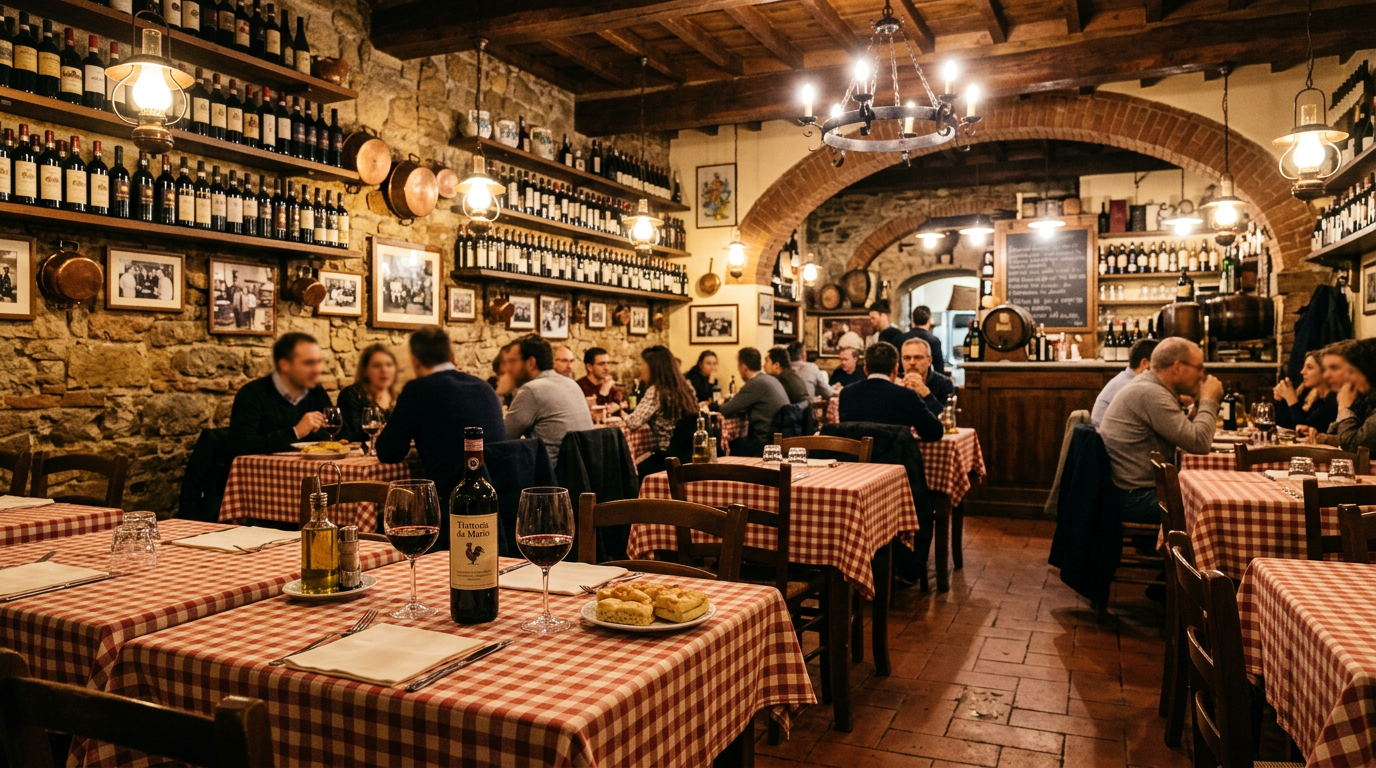
Real Florentine taverns: where to find a true osteria
What a real Florentine osteria is
The word osteria derives from the Latin hostes, meaning host or guest. In practice, for most of its history, the Florentine osteria was the place where working people ate a hot midday meal for as little money as possible. A single dish, a quarter litre of house wine, a piece of bread, and back to work. No menu. No service. The cook decided what was available, and you ate what was available.
That model has not entirely disappeared. Versions of it survive across Florence, particularly in the Oltrarno, Sant’Ambrogio, and Campo di Marte neighbourhoods, where the clientele is still composed largely of people who live and work nearby. These places typically seat between fifteen and thirty people, open for lunch six days a week, and close by 3 pm. Some open again for dinner. Many do not.
The defining characteristic of these establishments is indifference to the tourist economy. They are not trying to attract you. They do not need you to survive. This indifference is, paradoxically, the most reliable indicator that the food will be worth eating.
Signs that separate the genuine from the imitation
Tourist Florence has developed an extremely convincing aesthetic of authenticity. Old-looking interiors, reproductions of medieval paintings, menus that say “traditional Florentine cuisine” in six languages. None of these tell you anything about the food. The signs that matter are different and more prosaic.
A handwritten or chalk-board menu that changes daily. A wine list that fits on half a page and consists entirely of producers from within 50 kilometres. A room where, at 12:30 pm on a Tuesday, the majority of people speaking are speaking Italian. A smell of cooking that reaches you on the street before you push open the door. Prices for a first course between 7 and 12 euros in 2026, not 18.
What you will not find in a real osteria: a QR code menu, a photograph of the dish on the menu, a hostess who stands at the entrance with a tablet, background music that was chosen by an algorithm, or a bartender who describes the gin selection with the confidence of a sommelier.
The dishes that define the menu
Ribollita, the bread and bean soup reboiled from the previous day’s pot, is the dish most associated with the Florentine trattoria tradition. It is a winter dish, available from October through March. The correct version is almost solid, thick enough to hold the mark of a fork. The cavolo nero must be identifiable. The bread must have completely dissolved into the body. It costs 7 to 10 euros in a genuine establishment.
Pappardelle al cinghiale, wide, rough-cut pasta with wild boar ragù, is an autumn and winter staple. The boar is cooked for hours with red wine, juniper, rosemary, and tomato. The pasta is made daily. The combination is heavy, flavoursome, and intended for people who have done physical work. A portion costs 10 to 14 euros.
Trippa alla fiorentina remains one of the cheapest and most contentious dishes on any traditional menu. Tripe cleaned, simmered in tomato sauce with sage and parmigiano, served in a deep bowl. It costs 8 to 11 euros. Florentines argue that you have not really eaten in the city until you have ordered it.
Fagioli al fiasco, white Sorana or cannellini beans cooked slowly in olive oil and sage until they are creamy and deeply flavoured, appear either as a standalone first course or as a side to roasted meat. They cost 5 to 8 euros. They are rarely listed on tourist menus. Order them when you see them.
Neighbourhoods where the real osterie remain
Oltrarno holds the densest concentration. The area between Via dei Serragli and Borgo San Frediano, roughly a ten-minute walk from Ponte Vecchio heading southwest, contains several places that have been feeding the neighbourhood for decades. The clientele is largely over fifty. The tables turn slowly. The conversation is loud and in Florentine dialect.
Sant’Ambrogio, east of the Duomo and south of Santa Croce, has a morning produce market and a cluster of genuine neighbourhood restaurants within a four-block radius. The market itself closes by 2 pm, but the bars and trattorias nearby stay open through lunch. This area receives far fewer tourists than the central zone around Via dei Calzaiuoli.
Campo di Marte and the Gavinana district, east of the centre across the Arno, are almost entirely off the tourist map. The bus ride from Piazza Beccaria takes fifteen minutes. The osterie here have never adjusted their hours, their menus, or their prices for an outside audience. This is their greatest quality.
The unwritten rules
Enter and wait. Even if the room looks empty, do not seat yourself without acknowledgement from the owner or staff. A nod, a raised eyebrow, a gesture toward a table, these are all the invitation you need. Ignoring this sequence marks you immediately.
Do not request substitutions. In a kitchen making twenty portions of a dish that was designed a specific way, the request to have it without garlic, or with the sauce on the side, or as a half portion, is not a reasonable customisation. It is a disruption to a system that does not have space for it. Accept the dish as it comes.
The cover charge, pane e coperto, is between 1.50 and 2.50 euros per person in a genuine establishment. It covers the bread and the laying of the table. It is compulsory, standard, and entirely reasonable. Questioning it reveals you as someone unfamiliar with the context.
Finish eating and leave. The table is not yours for the afternoon. In a thirty-seat restaurant serving two sittings, occupying a table for two hours after you have eaten your dessert forces someone else to wait on the street. Take your coffee standing at the bar, as Florentines do, and free the table for the next group.
Where to stay
Staying in the right neighbourhood is the first practical step toward eating well in Florence. The genuine Florentine osteria tradition is concentrated in Oltrarno, and the best way to find these places is to walk the streets in the early afternoon and look for the chalk boards and the full rooms. For a base in the neighbourhood, De’ Medici is a guesthouse in Oltrarno, positioned within easy reach of the streets where the city’s most authentic trattoria cooking is still being produced.