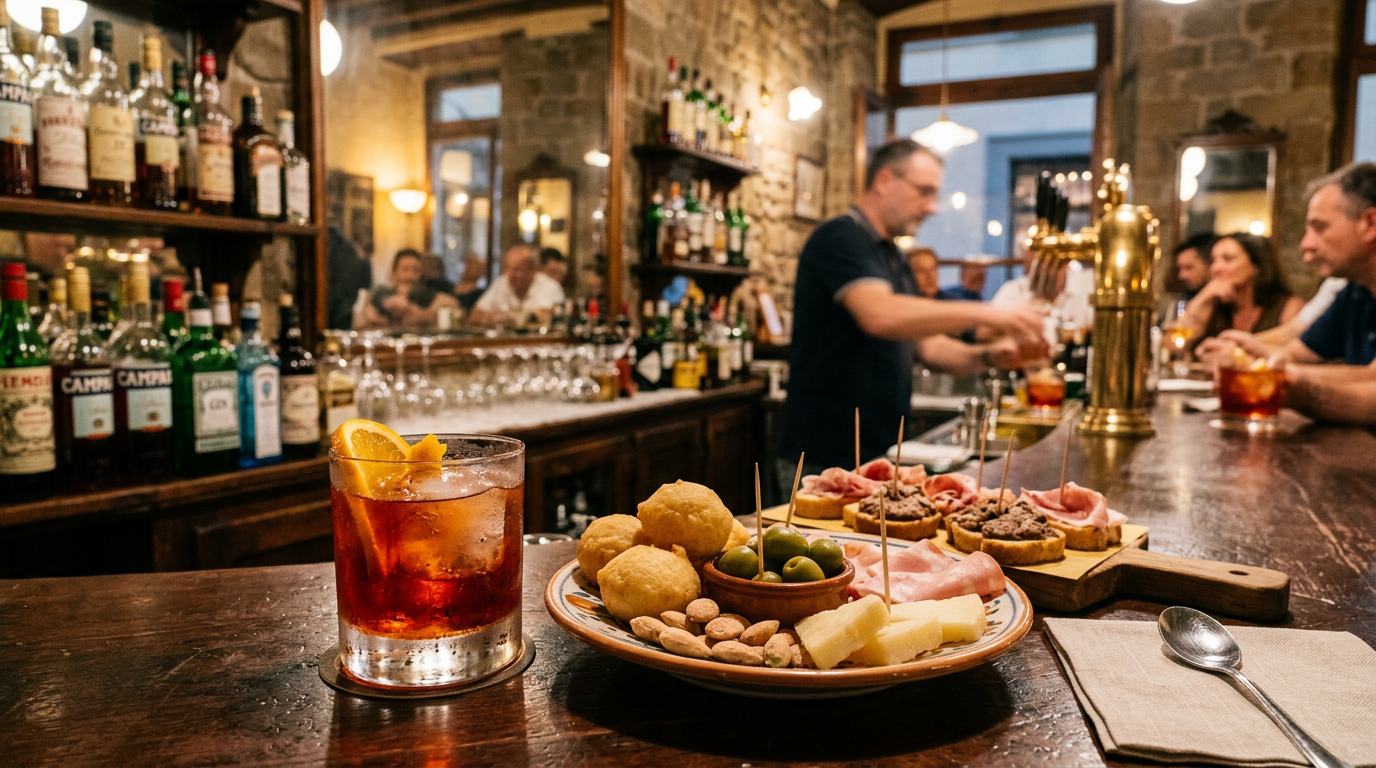
Florence aperitivo: where locals drink authentically
The aperitivo in Florentine culture
In Florence, the aperitivo is not a meal replacement or a social performance. It is a transitional moment between the end of the working day and dinner, a drink, sometimes accompanied by a small amount of food, taken between roughly 18:00 and 20:30. The format has existed in the city since at least the late nineteenth century, when vermouth and bitter liqueurs became central to Tuscan bar culture.
The practice is distinct from the Milan spritz-and-buffet model that became dominant in northern Italy in the early 2000s. Florentine bars traditionally serve one or two small bites, a few crostini, olives, a small portion of cured meat, with a drink. The drink itself is the focus. You pay for the drink at a price between €8 and €12 in 2026 at an established bar, and what comes with it is a courtesy.
This distinction matters for visitors who expect a paid-admission aperitivo with unlimited food access. That model exists in Florence, but primarily at hotel bars and newer venues targeting tourists. At the wine bars and traditional bars of Oltrarno, the aperitivo is simpler, cheaper, and more honest.
The Negroni: Florence’s most documented cocktail
The Negroni is arguably the only cocktail with a well-documented Florentine origin. The drink, one part gin, one part sweet vermouth, one part Campari, stirred with ice and served with an orange twist, is said to have been created at Caffè Casoni (now Caffè Giacosa) on Via della Vigna Nuova in 1919. Count Camillo Negroni, a Florentine nobleman with a taste for the gin-based drinks he had encountered in London and the United States, reportedly asked bartender Fosco Scarselli to strengthen his usual Americano (vermouth, Campari, soda) by replacing the soda with gin.
The story is consistent with the cocktail’s recorded spread through Tuscany in the 1920s. Campari’s own archives include early references to the drink as a Florentine preparation. By the 1950s it was the standard pre-dinner cocktail at most Florentine bars and had spread across Italy.
In 2026, a Negroni at a traditional Florentine bar costs between €9 and €13. The ratio remains 1:1:1. The only variable is the gin, which at upmarket bars may be a specific botanical selection. The correct presentation is in a rocks glass, stirred, not shaken, with a slice of orange peel rather than a cherry. Any bar serving a Negroni shaken or with excessive garnish is not following Florentine bar convention.
Where to drink aperitivo in Oltrarno
Buca Mario and the broader Oltrarno neighbourhood between Piazza Santo Spirito and Via dei Serragli have the densest concentration of bars where aperitivo culture remains in its traditional form.
Enoteca Pitti Gola e Cantina on Piazza Pitti, about 800 metres from Via Pisana 191, is a wine-forward bar with a serious list of Tuscan and Italian wines by the glass. The aperitivo format here centres on wine rather than cocktails, with glasses from €6 and a selection of local cheeses and salumi at the bar. The interior is narrow and often standing-room only after 18:30.
Il Santino, the wine bar connected to Trattoria Sant’Agostino on Via di Santo Spirito, focuses on natural and small-production Tuscan wines. A glass of Morellino di Scansano costs approximately €7 in 2026. The accompanying food, usually a few slices of lardo or crostini with ricotta, is prepared in the adjoining kitchen.
Rasputin on Via Sant’Agostino is a smaller, less formal bar that has operated in this neighbourhood for decades. It serves Negroni and Americano at around €8 and attracts a mixed local and visitor clientele. The crostini are included with the drink.
Caffè degli Artigiani on Via dello Sprone, about 500 metres from Via Pisana 191, is a daytime bar that extends into aperitivo service in the evening. Known to the local neighbourhood as a reliable everyday address, not a destination bar. Negroni costs €9. Small snacks are self-serve from the counter.
Vermouth: the historical base
Before gin became central to the Negroni and to Florentine bar culture, vermouth was the defining aperitivo drink of Tuscany. Vermouth is a fortified, aromatised wine, white or red, flavoured with a blend of botanicals including wormwood (artemisia absinthium, from which vermouth takes its name via the German Wermut).
Tuscan vermouth has a long production history. Carpano (now produced in Turin) and Punt e Mes were the early industrial vermouth brands, but local producers in Tuscany also made house vermouth for their own bars through the mid-twentieth century. A few wine bars in Florence still offer a house vermouth bianco or rosso at around €5–€6 per glass.
The correct service for vermouth in Tuscany is chilled, in a small wine glass, with a slice of orange or a green olive. It is not mixed. It is not diluted with soda unless specified. The alcoholic content is 14–18% ABV, which makes it lighter than a cocktail but stronger than table wine.
What to eat with the aperitivo
At traditional Florentine bars, the aperitivo food is limited and specific. The standard selection includes: small slices of unsalted Tuscan bread with chicken liver pâté (crostini neri), sliced cured meats (prosciutto crudo, finocchiona, salame toscano), a few olives (usually small Tuscan cultivars, not large Spanish olives), and occasionally a piece of pecorino.
Nothing deep-fried, nothing in small takeaway portions, nothing resembling a buffet. The point is not to replace the meal but to set up the appetite for it. Finocchiona, the Florentine salami flavoured with fennel seeds and fennel pollen, is the most characteristic local product and is worth trying on its own if it is available.
At wine bars in Oltrarno, you can often request a tagliere, a board of mixed cured meats and cheese, for €10–€14 in 2026. This is the most substantial aperitivo option available and is closer to a light first course than a bar snack.
Where to stay
The aperitivo culture of Florence is most concentrated in Oltrarno, the neighbourhood that has maintained its residential and artisan character more intact than any other part of the city centre. The bars on Via dei Serragli, Via dello Sprone, Via di Santo Spirito, and around Piazza Santo Spirito are within fifteen minutes’ walk of each other, making it practical to visit two or three in an evening. De’ Medici on Via Pisana 191 is the natural base for exploring this neighbourhood.