What to see in Oltrarno Florence: local guide
What Oltrarno is and why it matters
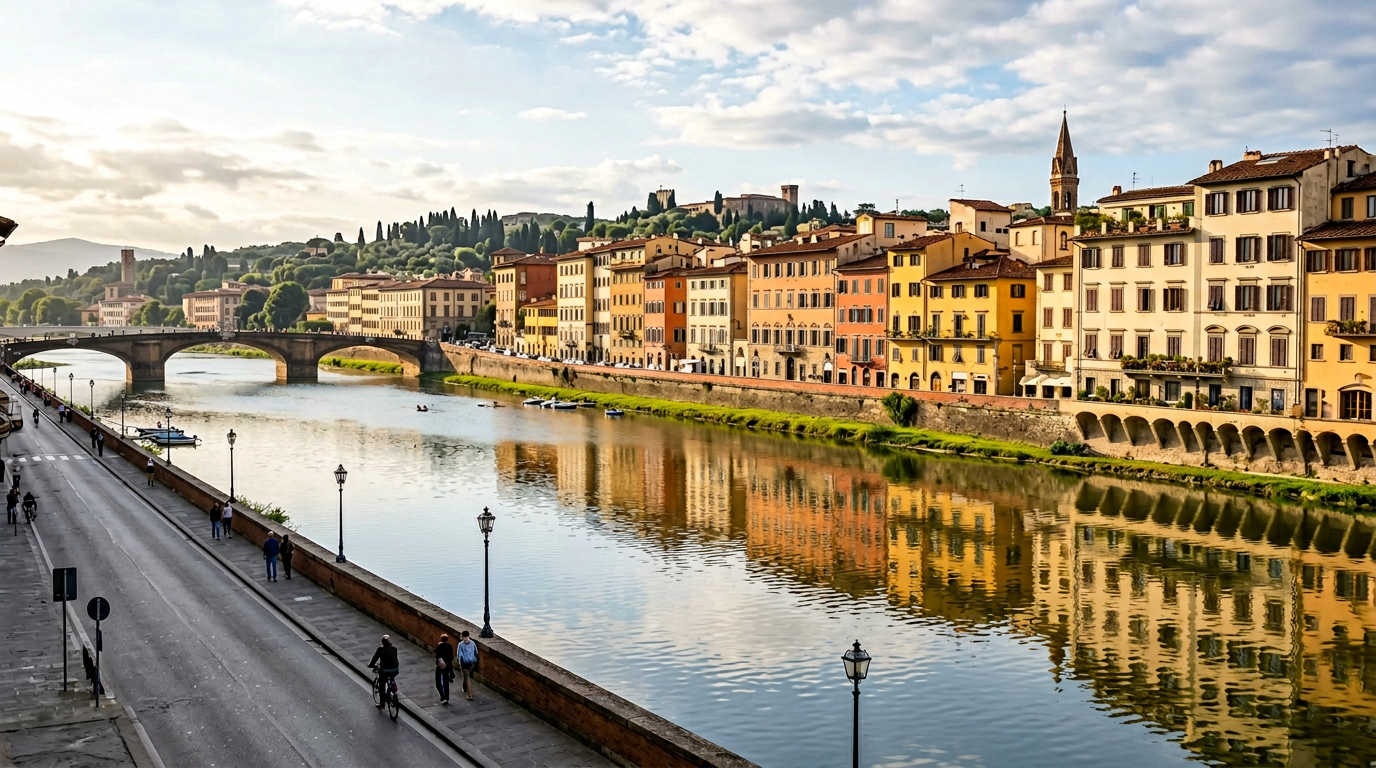
Oltrarno sits south of the Arno, separated from the historic centre by a river that was the city’s defining boundary for centuries. The name translates directly as “beyond the Arno” and still captures the essential character of the place: distinct, slightly apart from the tourist-facing Florence on the north bank, and structured around a mix of working residents and craft production that has persisted for five hundred years.
The neighbourhood covers roughly 1.5 square kilometres. Its northern edge is the river. Its western boundary is the medieval Porta San Frediano on Via Pisana. To the east, the neighbourhood transitions gradually into the quieter streets around Piazza Poggi and the Sant’Niccolò area. To the south, the land rises toward Forte Belvedere and the gardens of the Boboli and Bardini.
The distance from Ponte Vecchio to Piazza del Carmine, a diagonal walk through the central part of the neighbourhood, is under one kilometre. The density of things worth seeing along that route, and in the perpendicular streets off it, is unusually high for such a small area. You can walk from Palazzo Pitti to Porta San Frediano in 20 minutes, but doing it properly takes a full day.
Palazzo Pitti and the Boboli Gardens
Palazzo Pitti is the physical and historical anchor of Oltrarno. The building was commissioned by banker Luca Pitti in the 1450s, designed by Brunelleschi according to some sources and by Luca Fancelli according to others. It passed to the Medici in 1549 when Eleonora di Toledo, wife of Cosimo I, purchased it from the Pitti heirs. Under successive Medici and Habsburg-Lorraine rulers, the palace expanded until its facade reached 205 metres in width.
Today the palace houses five museums. The Palatine Gallery contains one of the most important collections of 16th and 17th-century painting in Italy, including major works by Raphael, Titian, Rubens, Caravaggio, and Andrea del Sarto. The Royal Apartments preserve the residential rooms as they were decorated in the 19th century during the Savoy period. The Gallery of Modern Art occupies the upper floors with a collection of Italian painting from the 18th to early 20th centuries. The Treasury (Museo degli Argenti) displays the Medici collection of goldsmith work, precious objects, and decorative arts.
In 2026, a combined ticket for all Palazzo Pitti museums plus the Boboli Gardens costs approximately €22. Separate entry to the Palatine Gallery alone is around €16. The gardens open at 8:15 and close at varying times depending on the season, 18:30 in winter, 19:30 in summer. Arriving when the palace opens significantly reduces the queue for the main gallery.
The Boboli Gardens extend up the hillside behind the palace across approximately 4.5 hectares. They were designed from 1549 onward by Niccolò Tribolo and contain formal axes, grotto structures, fountains, and an amphitheatre that dates from the 17th century. The views from the upper terraces extend across the city to the north. On a weekday morning, outside the July and August peak, it is possible to walk for 45 minutes without encountering more than a handful of other visitors.
Santo Spirito and Carmine: the neighbourhood churches
Two major churches define the western half of Oltrarno. Santa Maria del Carmine, in the piazza of the same name, is one of the most important buildings in the history of Western art. The Brancacci Chapel inside, commissioned by silk merchant Felice Brancacci in the 1420s, contains frescoes by Masolino da Panicale, Masaccio, and Filippino Lippi. The Masaccio sections, including the Expulsion from the Garden of Eden and the Tribute Money, are among the foundational works of the Italian Renaissance. Masaccio developed the use of linear perspective and volumetric figure modelling here at a time when no other painter in Europe was working in the same way.
Entry to the Brancacci Chapel in 2026 costs €10. Access is timed to avoid overcrowding; no more than 30 people are in the chapel at any one time. Booking in advance through the Comune di Firenze system is strongly recommended, particularly in spring and summer. The chapel is open Tuesday to Sunday, 10:00 to 17:00 (closed Monday).
Basilica di Santo Spirito, in Piazza Santo Spirito, was designed by Brunelleschi in 1444 and construction continued until the 1480s. The interior plan, a Latin cross with aisles of equal width to the nave and 35 chapels distributed around the perimeter, was Brunelleschi’s most complex spatial composition. Each chapel was financed by a different merchant family and decorated with an altarpiece; the result is an in-situ survey of 15th and early 16th-century Florentine painting outside the museum system. Entry is free, though a suggested donation of €2 is posted.
The artisan streets and workshops
Borgo San Frediano and the parallel streets between it and Via Serragli form the core of Oltrarno’s surviving artisan economy. Between the Porta San Frediano at the western end and Piazza del Carmine at the eastern end, a walk of about 500 metres along Borgo San Frediano passes more active craft workshops per linear metre than almost any equivalent street in Italy.
The trades represented include furniture restoration, picture framing, gilding, leatherwork, upholstery, metalwork, and book restoration. The workshops are typically small, one to three people, and many have operated from the same premises for several generations. Doors are generally open during working hours, and while it is not appropriate to interrupt work in progress, most artisans will acknowledge a visitor who stops to look.
The Scuola del Cuoio (Leather School) at Via San Giuseppe 5, adjacent to Santa Croce on the north bank but closely connected to Oltrarno’s leather tradition, provides a more formal context for understanding Florentine leatherwork. In Oltrarno itself, several leather shops on Via Guicciardini and Via Maggio sell handmade goods produced in local workshops, at prices ranging from €30 for small accessories to several hundred euros for full leather bags.
Piazza Santo Spirito and the markets
Piazza Santo Spirito is the social and commercial centre of the neighbourhood. It is an irregular rectangular space, shaded by trees, with the plain white facade of Brunelleschi’s basilica at one end and a mix of restaurants, bars, and small shops on the surrounding buildings. A farmer’s market operates every morning from Monday to Saturday, selling produce from the Chianti and Valdarno areas. On the second Sunday of each month, an organic food and craft market takes over the square.
The atmosphere in the piazza changes significantly by hour. At 8:00, it is residents buying vegetables. By 11:00, the cafe tables fill with a mixed crowd of locals and visitors. In the evenings, particularly in summer, the square becomes one of the liveliest social spaces in the city. The fountain in the centre, installed in 1958, is a post-war addition that replaced an earlier 19th-century structure.
Adjacent to the church, the Fondazione Salvatore Romano on the eastern side of the piazza occupies the former refectory of the Augustinian convent. It contains a small but significant collection of Romanesque and medieval sculpture, including a large fresco by Orcagna and works from the 12th to 14th centuries that are rarely seen by visitors focused on the Renaissance collections in the major museums. Entry is free.
Where to stay
Oltrarno rewards staying rather than visiting. The neighbourhood’s character becomes apparent over two or three days of slow exploration: the morning markets, the artisan hours, the evening rhythms around Santo Spirito. For accommodation at the centre of this neighbourhood, De’ Medici places you within minutes of everything described above.