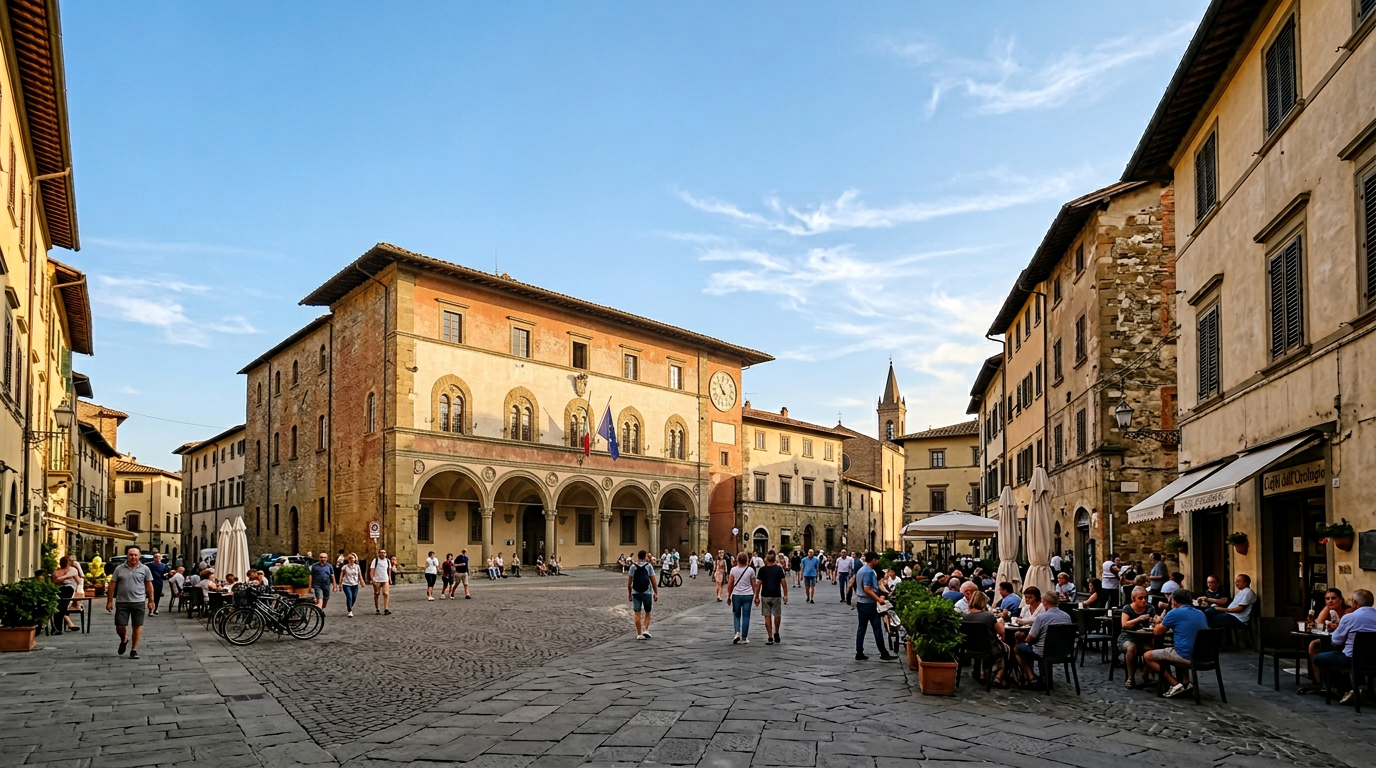
Day Trip to Castelfiorentino: What to See
Castelfiorentino: position and access
Castelfiorentino is a town of approximately 17,500 residents in the Valdelsa, the valley of the Elsa river in the province of Florence. It sits 37 kilometres southwest of Florence, at an elevation of 50 metres above sea level on a low ridge above the river plain. The drive from Via Pisana 191 via the FI-PI-LI superstrada and the Empolese Valdelsa road takes approximately 45 minutes without traffic. Parking in the town centre is available on Piazza Gramsci and along Via Roma at no cost on weekdays.
By public transport, take the train from Florence Santa Maria Novella to Empoli (journey time 25–35 minutes, trains run approximately every 30 minutes), then a regional bus from Empoli bus station to Castelfiorentino (approximately 20 minutes). The total journey from the city centre is under one hour. A return train from Florence to Empoli costs around €4.40 in 2026.
The town is compact enough to visit entirely on foot. The main sites are concentrated within a 600-metre radius of Piazza Gramsci, which is the commercial and civic centre.
The Museo Benozzo Gozzoli
The most significant reason to visit Castelfiorentino is the Museo Benozzo Gozzoli, housed in the former oratory of the Madonna della Tosse on Via Testaferrata. The museum preserves two sinopie and a series of detached fresco fragments by Benozzo Gozzoli (1421–1497), recovered from three tabernacles in the territory of Castelfiorentino during restoration works in the 1960s and 1980s.
Gozzoli is best known in Florence for the frescoes inside the chapel of the Palazzo Medici Riccardi, painted between 1459 and 1461, which depict the procession of the Magi with portraits of the Medici family. The Castelfiorentino cycle is less famous but equally refined. The fresco known as the Madonna della Tosse dates from 1484 and shows the Virgin enthroned with saints and donors, surrounded by architectural elements that demonstrate Gozzoli’s late mastery of spatial organisation. The sinopie, preparatory drawings made directly on the wall in red ochre before the final plaster was applied, allow visitors to observe the working method of a fifteenth-century fresco painter without the finished surface in the way.
The museum is small, with four rooms, but the quality of the preserved material is high. Entry costs €5 in 2026 (reduced €3 for under 18 and over 65). Opening hours are Tuesday to Sunday, 10:00–13:00 and 14:30–17:30. Closed Monday.
The collegiate church of Sant’Andrea
Castelfiorentino’s main church, the Collegiata di Sant’Andrea, stands on Piazza del Popolo, about 300 metres from the museum. The building has a Romanesque origin, with subsequent modifications in the fourteenth and sixteenth centuries. The current facade dates from an eighteenth-century intervention and is plain compared with the interior.
Inside, the left nave contains a wooden crucifix from the thirteenth century and a painting attributed to Ridolfo del Ghirlandaio, son of the more famous Domenico, dating from the early sixteenth century. The nave arches retain traces of fresco decoration from multiple campaigns. The sacristy, accessible upon request from the sacristan, holds a small collection of liturgical objects including a sixteenth-century chalice in gilded silver.
The church is generally open from 9:00 to 12:00 and 15:30 to 18:30. Entry is free. The piazza in front is used as a weekly market on Saturday mornings, when local producers from the Valdelsa sell vegetables, cheese, and cured meats. This is a functional agricultural market, not a tourist event.
The historic centre and Palazzo Pretorio
The historic core of Castelfiorentino is organised around two parallel streets, Via Ferruccio and Via Roma, that run roughly north to south through the ridge. Several medieval buildings survive here in various states of preservation.
The Palazzo Pretorio on Piazza del Popolo is the former seat of local government, a structure with a loggia and an exterior decorated with coats of arms of the podestà who administered the town from the fourteenth century onward. The palace has been used as a town hall, a courthouse, and a storage facility at different points in its history. It is not currently open to the public for visits, but the exterior can be examined closely.
The Torre dei Berti, a medieval tower on Via Roma, is one of the few remaining examples of private defensive architecture in the town. It was built in the thirteenth century by a local family and later incorporated into a residential building. The street level around it shows the medieval street width, significantly narrower than the surrounding post-unification streets.
Walking the length of Via Ferruccio from the collegiate church to the northern edge of the historic centre takes about fifteen minutes and passes several late-medieval palazzi with dressed stone facades, iron window grilles, and coats of arms above the doors.
The surrounding Valdelsa
The countryside around Castelfiorentino is characterised by the Valdelsa, a wide agricultural valley known for vine cultivation, olive groves, and the remains of several minor medieval settlements on the ridge tops.
The Abbey of San Vivaldo, 12 kilometres east of Castelfiorentino via the Volterrana road, is a Franciscan sanctuary that contains a series of small chapels built between 1500 and 1516 to replicate the holy sites of Jerusalem. The project was commissioned as a substitute pilgrimage for those unable to travel to the Holy Land. Forty-four chapels were originally built; seventeen survive with their painted terracotta figures, many produced in the workshop of Giovanni della Robbia. Entry is free. The site is open daily, 9:00–12:30 and 14:00–17:00.
The village of Certaldo, 12 kilometres north, is the birthplace of Giovanni Boccaccio (1313–1375) and is itself worth an afternoon. The upper town (Certaldo Alto) is reached by cable car or foot and retains an intact medieval street plan with brick towers and a small museum in the house traditionally associated with Boccaccio.
Where to eat and local food
The Valdelsa is not one of Tuscany’s prestige food zones, but Castelfiorentino has several honest trattorias serving local food at non-tourist prices.
Ristorante La Lanterna on Via Ferruccio is reliable for pasta and grilled meat at around €12–€18 per main course. Ribollita, the dense Tuscan bread and vegetable soup, is consistently good here and costs around €9. The wine list features local Chianti and some Valdelsa IGT whites.
The weekly market on Saturday morning (Piazza del Popolo, 8:00–13:00) is the most direct way to engage with local food production. Vendors from the surrounding farms sell seasonal vegetables, local honey, and fresh pasta. Prices are appreciably lower than in Florence.
Where to stay
For a day trip to Castelfiorentino, Florence is the natural base. Returning from the town centre to Florence by car takes under an hour, and the train route via Empoli is reliable. Staying in Oltrarno keeps you on the southern side of the Arno, which is the logical departure point for trips southwest into the Valdelsa. De’ Medici on Via Pisana 191 is eight kilometres from Empoli, the nearest rail junction for the Castelfiorentino bus connection.