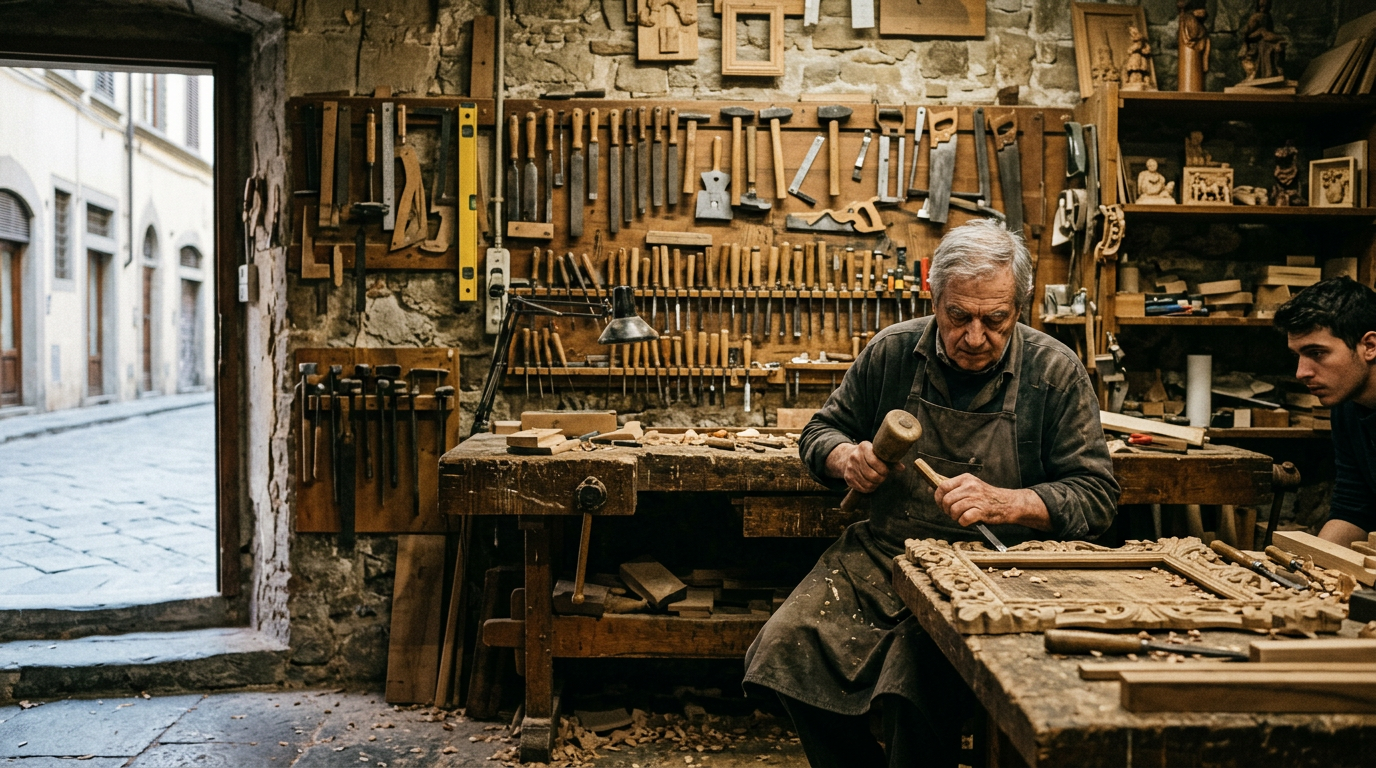
Authentic artisan workshops in Florence Oltrarno
The artisan geography of Oltrarno
Oltrarno, the district of Florence south of the Arno, bounded roughly by Ponte Vecchio to the east and the Porta San Frediano to the west, has functioned as the city’s workshop district since at least the fourteenth century. Goldsmiths, leather workers, woodworkers, gilders, bookbinders, and textile weavers established botteghe here because rents were lower than in the centre north of the river, the streets were wider for loading goods, and the neighbourhood was adjacent to the guild offices and the Ponte Vecchio goldsmiths’ market.
The density of workshops in the area peaked in the nineteenth century, when the textile and furniture industries of Florence were still fundamentally artisan in structure. Industrial consolidation after 1950 reduced the number of active botteghe substantially. By 2000, many of the ground-floor spaces that had been workshops were converted to residential or retail use. But the contraction stopped rather than eliminated the craft base.
As of 2026, approximately 200 active artisan workshops operate in Oltrarno, according to figures published by the Associazione OMA (Oltrarno Masters of Artisans). This is concentrated primarily in three streets, Via Maggio, Via dei Serragli, and Via Santo Spirito, and in the smaller cross-streets between them, particularly Via dell’Orto, Via Maffia, Sdrucciolo de’ Pitti, and Borgo San Frediano.
How to tell a working workshop from a retail front
The most important distinction for a visitor is between a genuine artisan workshop, where production takes place on the premises, and a retail shop that sells craft-style goods produced elsewhere, often in Asia or in industrial facilities in other parts of Italy.
The indicators of a genuine workshop are visible if you know what to look for. The most reliable is evidence of production: dust, shavings, sawdust, chemical smells (lacquer, leather dye, glue), tools in use or recently used, raw materials in various stages of completion. A working bottega has a particular disorder. Finished goods may be displayed in the front, but the rear of the space will contain a workbench, storage for materials, and equipment.
The scale of product variety is a secondary indicator. A working artisan produces a limited range of things using a specific set of techniques. A framer produces frames; a bookbinder binds books; a leather worker makes bags and belts. Shops that carry forty different product categories, scarves, ceramics, jewellery, prints, bags, soaps, are aggregating goods from multiple sources, not producing them.
A third indicator is willingness to explain the process. Artisans who make things on the premises are generally forthcoming about materials, techniques, and timelines. This is not only professional pride; it is also the most effective sales strategy for justifying the price difference between handmade and industrial goods. If a question about how something is made produces a vague or dismissive answer, the item was probably not made there.
Specific crafts to look for
Gilding and frame-making (corniciai e doratori): Several workshops on Via Maggio and the surrounding streets specialise in gilding picture frames using the traditional Florentine water-gilding technique. This process involves applying multiple layers of gesso (calcium sulphate and rabbit-skin glue) to the wooden frame, burnishing with agate, applying gold leaf in sheets, and then tooling the surface with patterned stamps. The result is the rich, matte-then-shiny surface of historic European frames. Water gilding cannot be replicated convincingly by oil gilding or spray metallic paint; if you see the difference, you will not confuse them.
Bookbinding (legatoria): Oltrarno retains several working bookbinders who produce blank notebooks, address books, and restored antique books using traditional Florentine marbled paper and leather covers. The Florentine bookbinding tradition dates from the fifteenth century, when Florence was a major centre of manuscript and early printed book production. Legatoria Giulio Giannini e Figlio on Piazza Pitti 36/r has been operating since 1856 and is among the oldest continuously operating businesses in Florence. A marbled-paper notebook costs €18–€35 depending on size in 2026.
Furniture restoration and intarsia: Cabinet makers and furniture restorers occupy several spaces on Via dei Serragli and Via dell’Orto. The intarsia technique, geometric wood inlay using contrasting veneers, is historically associated with Tuscany and has been practiced in Florentine workshops since the Renaissance. Pieces in progress, with templates, clamps, and veneer strips on the workbench, are visible through the open doors in warm weather.
Textile weaving: A small number of workshops in Oltrarno still operate hand looms producing woollen and silk textiles. Antico Setificio Fiorentino on Via Bartolini, about 400 metres from Via Pisana 191, has been producing silk and wool fabrics on eighteenth-century looms since the 1786 founding of the original business. It is the most documented surviving example of traditional Florentine textile production. Visits can be arranged by appointment; fabric is sold by the metre and by the object (scarves, pillows, table runners).
Visiting hours and practical considerations
Most Oltrarno workshops operate during standard shop hours: 9:30 to 13:00 and 15:30 to 19:30, Monday to Saturday, with longer closures in August. Many close on Saturday afternoon in summer. Smaller workshops operated by a single artisan may be shut without warning when the craftsperson is at a fair, sourcing materials, or working on a client delivery.
The best time to find workshops open and artisans at work is Tuesday through Friday, 10:00 to 12:30. Monday mornings are often used for administrative work or material procurement. The Monday-specific closure pattern common in Florentine restaurants does not apply to artisan workshops, but Friday afternoons can be slow if the craftsperson is preparing for a weekend market.
Approaching a working artisan is straightforward: enter the workshop, wait for a natural pause in the work, and ask whether you may look around. Most will assent. Speaking a few words of Italian is helpful, though not essential. Buying something, if it is within your budget and genuinely interests you, is appreciated but not expected in exchange for showing the space.
Prices and what to expect
Handmade goods from Oltrarno artisans are priced to reflect the time cost of hand production, which is incompressible. A gilded picture frame for an A4 print costs approximately €60–€120 depending on profile width and leaf quality. A custom leather bag takes three to five days to produce and costs €180–€450 depending on leather type and complexity. A bound blank notebook in Florentine marbled paper costs €18–€40.
These prices are not negotiable in the way that market prices are. The artisan has a fixed cost structure based on materials and time. Attempting to bargain significantly is unusual in this context and tends to damage the relationship. What is appropriate is asking about timing (can this be completed before I leave?), customisation options, and shipping if you cannot carry the item.
Several workshops ship internationally at rates they can quote directly.
Where to stay
The artisan geography of Oltrarno is most accessible on foot. The concentration of workshops between Via Maggio and Via dei Serragli covers an area of roughly 800 by 400 metres. Walking this area systematically and entering the open workshops takes a half-day at a relaxed pace. Staying at De’ Medici on Via Pisana 191 places you at the western edge of this zone, within five minutes’ walk of Borgo San Frediano and the Antico Setificio Fiorentino.