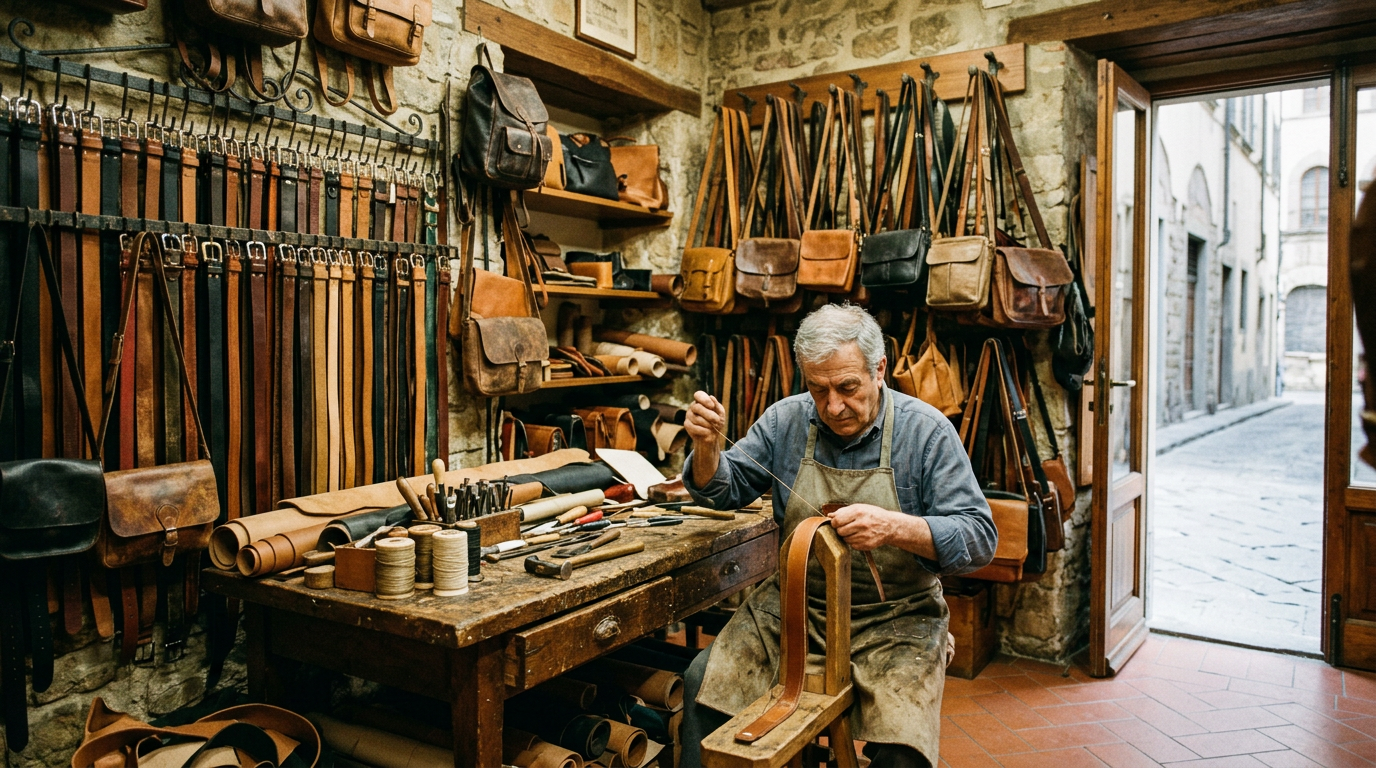
Oltrarno leather artisans in Florence: where to buy
The Florentine leather tradition: a brief history
Florence has been a centre of leather production since at least the thirteenth century. The Arte dei Cuoiai e Galigai, the guild of tanners and leather workers, was one of the fourteen recognised major and minor guilds of medieval Florence, with statutes regulating production standards, apprenticeship conditions, and market access. Tanneries were located outside the city walls along the Arno tributaries, where water access was essential for processing hides. The smell of tanning, which uses tannin extracted from oak bark in a multi-week wet process, made it an unpopular neighbour.
By the fifteenth century, Florentine leather goods, particularly shoes, book covers, saddle leather, and bags, were being exported across Europe. The leather school at Santa Croce, founded inside the monastery of the Franciscan complex in 1950, continues this tradition by teaching hand-stitching, cutting, and finishing techniques to apprentices. The school is open to visitors; you can watch production from the gallery. It is not in Oltrarno, it is in the Santa Croce neighbourhood, about 2.2 kilometres from Via Pisana 191, but it is the most transparent entry point into understanding the Florentine method.
Oltrarno has a distinct leather tradition focused on smaller workshops producing bags, wallets, belts, and accessories using full-grain vegetable-tanned leather. This tradition has maintained itself more intact in Oltrarno than in the Santa Croce area, where tourist pressure has commodified much of the retail.
Vegetable tanning versus chrome tanning
Understanding the difference between vegetable-tanned and chrome-tanned leather is essential for evaluating what you are buying in Florence.
Vegetable tanning uses tannin from natural plant sources, oak bark, chestnut bark, quebracho, in a process that takes between thirty and ninety days depending on the hide thickness. The result is a dense, firm leather that has a natural smell, ages to a darker colour with use, and develops a patina specific to its owner. It is used in fine luggage, traditional shoes, knife sheaths, and book covers. Vegetable-tanned leather made in Tuscany carries the designation Pelle Conciata al Vegetale in Toscana, a certification system established by the Consorzio Vera Pelle Italiana Conciata al Vegetale in the 1990s with Tuscan tanneries in the Santa Croce sull’Arno district (about 50 kilometres from Florence).
Chrome tanning uses chromium salts in a process that takes twenty-four to forty-eight hours. The result is softer, more uniform in colour, and more resistant to water, but it does not develop the same patina and has a chemical smell when new. Most mass-market leather goods, including much of what is sold in tourist shops near Ponte Vecchio, use chrome-tanned leather from non-Italian sources.
The distinction is usually unmarketed in retail shops because chrome-tanned goods are cheaper to produce and customers rarely ask. An artisan producing with vegetable-tanned Italian leather will say so unprompted, because the cost premium requires justification. If nobody mentions the tanning method, it is likely chrome-tanned.
Authentic workshops in Oltrarno
The density of working leather workshops in Oltrarno is lower than the density of shops selling leather goods. The separation requires attention.
Scuola del Cuoio Oltrarno on Via dei Serragli, about 550 metres from Via Pisana 191, is a small teaching and production workshop where bags and accessories are made using hand-stitching on vegetable-tanned Tuscany-certified leather. The workshop is run by a certified artisan and accepts one to two apprentices per year. Items can be purchased directly, and custom orders are taken with a two-to-three-week turnaround. A small card wallet costs €35–€55 in 2026; a medium tote bag costs €160–€220.
Pelletteria Romano on Borgo San Frediano, about 300 metres from Via Pisana 191, is a multi-generational workshop that has been in the same family since the 1960s. The production range focuses on belts, key holders, and small bags. All goods are made on-site; you can see the cutting tables and stitching machines through the open door. Belt prices run from €45 to €90 depending on buckle type and leather thickness.
Giuditta Blandino Leatherworks on Sdrucciolo de’ Pitti, about 900 metres from Via Pisana 191, produces structured bags and leather-covered notebooks. The workshop occupies a ground-floor space with large windows, and production is visible from the street. A leather-covered journal costs approximately €65; a small clutch bag costs €110–€145.
For custom sandals, a historically Florentine product, Giulio Giannini e Figlio on Piazza Pitti does not produce sandals, but Calzolaio Stefano Bemer on Borgo San Frediano does, at made-to-measure prices starting around €380 for a basic model in 2026. Bemer’s workshop also produces dress shoes on commission; the waiting time for a full made-to-measure shoe is four to six months.
What to look at when buying
Before purchasing any leather item in Florence, examine the cut edge of the leather. On a vegetable-tanned hide, the cut edge (called the “flesh side”) will be burnished, slightly darker than the grain surface, and smooth to the touch. On chrome-tanned leather, the edge is often painted or sprayed to mask the looser fibre structure of the flesh side.
Look at the stitching. Hand-stitching uses two needles and a single thread running through each stitch hole twice (the saddle-stitch method). The result is a zig-zag pattern visible on both sides of the seam, and each stitch is individually secure, if one stitch breaks, the others hold. Machine stitching uses a loop stitch and will unravel progressively if a thread breaks. You can distinguish them by looking at the underside of the stitch line.
Smell the leather. Vegetable tanning produces a characteristic earthy, slightly bitter smell associated with tannin. Chrome tanning produces a chemical, slightly synthetic smell. The difference is immediate to anyone who has been around both types.
Ask where the hide was tanned. Legitimate Florentine leather artisans source from the Santa Croce sull’Arno tanning district, about 50 kilometres southwest of Florence along the Arno. Hides from this district carry certification documentation. An artisan who cannot tell you the origin of the leather is not using a premium source.
Prices in context
Handmade vegetable-tanned leather goods from genuine Oltrarno workshops cost significantly more than the items sold in tourist shops near the Duomo or Ponte Vecchio. The following ranges apply in 2026:
- Card wallet: €35–€65
- Belt: €45–€90
- Key holder: €20–€40
- Small shoulder bag: €120–€200
- Medium tote or satchel: €180–€350
- Leather-covered notebook: €55–€85
Items sold below these ranges in tourist shops are almost certainly chrome-tanned leather from non-Italian sources, machine-stitched. They may be durable, but they will not age in the same way and are not products of the Florentine artisan tradition.
Where to stay
The leather workshops of Oltrarno are geographically compact. Borgo San Frediano, Sdrucciolo de’ Pitti, Via dei Serragli, and the surrounding streets form a walkable cluster where most of the active production workshops are located. The leather school at Santa Croce is a 25-minute walk or a 10-minute bus ride via Ponte alle Grazie. Staying at De’ Medici on Via Pisana 191 puts you within a five-minute walk of the majority of these workshops.