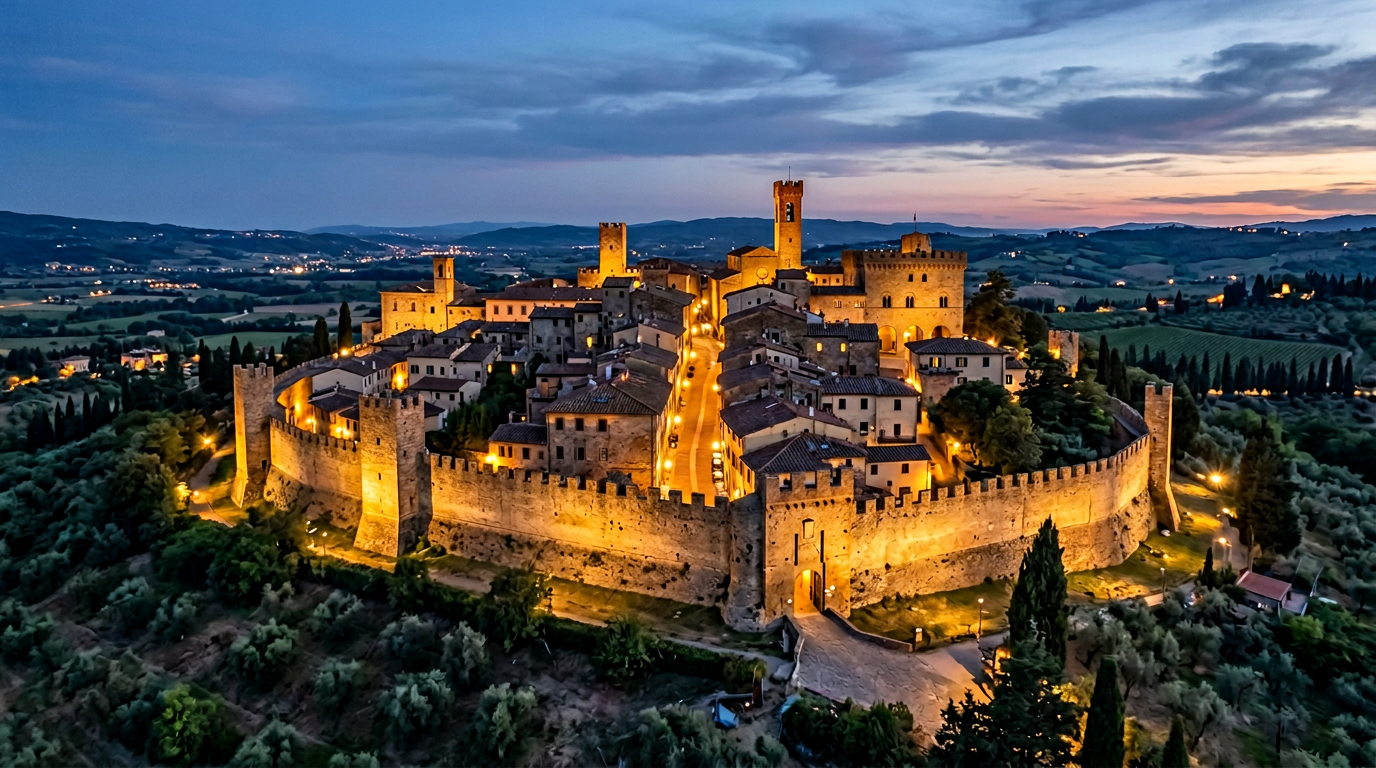
Florence Certaldo and Boccaccio: History and Places
Who Boccaccio was and why he matters
Giovanni Boccaccio was born in 1313, the year and place are debated, with Certaldo, Florence, and Paris all having been proposed, and died in Certaldo in 1375. He spent his adult life between Naples, where he worked in the Florentine banking network of the Bardi family and developed his literary skills at the Angevin court, and Florence and Certaldo, where he produced his most important works. He knew Petrarch personally and corresponded with him for decades. He lectured publicly on Dante in Florence in 1373, a year before his death, producing detailed commentary that remains a source document for Dante scholarship.
The Decameron, composed between 1348 and 1353, is the work for which Boccaccio is internationally known. It is a collection of one hundred novellas organised around a frame narrative: ten young people (seven women and three men) flee Florence during the Black Death of 1348 and spend ten days in a series of country estates outside the city, telling stories to pass the time. Each day has a theme, and each storyteller has an assigned seat in the rotation. The structure is elaborate and precise. The number ten is present at every level: ten narrators, ten days, ten stories per day, one hundred stories total.
The work is not light entertainment despite its comic surface. It is a sustained argument about human capability in the face of Fortune, about the intelligence of women (a radical claim in 1350), about the corruption of the clergy (satirised relentlessly), and about the social utility of wit and adaptability. It was read, copied, and disputed throughout Europe within fifty years of its composition.
The Black Death and Florence in 1348
The frame narrative of the Decameron opens with a description of Florence during the Black Death that is among the most clinically precise documentary records of the epidemic’s effects on a medieval city. Boccaccio writes from experience; he was living in Florence during the outbreak of 1348 and lost personal contacts to the plague.
The Black Death, caused by Yersinia pestis, transmitted via fleas on rats, reached Florence from Sicily and Sardinia in the spring of 1348. Contemporary estimates suggest that the city lost between one-third and one-half of its population in the epidemic of that year. Florence had a pre-plague population of approximately 90,000–100,000; by 1360 it had fallen to around 50,000. The city did not recover its pre-plague population level until the early sixteenth century.
Boccaccio describes the social collapse in the opening pages of the Decameron with a specificity that historians have used as primary source material: the abandonment of the sick by their families, the breakdown of funeral rites, the failure of municipal authority, and the competing responses of different social groups, isolation, flight, pleasure-seeking, religious observance. The description is not neutral; it serves the narrative purpose of establishing why the ten protagonists’ retreat to the country is rational. But it is also observed, not invented.
The quarter of Florence most directly connected to the Decameron’s frame narrative is not Oltrarno but the eastern city, around the church of Santa Maria Novella, where the narrator says the group first assembles. Santa Maria Novella is about 3.5 kilometres from Via Pisana 191 via Ponte alla Carraia.
Boccaccio’s places in Florence
Despite being closely associated with the city, Boccaccio left few fixed traces in Florence. The family did not possess major property in the city, and the literary sites associated with him are largely constructed around passages in the Decameron rather than documented biographical locations.
The church of Santa Croce, in the neighbourhood of the same name about 2.2 kilometres from Via Pisana 191, is the most significant Boccaccio-connected location in Florence. He was buried there initially, his remains were later moved to Certaldo, and the Florentine Humanist network with which he was associated used the church’s library and cloisters as an intellectual meeting point. The Pazzi Chapel, begun by Brunelleschi in 1430 after Boccaccio’s death, and the Bardi and Peruzzi chapels with their Giotto frescoes (c.1315–1325, contemporary with Boccaccio’s youth) are the significant visual material in this building.
The Bargello on Via del Proconsolo, about 2 kilometres from Via Pisana 191 via the river, contains a portrait medallion sometimes attributed to Giotto’s workshop that may depict Dante, and therefore provides context for the late medieval Florentine literary culture within which Boccaccio worked. The Bargello also has a 1495 portrait of Boccaccio (along with Petrarch and Dante) in the lunette by the workshop of Ghirlandaio. Entry costs €12 in 2026; closed Tuesday.
The Biblioteca Medicea Laurenziana in San Lorenzo, about 3 kilometres from Via Pisana 191, holds manuscripts of Boccaccio’s works, including a copy of the Decameron with corrections in Boccaccio’s own hand (Hamilton 90, a manuscript now divided between Berlin and Florence). The reading room is accessible to researchers; the Sala di Michelozzo, designed by Michelangelo (construction began 1524), can be visited independently. Entry €9 in 2026; open Monday to Saturday, 9:30–13:30.
Certaldo: the essential visit
Certaldo is 35 kilometres southwest of Florence in the Valdelsa valley, accessible by train from Florence Santa Maria Novella to Certaldo station (a 50-minute journey, trains approximately every hour) and then by funicular or a 15-minute uphill walk to Certaldo Alto, the medieval upper town.
Certaldo Alto is one of the most intact medieval hilltop centres in Tuscany. The entire upper town is brick, walls, towers, paving, with no later overlay of stucco. It was built primarily in the thirteenth and fourteenth centuries and has been subject to careful restoration rather than reconstruction. The population of the upper town is small (around 100 permanent residents) and the atmosphere is residential rather than touristic during weekdays.
The Casa del Boccaccio on Via Giovanni Boccaccio is a reconstructed fifteenth-century building on the site traditionally identified as the Boccaccio family house. The original structure was destroyed by bombing in 1944; the current building is a post-war reconstruction housing a small museum and library focused on Boccaccio’s life and the manuscript tradition of his works. Entry €4 in 2026; open Tuesday to Sunday, 10:00–19:00 (summer), 10:00–17:00 (winter).
The church of Santi Michele e Jacopo holds the tomb of Boccaccio. The tomb is a plain stone slab in the pavement of the church, restored in the eighteenth century. The inscription in Latin is a self-composed epitaph. The church also contains fragments of fourteenth-century fresco and a Madonna attributed to a follower of Benozzo Gozzoli. Entry is free.
The Palazzo Pretorio on Via Boccaccio is the former seat of the Florentine vicar who administered the Valdelsa for the Republic. The exterior loggia is decorated with the coats of arms of successive vicars. The interior houses a small collection of fourteenth- and fifteenth-century Sienese and Florentine paintings. Entry €4 in 2026.
The Decameron’s literary legacy and European influence
The Decameron was copied extensively in the half-century after its composition. Petrarch translated some of the novellas into Latin, which gave them access to the international scholarly reading public. Chaucer’s Canterbury Tales (c.1387–1400) follows a structural model demonstrably similar to the Decameron’s frame narrative, and several of the individual stories have direct parallels, though Chaucer likely used an intermediary source rather than a direct Italian text.
In the sixteenth century, the Decameron became a reference text for Tuscan prose style. Pietro Bembo’s Prose della volgar lingua (1525), which established the norms for literary Italian, cited Boccaccio alongside Petrarch and Dante as the three authoritative models. This canonisation shaped Italian prose writing for three centuries and meant that Boccaccio’s vocabulary and sentence structures were studied systematically in Italian schools from the Renaissance onward.
The text was also a target. The Counter-Reformation Church placed it on the Index of Prohibited Books in 1559, and a censored edition produced in 1573 replaced clerical characters with laypeople to reduce the anti-clerical content. The original was restored in later editions, and the 1573 censorship is now itself a primary document for studying how the Catholic Church managed literary texts in this period.
Where to stay
Certaldo makes a logical day trip from Florence rather than an overnight stay; the town has limited accommodation, and the train connection is reliable. A base in Florence that is well-placed for southwest Tuscany, toward Empoli, Certaldo, San Gimignano, and the Valdelsa, minimises transit time for these excursions. De’ Medici on Via Pisana 191 is eight kilometres from Empoli station, the rail junction for the Certaldo line, making it the most convenient Florence address for this literary itinerary.