Historic cafes in Florence: where to drink well
The coffee geography of Florence
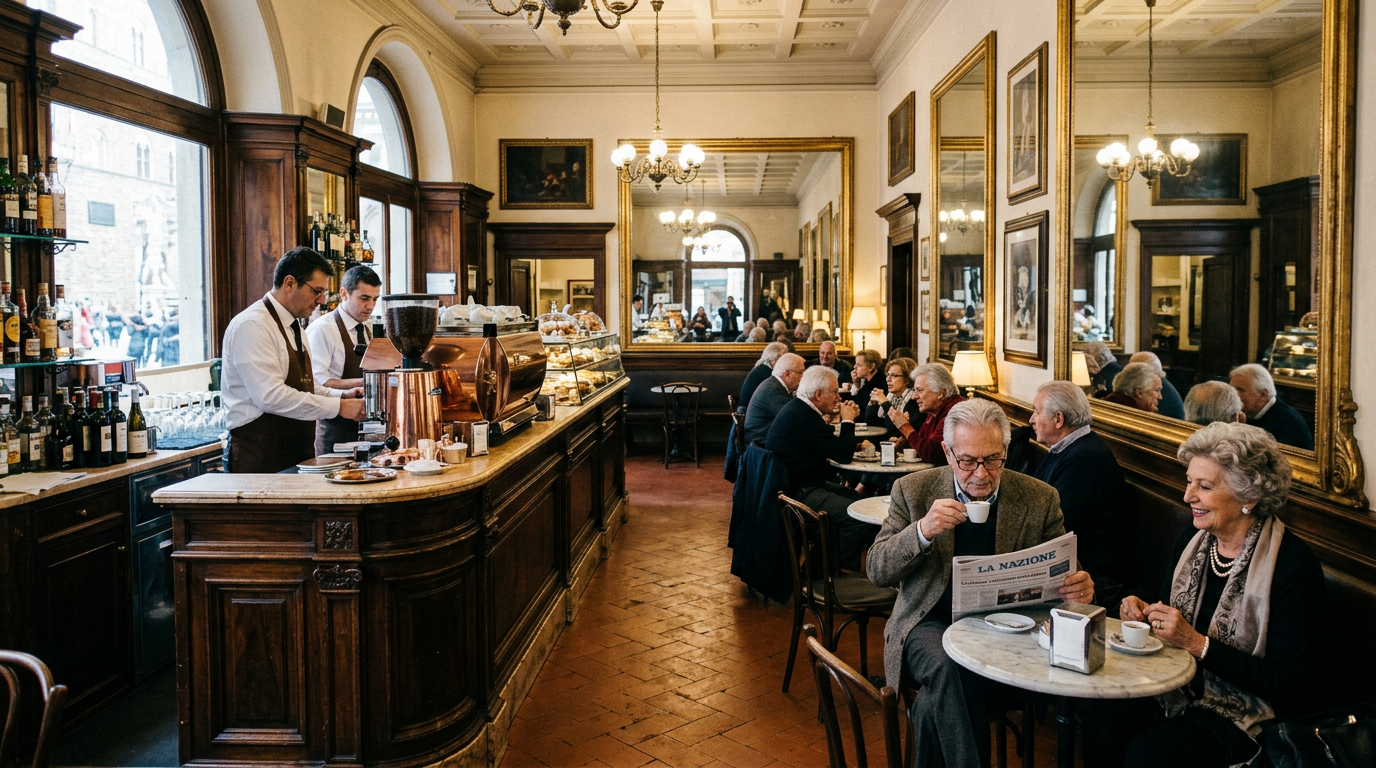
Florence divides cleanly into two coffee economies. The first belongs to the grand historic establishments on and near Piazza della Repubblica, Caffè Gilli (founded 1733), Caffè Rivoire (1872), and Caffè delle Giubbe Rosse (1896). These places charge €2.50–€4.00 for a standing espresso, roughly double or triple the city average, because you are paying for the marble, the gilded ceilings, and the accumulated mythology as much as for the coffee itself. The second economy belongs to the neighbourhood bar, where a ristretto costs €1.10–€1.30 and no one expects you to stay longer than three minutes.
Understanding this geography matters because tourists often stumble into a historic cafe without knowing they have crossed an invisible price threshold, then feel overcharged. The solution is not to avoid the historic places, several genuinely merit a visit, but to go in knowing what you are buying and what the experience includes.
The Oltrarno neighbourhood, south of the Arno and roughly 2 km from Piazza della Repubblica along Via de’ Bardi or Ponte Vecchio, operates almost entirely in the second economy. This is where Florentines who actually live in the city drink their morning coffee, and where the price of an espresso has barely moved from €1.20 in several years.
The landmark establishments worth visiting
Caffè Gilli on the corner of Via Roma and Via degli Speziali is the oldest surviving cafe in Florence, though the current premises date from a 1930s renovation. The interior, carved wood, bevelled mirrors, vaulted ceilings, is genuinely impressive, and a coffee at the bar costs €2.50 in 2026. A seated service at one of the outside tables will cost €5.00 or more. The pastries are freshly made and reliably good. Go for the architecture, not for value.
Caffè Rivoire on Piazza della Signoria occupies the ground floor of a 15th-century building directly opposite the Palazzo Vecchio. The chocolate is the house speciality, a cup runs €5.00–€6.00, and the outdoor tables offer one of the most architecturally significant views available in any cafe in Europe. The espresso at the bar (€3.00) is competent but not remarkable. What is remarkable is standing at the counter with the tower of the Palazzo Vecchio visible through the window, a view that has not changed substantially since the cafe opened.
Caffè delle Giubbe Rosse on Piazza della Repubblica was the meeting place of the Futurists in the early 20th century. The name comes from the red jackets worn by its Austrian-period waiters. The interior retains its original 1896 finishes. A standing espresso costs €2.80; literary readings and small exhibitions still take place here sporadically. Of the three landmark establishments, this one makes the most serious claim to cultural content beyond décor.
The neighbourhood bar culture of Oltrarno
Caffè Ricchi on Piazza di Santo Spirito, directly facing Brunelleschi’s unfinished church facade, charges €1.20 for an espresso at the bar. The square itself is the social centre of Oltrarno, in the morning, it is used by residents walking dogs and buying newspapers; by late afternoon, it fills with students from the nearby university faculties. The bar has been operating in the same location since 1991, and its outdoor seating operates year-round under heaters from October to April.
Bar Bevo, a few steps east of Ponte Santa Trinita on the Oltrarno side, opens at 6:30 a.m. and closes at 2:00 p.m., the schedule of a bar that exists primarily to serve the pre-work coffee rush. The espresso costs €1.10. There is no food worth mentioning, no WiFi, and no tables. It is, by all measurable criteria, a functional neighbourhood bar. It is also a good bar.
Caffè del Verone inside the Museo degli Innocenti in Piazza Santissima Annunziata (a 20-minute walk north-east from Oltrarno via Ponte alle Grazie) is worth mentioning as an exception: a rooftop terrace cafe with a panoramic view of the square below, attached to a genuinely interesting museum, with espresso at €1.80 and a view that rivals Piazzale Michelangelo without the crowds.
How Florentines drink coffee
The operative rule of Florentine coffee culture is that coffee drunk standing at the bar costs less than coffee drunk sitting at a table, and this price difference is legally mandated and must be displayed on the menu. A bar is required by Italian law to post its prices. If no price list is visible, you are entitled to ask and to pay the standing price regardless of where you drank it.
The macchiato in Florence refers specifically to an espresso stained with a small amount of cold (not steamed) milk. A caffè macchiato freddo is the correct term, though most locals shorten it to macchiato. The cappuccino is considered strictly a morning drink, ordering one after noon marks you immediately as a visitor, though no one will refuse to serve it. The marocchino, a small drink layered with espresso, cocoa powder, and a small amount of frothed milk, is a north Italian import that has found a secondary home in Florence and costs €1.50–€2.50.
The ristretto, a shorter pull than the standard espresso, using the same amount of coffee but extracting less water, is how a significant portion of Florentine regulars drink their coffee. It is stronger, denser, and less bitter than a standard espresso. Ask for it by name at any bar.
Coffee quality and the roaster question
Florence does not have a dominant local roasting tradition in the way that Naples has its own espresso culture codified around a specific roast profile. Most Florentine bars use coffee from large industrial roasters, Illy, Lavazza, or the local Tuscan supplier Corsini. A smaller number source from specialty roasters.
Ditta Artigianale has two locations in Florence, one on Via dei Neri (near Santa Croce, about 1.5 km from Oltrarno via Ponte alle Grazie) and one on Via dello Sprone, which is in Oltrarno itself, less than 500 metres from Via Pisana. They roast their own beans and serve both standard Italian espresso and filter coffee. An espresso costs €1.80; a filter coffee is €3.50–€4.50 depending on the single-origin. The aesthetic is northern European third-wave, which creates an interesting friction with the traditional Italian bar experience next door.
Sospeso on Borgo San Frediano, deep in the western Oltrarno, operates with a slightly more neighbourhood feel than Ditta Artigianale, serves espresso at €1.50, and sources from small roasters. It is 1.2 km from Via Pisana 191 by foot along Via Pisana itself, turning north onto Borgo San Frediano. The walk takes twelve minutes.
Where to stay
Florence’s historic cafes and neighbourhood bars are best experienced on foot, moving between the grand establishments north of the river and the working bars of Oltrarno. Proximity to Oltrarno is decisive, it places you within walking distance of both worlds without the expense of the historic centre hotels. For accommodation that puts you at the centre of Oltrarno’s coffee geography, De’ Medici is the right base.