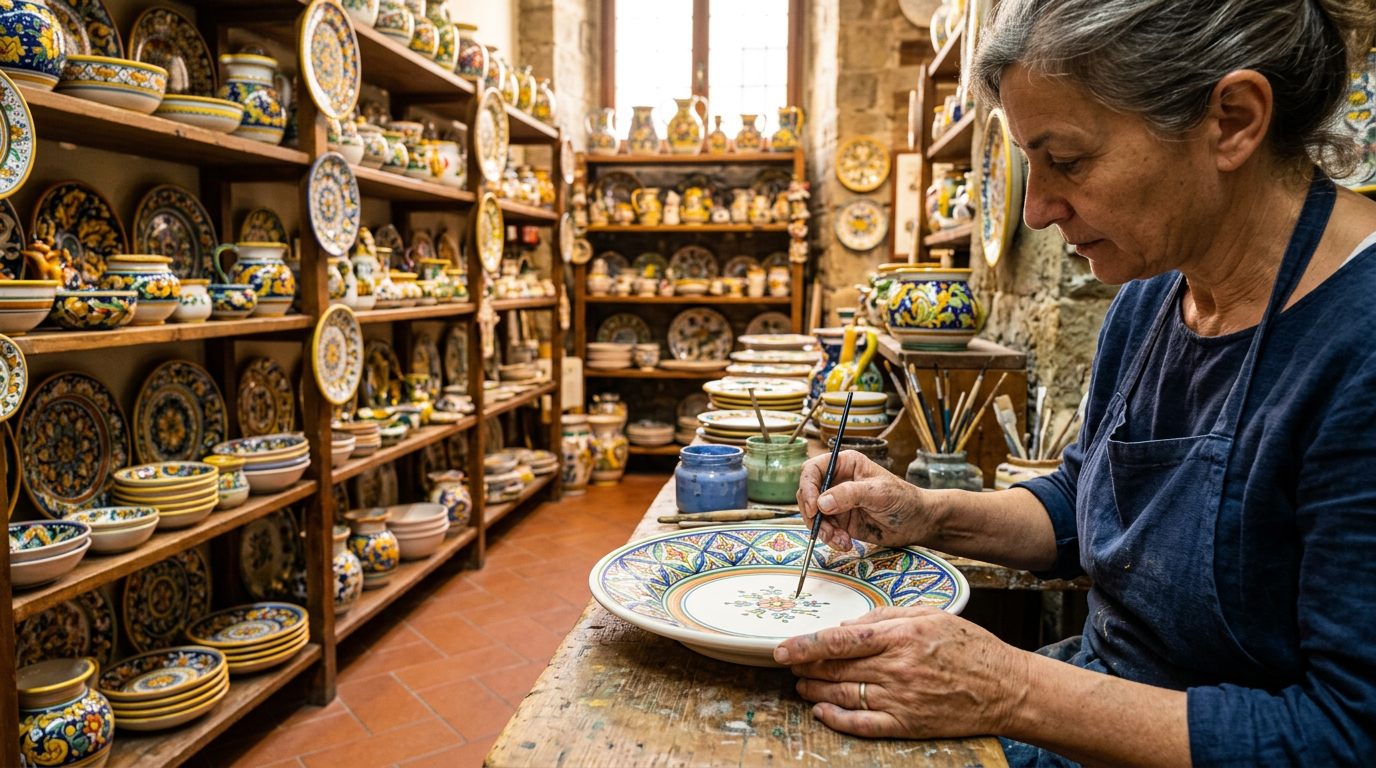
Artistic ceramics in Florence: majolica and workshops
The history of Tuscan majolica
Majolica, tin-glazed earthenware fired to produce an opaque white surface that accepts hand-painted decoration, arrived in Tuscany via Spanish and Moorish trade routes in the 14th century. The name derives from Majorca, one of the primary transshipment points for this type of ceramic work as it moved from the Islamic world into Europe. Florentine workshops began producing their own versions in the 15th century, initially imitating Spanish and later developing distinctly Italian decorative vocabularies.
The Medici court played a direct role in establishing Florence as a ceramic centre. Cosimo I de’ Medici patronised workshops producing both functional domestic ware and decorative objects, and the Museo Nazionale del Bargello holds a significant collection of 16th-century Florentine majolica that illustrates the range of decoration common in that period, grotesques, classical figures, dense geometric borders in cobalt and ochre. The Florentine workshops of the 15th and 16th centuries produced what is now called “archaic” majolica, identifiable by its restricted palette (manganese purple, copper green, ochre, cobalt) and relatively simple painted motifs.
The main productive centres for Tuscan ceramics today are not Florence itself but Montelupo Fiorentino, 22 km south-west of Florence on the Arno, and Sesto Fiorentino, 8 km north-west. Both towns have maintained continuous ceramic production since the Renaissance and continue to supply workshops and retailers throughout the region. Several Florence-based artisans source undecorated bisqueware from these suppliers and complete the painting and glazing in city workshops.
Active ceramic workshops in Oltrarno
Ceramiche Rampini, located at Piazza del Carmine 8 in the western Oltrarno, has operated since 1963 and produces hand-painted majolica using designs drawn from 16th and 17th-century Florentine sources. The workshop is also the retail point. A standard dinner plate costs €45–€65 depending on the complexity of the design; a full six-piece place setting (plate, side plate, bowl, espresso cup and saucer) runs €280–€450. Their work is identifiable by a relatively controlled palette and precise brushwork. The Carmine location is approximately 1.5 km from Via Pisana 191, fifteen minutes on foot heading east.
Studio Penko on Via Borgo Ognissanti 8, just north of the Arno on the edge of Oltrarno, produces both traditional majolica and contemporary ceramic work. The studio accepts commissions for custom-painted pieces, a dinner service with a family monogram or a specific decorative motif, with a lead time of six to eight weeks and pricing that begins at €150 for a single custom piece. They also sell ready-made stock at lower prices than the commissions.
Ceramiche d’Arte on Via della Vigna Nuova, about 1.2 km north of Ponte Santa Trinita, is a larger retail operation stocking ceramics from multiple Tuscan workshops. The range is wider and the prices more varied than in the smaller single-artisan studios, making it useful for comparison shopping. A hand-painted bowl might cost €25–€200 here depending on origin and complexity.
How to recognise genuine hand-painted ceramics
The most reliable indicator of hand-painted work is the slight irregularity in the brushstrokes. In machine-printed or transfer-decorated ceramics, the majority of what is sold at tourist-facing shops near the Duomo and Uffizi, the pattern is perfectly repeatable, lines are mechanically uniform, and the colour sits on the surface without variation. In genuinely hand-painted majolica, brushstrokes vary slightly in width and pressure, colour pools slightly at the centre of each area, and adjacent pieces in the same series are visibly similar but not identical.
A second test is to look at the piece’s base. Most genuine artisan workshops mark their work with a maker’s stamp, the artisan’s initials, and sometimes a date or series number. This information may be scratched, stamped, or painted onto the foot ring. The absence of any mark is not conclusive evidence of inauthenticity, but its presence is strong evidence of genuine workshop production.
The weight and surface texture also differ. Hand-thrown or hand-pressed stoneware and earthenware have slightly uneven walls and a surface that shows minor texture variations under raking light. Press-moulded commercial ware is uniformly smooth and thin. This distinction applies to the fired clay body, not the decoration, but the two correlate: serious ceramicists usually make their own blanks rather than importing industrial forms.
Montelupo Fiorentino: the production source
Montelupo Fiorentino is accessible from Florence SMN station by regional train in 35 minutes, with trains every 30–45 minutes and a ticket price of €3.60 in 2026. The town has a dedicated Museo della Ceramica at Piazza Vittorio Veneto 1, open Tuesday to Sunday, with a permanent collection tracing Montelupo production from the 13th century to the present. Entry costs €6.
The town’s workshop district, concentrated around Via Mazzini and Via Tosco-Romagnola, includes several studios that sell directly from production facilities. Prices are typically 20–30% lower than in Florence city centre retail points for comparable pieces. A substantial hand-painted decorative plate, 30 cm diameter, costs €35–€55 here versus €55–€90 in an Oltrarno studio shop. The trade-off is the journey.
The annual Ceramic Festival (Palio della Ceramica) takes place in June and includes open workshops, historical demonstrations, and market stalls from producers across Tuscany. The 2026 edition is scheduled for June 28–29. Entry to most festival events is free; the market stalls sell at competitive prices.
What to buy and what to avoid
The most practical ceramic purchase for someone with airline luggage to consider is a small set of espresso cups and saucers, lightweight relative to size, stackable, and genuinely useful. A hand-painted set of four espresso cups and saucers from a reputable Florentine workshop costs €80–€140 in 2026. This is significantly more than the €8–€15 sets sold at tourist shops near the Uffizi, but those are factory-made in eastern Europe or Asia and bear no relation to Florentine ceramic tradition.
For anything larger, plates, platters, decorative tiles, consider the shipping logistics before buying. Most reputable workshops will pack and ship internationally; expect shipping costs of €35–€80 for European destinations and €70–€150 for North America, depending on the volume and insurance value of the shipment. Ask about this before committing to a purchase.
Where to stay
The workshops of Oltrarno and the ceramics shops along Via della Vigna Nuova and Borgo San Jacopo are all accessible on foot from a base on the south side of the Arno. A stay in Oltrarno also puts you near the train station at Santa Maria Novella, the departure point for the Montelupo day trip. For a ceramics-focused visit to Florence, De’ Medici offers the right combination of location and convenience to reach all the main workshops and production sites.