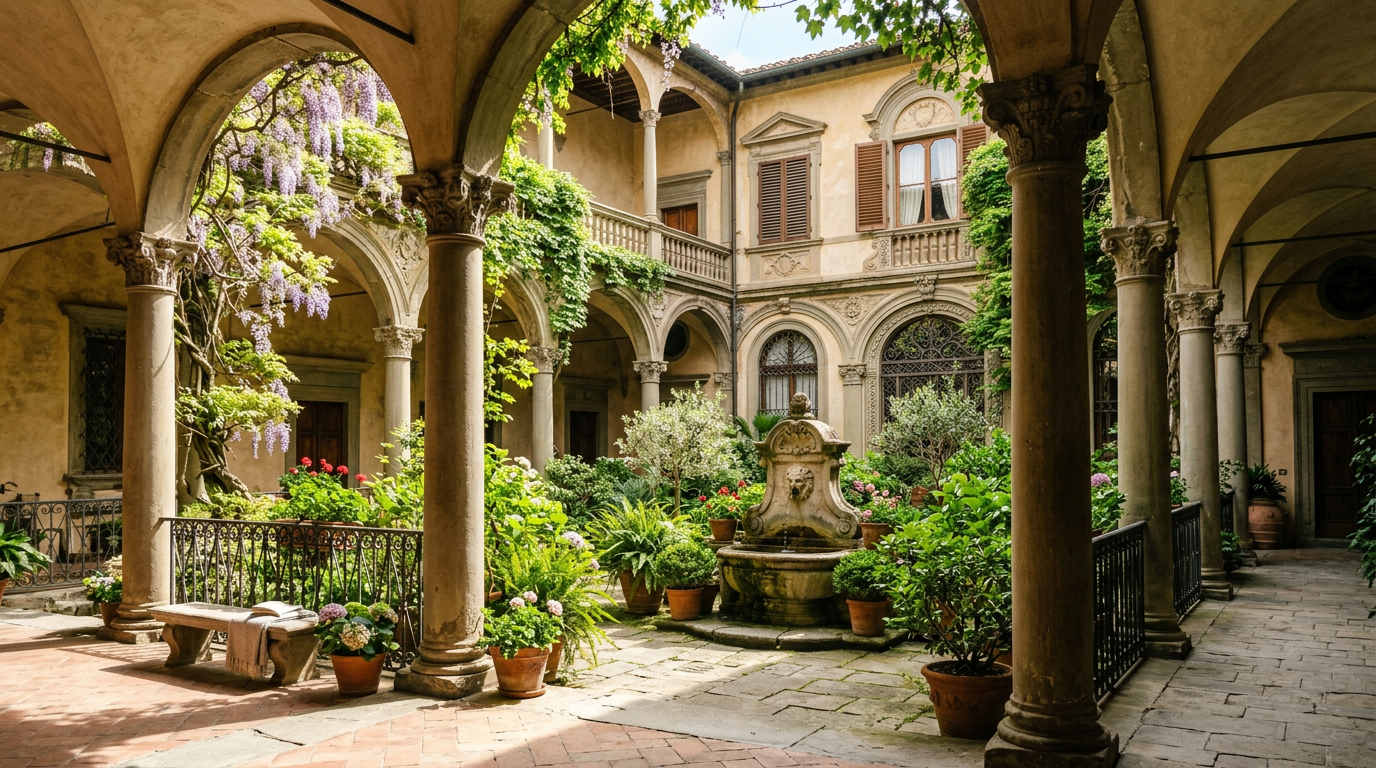
Secret courtyards of Oltrarno palazzi in Florence
The palace courtyard in Florentine architecture
The cortile, the internal courtyard, is the structural and social heart of the Florentine Renaissance palazzo. Unlike the French hotel particulier or the English townhouse, which present their grandest rooms at street level, the Florentine palazzo communicates almost nothing to the exterior. The facade is deliberately plain: large, rusticated stone blocks, small windows, an imposing portal. The scale and wealth of the building are revealed only once you pass through the entrance gate.
This inward-facing arrangement was partly defensive, Florence’s medieval factionalism made a fortified street presence practical, and partly civic. The cortile was a transitional space between the public street and the private piano nobile, used for receiving visitors of intermediate social standing, for assemblies, and for the display of sculpture, classical inscriptions, and garden planting. The Medici palace on Via Larga (now Via Cavour) set the template in 1444–1484: a colonnaded courtyard by Michelozzo, with ancient Roman inscriptions set into the walls and a Donatello bronze displayed on a column at the centre.
Oltrarno has a high density of palazzi from the 15th through 18th centuries, many of them built by the Florentine families, Pitti, Capponi, Guicciardini, Tempi, who preferred the quieter south bank of the Arno to the crowded historic centre. Several of these buildings retain their original courtyards in good condition. The challenge is access: unlike the Palazzo Medici Riccardi, which operates as a museum, most Oltrarno palazzi are private property, divided into apartments, or used by institutions that maintain restricted public access.
Palazzo Pitti: the largest courtyard in Florence
The Palazzo Pitti on Piazza Pitti is technically in Oltrarno, though it operates as a full museum complex and does not qualify as “secret.” Its cortile dell’Ammanati, the internal courtyard designed by Bartolomeo Ammanati in the 1550s and 1560s, facing the Boboli Gardens, is one of the most impressive Renaissance courtyard spaces in Italy. Three stories of rusticated arches surround a space large enough to have been used for theatrical performances and water festivals under the Medici.
The courtyard is included in the combined ticket for the Palazzo Pitti museum complex: €16 for adults in 2026, covering the Galleria Palatina, the Galleria del Costume, and the Boboli Gardens. The gardens, accessible directly from the rear of the courtyard, extend up the hillside behind the palace for approximately 4.5 hectares.
Palazzo Capponi delle Rovinate
On Via de’ Bardi, running along the Oltrarno bank of the Arno between Ponte Vecchio and Ponte alle Grazie, the Palazzo Capponi delle Rovinate presents a largely unaltered 15th-century facade with a heavy stone portal. The building is named partly for the Capponi family and partly for a landslide (rovine) that damaged the hillside behind it in the 14th century. The cortile inside is a single-story loggia with pietra serena columns; it can sometimes be seen through the open entrance gate during working hours (Monday to Friday, roughly 9:00–17:00, when the building is occupied by offices).
The building is not a museum and does not offer formal visitor access, but the gate is often left open during office hours, and it is not unusual for passers-by to look in from the entrance. The cortile retains its original stone paving and a stone well head in the centre. The Capponi family produced several senior figures in the Florentine Republic’s government in the 15th and 16th centuries; a member of the family is buried in a chapel designed by Brunelleschi in Santa Felicita, fifty metres east.
Palazzo Guicciardini
On Via Guicciardini, the street that runs directly from Ponte Vecchio to the Pitti Palace, the Palazzo Guicciardini has been inhabited by the same family since it was built in the 15th century. Francesco Guicciardini, the historian and statesman who wrote the Storia d’Italia, the first major history of Italy as a political unit, was born here in 1483 and lived in the palace for much of his life.
The building is still privately occupied and does not offer public access to the cortile. During the Giornate FAI (the Italian national open house organised by the Fondo Ambiente Italiano), typically held in March and October, several Florentine private palaces including Palazzo Guicciardini open their courtyards to the public. The 2026 spring event is scheduled for March 21–22. Registration is free through the FAI website; some events require advance booking.
The Giornate del Patrimonio and systematic courtyard access
The Giornate Europee del Patrimonio (European Heritage Days), held annually in late September, provide the most systematic public access to private Florentine palazzi. In 2026, the event is scheduled for September 27–28. Participating buildings typically include ten to twenty Oltrarno palazzi with courtyards that are otherwise inaccessible, some of them opening for the only time in the calendar year.
The Florence municipal website (comune.fi.it) publishes the list of participating buildings approximately three weeks before the event. Queues form quickly at the most famous locations, but the Oltrarno buildings, being less centrally located than those near the Duomo, are generally accessible without a wait of more than thirty minutes.
Outside these organised events, two strategies work for casual courtyard access. First, major bank branches and government offices frequently occupy ground floors of historic palazzi and leave their entrance gates open during business hours; the Banca CR Firenze branch on Via de’ Guicciardini can be accessed from the street in this way. Second, condominium buildings in Oltrarno sometimes ring buzzers randomly, this is of questionable etiquette but is a practice noted by several Florence-based urban walkers.
Architectural details worth noting
When you gain access to any Oltrarno cortile, the following details are worth examining specifically. First, the capitals of the columns: many Oltrarno palazzi use composite capitals combining Corinthian acanthus leaves with Ionic volutes, a combination characteristic of Florentine Renaissance practice that differs from the purer classical vocabulary used in Rome. Second, the well head: most 15th and 16th-century cortili contained a central well, often decorated with heraldic carving. The quality of the carving indicates the period of construction and the wealth of the patron. Third, pietra serena detailing: the grey sandstone known as pietra serena, quarried near Fiesole and used throughout Florentine Renaissance architecture, appears in column shafts, window surrounds, and cornice mouldings. It weathers poorly in polluted air but retains its quality in protected courtyard spaces.
The planted elements also deserve attention. Many Oltrarno courtyards that were originally paved have been partially replanted in the 18th and 19th centuries with lemon and orange trees in terracotta pots, box hedges, and climbing roses. This planting style, a Northern European romanticism imposed on a Renaissance architectural form, is not original but has its own historical interest as evidence of changing tastes.
Where to stay
Exploring the cortili of Oltrarno is inherently a slow, opportunistic activity, you walk, you look through open gates, you come back during the Giornate FAI. A base that allows this kind of unhurried neighbourhood exploration, without the time pressure of daily commuting from the north bank, is essential. De’ Medici is located in Oltrarno and provides immediate access to the streets where the palazzi are concentrated, on foot, at any hour.