Guide to Florence leather crafts: Oltrarno and beyond
Florence and leather: the historical context
Florence’s connection to leather production dates to the medieval guild system. The Arte dei Calzolai (shoemakers’ guild) and the Arte dei Vaiai e Pellicciai (furriers and skin merchants) were two of the more powerful minor guilds in the Florentine corporate structure. The leather trade was closely tied to the Santa Croce neighbourhood, where the tanneries operated along the stream that ran through the area before it was channelled underground in the 19th century. The smell of the tanning process, using oak bark and other vegetable agents, was a persistent feature of the eastern quarter of medieval Florence.
This geographic and industrial heritage partly explains why the most famous surviving leather institution in Florence, the Scuola del Cuoio, is located inside the Basilica di Santa Croce complex. The school was established in 1950, in the aftermath of the Second World War, by Franciscan monks who wanted to provide a vocational training resource for Florentine orphans. The monks negotiated access to the oratory behind the church; the school has operated continuously since then and now functions simultaneously as a working teaching workshop and a retail operation.
The Oltrarno, across the river, developed a parallel leather-working tradition tied to the production of fine goods, wallets, bags, belts, bookbinding leather, for the luxury market. This tradition survives in a handful of workshops between Via Maggio and Borgo San Jacopo.
The Scuola del Cuoio at Santa Croce
The school occupies a series of rooms in the former monks’ dormitory behind the apse of Santa Croce, accessible via a separate entrance at Via San Giuseppe 5r (also reachable through the church itself if you have a museum ticket, which costs €8 in 2026). The workshop areas are visible to visitors during opening hours: Monday to Saturday 10:00–18:00, Sunday 10:30–18:30.
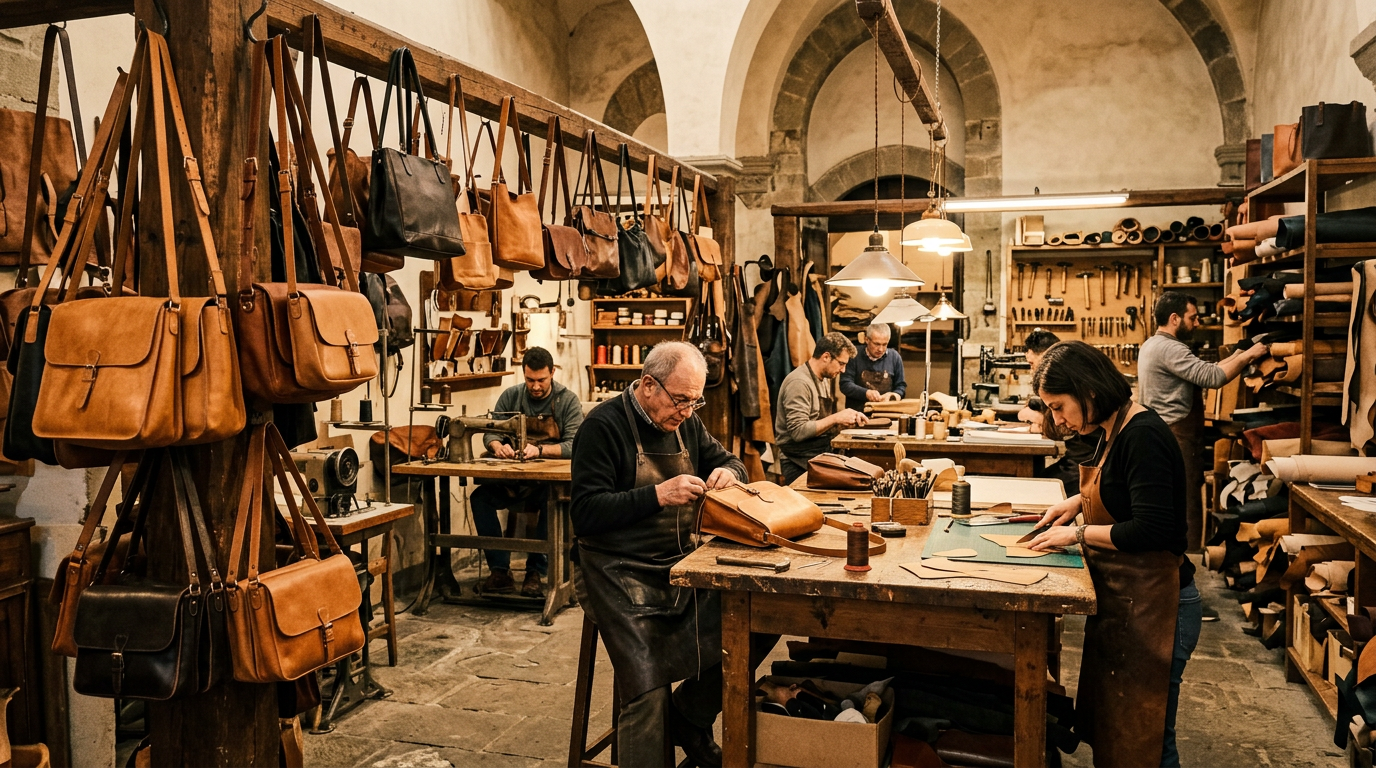
What you will see inside is genuine: students at benches cutting and stitching leather, instructors demonstrating saddle-stitch technique, and goods at various stages of completion. The products sold in the adjacent retail area, wallets, belts, document cases, small bags, are made on the premises, and the quality is consistent with genuine artisan production. Prices reflect this: a leather wallet costs €85–€150 depending on complexity; a small tote bag runs €220–€380.
The school also offers short courses for visitors: a half-day leather-work introduction costs €120 per person and includes materials. Full-week intensive courses are available for more serious students. Places on both course types should be booked through their website at least two weeks in advance, as demand from visitors and from the resident Florentine student population competes for the same spaces.
Oltrarno workshops producing leather goods
Mannina on Via Guicciardini 16r, approximately 400 metres south of Ponte Vecchio heading toward the Pitti Palace, has been making shoes and leather accessories since 1953. The workshop is family-run in the third generation. Bespoke shoes require three to four fittings and start at €650; ready-to-wear models using the same last system are €180–€350. The leather goods, wallets, belts, small card cases, start at €45 for simple items. The shop is small and the stock is limited; this is a working shoemaker’s, not a showroom.
Grevi on Piazza del Limbo 4, a small square off Via Por Santa Maria at the north edge of Oltrarno, produces leather-lined hats and accessories. The hat-making tradition overlaps with leather work here: the sweatbands and inner linings of their handmade straw and felt hats are vegetable-tanned Florentine leather. A handmade straw hat costs €95–€180; felt options start at €120.
Bottega Veneta does not operate a workshop in Florence (it is a Veneto brand), and the several shops on Via Tornabuoni bearing luxury house names are not Florentine craft production. This distinction matters: a genuine Florentine workshop is typically small, run by one to five people, visibly producing on the premises, and located in Oltrarno or the Santa Croce area rather than in the luxury retail corridor near Piazza della Repubblica.
How to identify genuine Florentine handmade leather
The most reliable indicator of genuine handmade leather work is the stitching. Machine-stitching in leather produces an even, lockstitch pattern where both threads cross at exactly the same angle and depth, creating a continuous groove on both surfaces of the leather. Saddle stitching, the technique used by hand, creates a different geometry: two needles passing through the same hole from opposite sides produce an angled X pattern on the visible surface. Under magnification, the stitches in saddle-stitched leather are individually angled; in machine stitching they are perpendicular.
The edges of the leather are a second indicator. Factory-cut edges on commercial goods are often painted with a single coat of edge finish and left square. Handmade goods have their edges bevelled with a hand tool, then burnished smooth using a wooden slicker and bone folder, sometimes over multiple rounds of moistening and working. The result is a rounded, polished edge that shows the cross-section of the leather clearly.
Vegetable tanning, the traditional method using natural plant tannins, produces leather that is firmer, denser, and develops a patina with use. Chrome-tanned leather, which dominates commercial production because the process takes days rather than months, is softer and more uniform but does not develop the same depth of colour with age. You can distinguish them by smell (vegetable-tanned leather has an earthy, organic scent; chrome-tanned is faintly chemical or odourless) and by feel (vegetable-tanned is slightly stiffer and the surface shows tooling marks clearly; chrome-tanned is more uniform).
Price reference: what genuine work costs in 2026
The following prices are anchors based on mid-2026 market conditions in Florence artisan workshops. They do not include items from tourist-facing market stalls, which sell largely imported goods:
A hand-saddle-stitched leather wallet, vegetable-tanned, made in Florence: €75–€140. A leather belt, hand-stitched, 3 cm width: €55–€90. A small messenger bag, single-compartment, hand-stitched: €280–€450. A leather notebook cover for A5, with saddle-stitched spine: €65–€120. A pair of bespoke leather shoes with custom last: €600–€900.
Items significantly below these prices at shops claiming handmade Florentine production warrant scrutiny. The material and labour costs of genuine artisan leather work create a floor beneath which production is not economically possible in a Florence workshop.
Where to stay
The Oltrarno workshops are concentrated in a corridor from Via Maggio to Borgo San Jacopo, roughly 800 metres long and accessible entirely on foot. The Santa Croce Scuola is 2.5 km from Via Pisana via the Ponte alle Grazie, a thirty-minute walk or a ten-minute bus ride on line 23. For anyone visiting Florence to understand its surviving artisan economy firsthand, a base in Oltrarno is the logical choice, and De’ Medici puts you in the middle of the neighbourhood where that economy is most visible.