Historic gardens in Oltrarno Florence: visit guide
Three gardens on one hillside
The south-facing slope above the Arno contains more historic garden space than any other district in Florence. Boboli, Bardini, and the Giardino delle Rose occupy the hillside between Palazzo Pitti and the church of San Miniato al Monte in an almost continuous sequence of terraces, axes, and planted slopes. Together they cover several dozen hectares. All three can be reached on foot from the Lungarno in under thirty minutes.
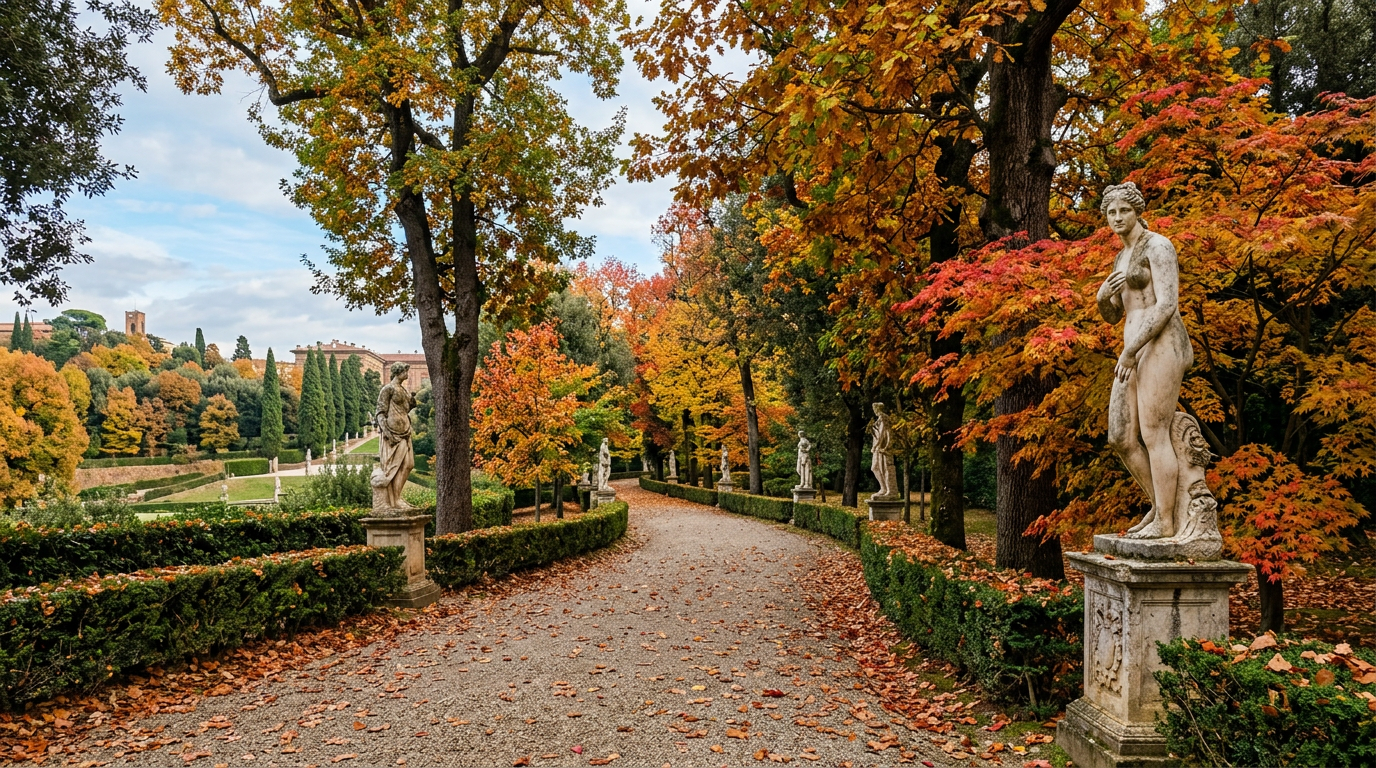
The differences between them are worth understanding before you visit. Boboli is a monumental dynastic garden begun in 1549 for Eleonora di Toledo, wife of Cosimo I de’ Medici, and expanded continuously over the following century and a half. It is the largest historic garden in Florence, with strong axial geometry, a collection of ancient and Renaissance sculpture, and a highly managed landscape of clipped hedges, gravel paths, and formal plantings. Bardini is smaller, wilder in its middle section, and far less visited. The Giardino delle Rose is a public municipal garden on a natural terrace, free to enter, best known for its collection of four hundred rose varieties in late April and May.
Visiting all three in a single day is physically possible but experientially counterproductive. The better approach is to allocate a full morning to Boboli and Bardini, entering Boboli from Piazza de’ Pitti at opening time and connecting through to Bardini via the upper section, and to reserve the Giardino delle Rose for a separate, shorter visit.
Boboli Garden: admission, layout, and what to prioritise
Entry to the Boboli Garden is included in the combined ticket for Palazzo Pitti and its three museums (Palatine Gallery, Treasure of the Grand Dukes, Gallery of Modern Art): €22 for adults in 2026. The garden can also be entered directly from the gate on Piazza de’ Pitti using the same ticket. A standalone garden-only ticket is available for €10. The garden is open every day except the first and last Monday of each month. Opening time is 8:15 am year-round. Closing time varies from 4:30 pm in January and February to 7:30 pm in June, July, and August.
The garden’s main axis runs from the Amphitheatre directly behind the palace, where Roman statues surround an Egyptian obelisk of the 2nd century AD, uphill along a central avenue to the Kaffeehaus pavilion on the crest. This is the most visited corridor and the most crowded between 10:00 am and 1:00 pm. To avoid it, turn west immediately after entering through the Porta Romana gate, which brings you into the Isolotto section. The Isolotto is an oval artificial lake encircling a small island planted with lemon trees in terracotta pots. The central fountain, Neptune’s Fountain, dates from 1565. The atmosphere here is quiet even on summer weekends.
The Grotta del Buontalento, immediately to the left of the main palace entrance from Piazza de’ Pitti, is the single most architecturally unusual feature of the garden. Bernardo Buontalento designed it between 1583 and 1593. The interior is lined with artificial stalactites, coloured stone, shells, and plaster figures emerging from the walls. The innermost chamber contains a copy of Giambologna’s Venus, the original is in the Bargello. Timed admission is required; tickets are included with the general garden entry and issued at the entrance kiosk. Slots fill by mid-morning on busy days.
Giardino Bardini: the garden few visitors find
The Giardino Bardini covers approximately four hectares on the slope above Via de’ Bardi, between the Costa San Giorgio and the Bastione di San Giorgio. It is entered either from Via de’ Bardi 1r or from a higher gate on Costa San Giorgio. Opening days are Tuesday to Sunday. Entry costs €10, or €15 in a combined ticket with the Villa Bardini and its interior collections (which include 17th- to 20th-century decorative arts and a room dedicated to the fashion designer Roberto Capucci).
The garden was assembled by the antiquarian Stefano Bardini between 1913 and 1922 from several adjacent parcels, some of which had been cultivated since the 15th century. After his death, it passed through several owners and suffered decades of neglect before the Fondazione Parchi Monumentali Bardini e Peyron undertook a systematic restoration. Bardini reopened to the public in 2005 and has been maintained carefully since.
The vertical layout divides the garden into three distinct registers. At the base, nearest Via de’ Bardi, a formal Italian parterre features clipped box hedges, a central stone staircase, and a covered loggia with a view toward the Arno. The middle section abandons formal geometry for a naturalistic English-style landscape, irregular paths, planted slopes, trees that interrupt any clear sightlines. The upper section returns to formality with a long wisteria pergola on metal columns that frames a direct view north over the Arno and the city. The wisteria blooms in late April and the first half of May. At that period, the fragrance and the flowering density are exceptional.
Giardino delle Rose: free entrance, best in May
The Giardino delle Rose occupies a natural terrace on the hillside between Piazzale Michelangelo and Piazza Poggi, about forty metres above the Lungarno. It is managed by the Comune di Firenze and free to enter throughout the year. There is no gate and no fixed opening schedule.
The garden contains approximately 400 rose varieties from Europe, North America, and Asia, organised in beds along a central path. The main flowering peak is from the last week of April through the third week of May. During this period the garden is genuinely spectacular: colours range from white and pale yellow through deep crimson, and the scent on a warm morning is dense. The collection also includes Japanese azaleas that bloom slightly earlier, in mid-April, creating a secondary spectacle before the roses open.
Outside the rose season, the garden functions primarily as a viewpoint. Benches face north across the Arno toward the historic centre, with the dome of Santa Maria del Fiore and the tower of Palazzo Vecchio clearly visible at a distance of roughly 800 metres. The perspective is higher than the Lungarno and lower than Piazzale Michelangelo, which gives it a mid-height view that most visitors overlook. Access on foot from central Oltrarno takes approximately twenty minutes: walk east along the Lungarno to Piazza Poggi, then climb the path between the Kaffeehaus pavilion and the old city wall.
Avoiding crowds across all three
The timing logic for all three gardens is identical: arrive at or near opening time. Boboli and Bardini both accept visitors from 8:15 am. The Giardino delle Rose has no gate but is functionally empty before 8:30 am on most days. Arriving early does not just mean fewer people, the light on the south-facing hillside is at its best in the first two hours after sunrise, particularly in September and October when the angle is low.
For Boboli specifically, the western section of the garden, the Isolotto, the meadow between the Isolotto and the Kaffehaus, the paths running along the garden’s western wall toward the Viottolone of cypress trees, is reliably less crowded than the central axis at any time of day. The Viottolone, a double avenue of cypresses dating from the 16th century, is one of the oldest surviving planted features in the garden and among its most impressive spaces. Most visitors on the central axis walk past the entrance to it without turning.
Bardini is small enough that it rarely becomes unpleasantly crowded; its weekday mornings are almost always quiet. Weekend afternoons in May are the one exception, when the wisteria draws larger numbers. The Giardino delle Rose peaks on May weekends between 10:00 am and 1:00 pm; arriving before 9:00 am gives you the garden effectively alone.
The optimal visiting season is the shoulder period on either side of summer: April to early June and mid-September to early November. July and August expose south-facing hillside gardens to serious heat between 11:00 am and 4:00 pm. Winter is viable for Boboli in particular, the bare structure of the garden is austere but coherent, but the rose collection and the wisteria offer nothing before late April.
Where to stay
All three gardens open from the south bank of the Arno, within walking distance of each other and of the residential streets of Oltrarno. Staying in the neighbourhood means the gardens are accessible at opening time, before the day heats up and before the queues form at the ticket counters. De’ Medici is positioned in Oltrarno, a short walk from the Pitti entrance to Boboli and from the Via de’ Bardi gate to Bardini.