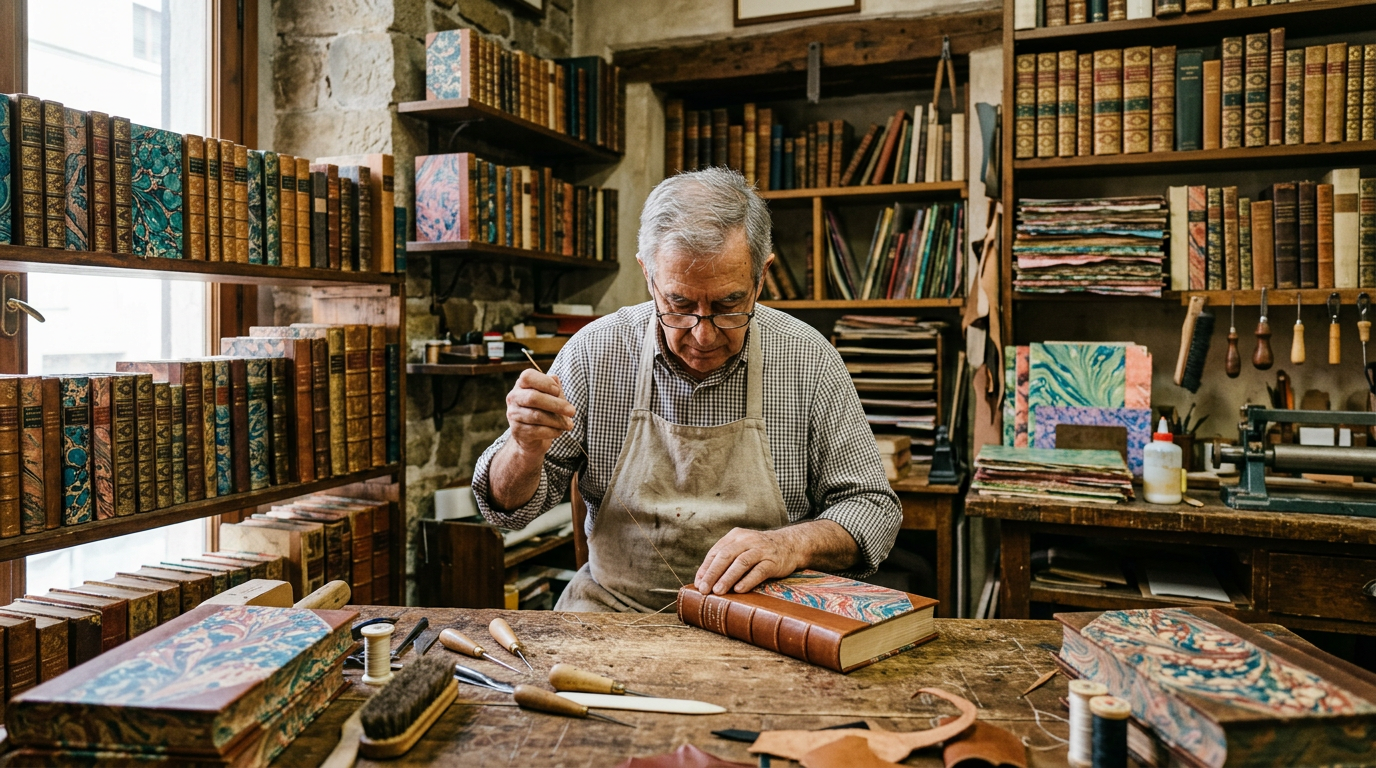
Artisan bookbinders in Florence: a living tradition
Why bookbinding took root in Florence
The material conditions for an exceptional bookbinding tradition were in place in Florence earlier than almost anywhere else in Europe. The Medici library, the Biblioteca Medicea Laurenziana, housed in Michelangelo’s building on the cloister of San Lorenzo from the 1570s, contained thousands of manuscripts and early printed books by the mid-15th century, each requiring a durable cover, reinforced spine, and careful storage. The demand generated by a single collection of that scale sustained multiple workshops. Florence also controlled the trade routes through which materials arrived: the alum essential to mordanting paper for marbling came from Volterra and later from Tolfa, both within the Medici state; quality leather came from the tanneries of Oltrarno and Santa Croce.
By the 16th century, Florentine binderies were working for the courts of France, Spain, and the Holy Roman Empire. The distinctive marbled paper that became associated with the city was adapted from Ottoman techniques, marbling was practised in Istanbul from at least the 1550s, but Florentine craftspeople modified the patterns, changed the base materials, and standardised production in ways that made their version commercially distinct. The peacock pattern and the combed non-pareil pattern, both still made in Florentine workshops, are documented in Florentine sources from the late 17th century.
The industrial revolution did not destroy this tradition but it compressed it. Machine-made cloth bindings, mechanical gold-stamping, and eventually adhesive perfect binding made hand-sewn books economically rational only for luxury or specialist production. The workshops that survived into the 20th century did so by serving collectors, institutions, and clients who understood the difference between an object made to last fifty years and one made to last five.
How Florentine marbled paper is made
Carta marmorizzata is produced by floating mineral or water-based pigments on a thickened liquid called size. The size is traditionally prepared from carrageenan, an extract from seaweed that gives it a viscous, supportive consistency without breaking the surface tension that holds the pigment drops in place. A sheet of paper is pre-treated with alum, aluminium sulphate, applied as a weak aqueous solution and allowed to dry. The alum acts as a mordant, fixing the pigment to the paper fibres at the moment of contact.
The marbler drops pigments onto the size surface in a fixed sequence, then moves them with a stylus, comb, or brush to produce patterns. The combed pattern, one of the simplest, is made by drawing a metal comb through parallel rows of drops. The peacock pattern, the one most closely associated with Florence, requires additional passes with a finer comb at right angles to the first, then with a stylus to pull individual lines into pointed formations. Each pass modifies the pattern in ways that cannot be fully controlled or predicted. No two sheets produced by the same marbler with the same tools will be identical.
Genuine hand-marbled paper has specific physical characteristics. The pattern runs slightly deeper than the surface because the pigments sit into the fibres at the moment of contact. At a slight angle in raking light, the surface shows a faint relief texture. Machine-printed imitations, sold widely in tourist shops at €1 to €3 per sheet, have a flat, plastic quality and show pattern repetition at regular intervals. The price difference between genuine marbled sheets (€8 to €25 per sheet, depending on size and complexity) reflects real differences in production time and material quality, not branding.
Active workshops in Oltrarno and the historic centre
Giulio Giannini e Figlio on Piazza Pitti has occupied its current address since 1856, making it among the longest continuously operating commercial binderies in the city. The ground-floor shop sells marbled paper, notebooks, leather-bound albums, and stationery objects. The workshop occupying the upper floors is still active, orders placed at the counter are produced on the premises, not outsourced. The binding structures used follow traditional techniques: coptic stitch, long stitch, and French link stitch for notebooks; cased binding with decorated boards for albums and books. Opening hours are Monday to Saturday, 10:00 am to 7:30 pm.
Il Torchio on Via dei Bardi is a smaller operation, run by a single artisan who produces both hand-marbled paper and hand-bound objects. The street-facing window gives direct sight of the marbling trough, the drying racks, and the press. Products include photo frames, loose sheets, and notebooks in multiple formats. The scale is genuinely artisanal: a realistic daily output of marbled sheets is measured in dozens, not hundreds. Opening hours vary; Tuesday to Friday is reliable.
Legatoria Piazzesi on Piazza Santa Croce, technically north of the river, justifies the short walk. Founded in the 1870s, it holds documentation of its marbling techniques that traces back to 17th-century Florentine sources. The paper produced there uses a carrageenan size prepared according to formulas specific to the workshop. Patterns include historical designs reproduced from archive examples alongside some contemporary variations.
Several younger binderies have opened in Oltrarno over the past ten years, run by artisans who trained at traditional workshops before establishing their own spaces. These tend to offer a broader product range, phone cases, passport covers, agenda formats, alongside the classical notebooks and albums, reflecting a practical decision to serve contemporary users.
What genuine work costs and how to evaluate it
A hand-bound A5 notebook with a hand-marbled paper cover, sewn on tapes or cords in a traditional structure, costs between €25 and €55 at a working bindery in Florence in 2026. The key evaluation is structural rather than aesthetic: open the book flat and observe whether it lies without resistance. A well-bound book will open flat to any page. An adhesive-bound imitation will resist, and the spine will eventually crack. Close the book and feel whether the cover boards are rigid. Soft, flexible boards indicate cardboard substitutes; rigid boards mean genuine millboard.
A set of four A4 hand-marbled sheets in individual patterns costs €15 to €35 at an active workshop. These work as framing pieces, wrapping paper for small objects, or as raw material for bookbinders. Buying from the workshop rather than a souvenir shop guarantees that the paper was made there, on the premises, not printed in a factory.
Leather-covered photo albums range from €40 for a small format to €150 or more for a large format with hand-sewn structure. The quality of the leather, goatskin, calfskin, and covering leathers vary significantly in texture, durability, and cost, is the main variable. Ask what skin was used. A bindery that sources its leather from Tuscan or Italian tanneries will usually know and say.
Bespoke commissions, a custom diary with your specified paper weight and ruling, a rebinding of a damaged book, a hand-bound presentation edition, are available from most workshops. Prices start around €60 for a basic custom notebook and rise with complexity. Production takes two to four weeks. Shipping to a home address after the commission is complete is something most workshops will arrange.
Lessons in marbling and binding
Workshop lessons are now offered by most of the active binderies as a formal part of their business. A two-hour hand-marbling session, in which you learn the surface preparation, learn to apply and move the pigments, and take home two to four sheets you made yourself, costs €40 to €70 per person at most Oltrarno workshops. The skills involved are learnable in two hours to the degree that produces a satisfying result, though genuine mastery takes months of practice.
A half-day bookbinding workshop, covering folding and sewing signatures, attaching covers, and finishing a completed notebook, costs €60 to €120 per person. The finished object, your own sewn notebook, is yours to take. These sessions are not theatrical demonstrations for tourists but genuine skill-transmission experiences: the artisan works alongside you, corrects your technique, and explains the structural reasons behind each step.
Book in advance. Most workshops accept email enquiries; phone responses can be slow. Booking at least one week ahead is advisable and two weeks ahead is safer in peak season (April through October). Sessions are typically limited to two to four participants, which keeps the instruction direct.
Where to stay
The active bookbinding workshops of Oltrarno are concentrated within a ten-minute walk of each other on and around Via dei Bardi, Piazza Pitti, and the connecting streets. The craft is specific to this city, and the working examples of it are specific to this neighbourhood. De’ Medici is in Oltrarno, a short walk from the main binderies described here.