Oltrarno legends and stories: Florence hidden history
Why Oltrarno produces more stories than other districts
Florence north of the Arno presents a public face: broad squares, palatial facades, the dense tourist infrastructure of the historic centre. Oltrarno was built for a different purpose. Its palaces faced their gardens inward. Its aristocratic residents chose the south bank precisely because it was less observed than the area around Palazzo Vecchio and the Duomo. Its artisan guilds maintained internal hierarchies and initiation practices opaque to outsiders. The neighbourhood was simultaneously the home of the Grand Duke, Cosimo I moved the Medici court to Palazzo Pitti in 1549, and a working district of tanneries, smiths, and weavers, a combination that created social friction whose traces survive in the stories.
The layers of legend in Oltrarno also reflect the unusual density of physical history here. The crypt of Santa Felicita contains Christian burials from at least the 4th century AD. Beneath the surface of Via dei Bardi, drainage channels from the Roman period are documented in the archaeological record. The medieval city wall runs directly through the built fabric in several sections, sometimes forming the rear wall of inhabited buildings. In a city this old, the gap between recorded history and oral tradition is narrow, and the stories that fill it tend to draw on real but incompletely documented events.
None of what follows is invented. The legends described here all have traceable origins in the historical record, in the physical structure of the neighbourhood, or in documented social conditions. Where the evidence is ambiguous, that ambiguity is noted.
The deaths of Francesco I and Bianca Cappello
The most persistently discussed legend connected to Palazzo Pitti involves the deaths of Grand Duke Francesco I de’ Medici and his wife Bianca Cappello on 19 October 1587. The two died within hours of each other at the Medici villa of Poggio a Caiano, approximately 20 kilometres northwest of Florence. The official cause was malaria. Francesco’s brother, Cardinal Ferdinando de’ Medici, was in the villa at the time. He succeeded Francesco as Grand Duke immediately after the deaths.
The simultaneous deaths generated immediate suspicion in contemporary accounts. Bianca, a Venetian-born woman who had been Francesco’s mistress before becoming his wife in 1578, was deeply unpopular with the Florentine court. Her correspondence and that of contemporary observers contains references to Ferdinando’s hostility to her. After her death, her images were removed from official spaces, her coats of arms were suppressed, and her name was largely erased from Medici court records, a pattern of posthumous damnation that reinforces the political dimension of her death.
The story did not disappear. Bianca’s ghost was said to walk the rooms of Palazzo Pitti on the anniversary of her death, particularly in the eastern wing that housed the private apartments of the Grand Ducal family. The legend is almost certainly a later construction layered over genuine historical ambiguity.
In 2006, a forensic study of the exhumed remains of Francesco and Bianca found elevated arsenic concentrations in both sets of bones. The findings, published in a peer-reviewed journal, were consistent with deliberate poisoning. They were not conclusive: arsenic contamination can also occur post-mortem through soil contact. The historical question remains open. The legend has better evidence behind it than most.
The Corridoio Vasariano and the geometry of secrecy
Giorgio Vasari designed and built the elevated walkway that runs from Palazzo Vecchio through the Uffizi, across Ponte Vecchio, and through the fabric of Oltrarno to Palazzo Pitti between March and September 1565, nine months of construction to create a 750-metre covered passage. Cosimo I commissioned it for the specific purpose of allowing the Grand Duke to move between his administrative headquarters and his palace without appearing on the streets.
The function itself generated stories. A ruler who moves invisibly through the city, observing without being seen, is the central figure of several political legends. The Corridoio did in fact pass through private buildings, with compensatory agreements reached with their owners. The passage ran through the corridor of the church of Santa Felicita, where the Grand Ducal family attended mass from a private tribune directly above the congregation, present but separated, seen without being approached.
Several legends connect the Corridoio to secret communications, clandestine meetings, and escapes from political danger. Most of these are unverifiable. The documented history of the passage is sufficiently unusual that embellishment was unnecessary: a 16th-century ruler commissioned a private elevated street that remained in Medici use for nearly two hundred years.
Artisan guilds, confraternities, and night processions
Two categories of organisation in medieval and Renaissance Oltrarno are directly responsible for the neighbourhood’s tradition of nocturnal legend: the artisan guilds and the lay confraternities. Both operated with internal procedures deliberately excluded from public knowledge.
The confraternities, lay religious brotherhoods that organised charitable activity, devotional events, and, most notably, the accompaniment of condemned prisoners to execution, wore hooded robes at public functions. The Compagnia dei Neri, one of the most active confraternities in Florence, performed its public functions at night, processing through the streets in hooded black robes with torches, accompanying prisoners from the Stinche prison to the scaffold. The visual spectacle they created was intentional: the hooded figures were meant to symbolise the anonymity of death and the equality of all persons before it. The effect on observers was terrifying. Streets where the Compagnia processed regularly acquired reputations for supernatural activity that persisted long after the brotherhood’s dissolution.
Via dei Vellutini, the short alley off Piazza Santo Spirito, was used for nocturnal devotional gatherings by a laudesi confraternity attached to Santo Spirito. The laudesi sang hymns, laude, in procession. Their singing in the narrow alleys at night produced sounds that, to those unfamiliar with the practice, were unexplainable. Several alleys in Oltrarno acquired reputations for voices in the dark that have no origin other than this documented religious practice.
True stories and the method of separating them
Florentine urban legend often has a specific documentary pathology: a real event, incompletely recorded in the formal archive, is supplemented by oral tradition in ways that preserve the emotional content of the original while distorting the specific facts. The best example in Oltrarno is the system of subterranean passages.
Underground passages connecting buildings in Oltrarno are a recurring theme in local legend, with specific stories linking Palazzo Pitti to various points across the neighbourhood. The documentary reality is more prosaic: the neighbourhood has extensive medieval drainage channels, many of them still functional, running beneath the main streets. Several buildings have basements with connecting arches that were probably service passages for delivery or storage. The Palazzo Pitti complex has documented internal service corridors. None of these constitute “secret passages” in the dramatic sense, but they are real underground infrastructure that visible from the exterior appears as a blank stone facade.
The Brancacci Chapel frescoes survived the fire of 1771 that destroyed most of Santa Maria del Carmine’s interior. The survival was attributed in popular accounts to miraculous intervention. The structural explanation, the chapel walls are of a thicker construction than the nave walls and the fire damage was not uniform, is documented in the restoration records held by the Opificio delle Pietre Dure. Both accounts can coexist: the physical explanation of survival and the cultural meaning assigned to it are different categories of truth.
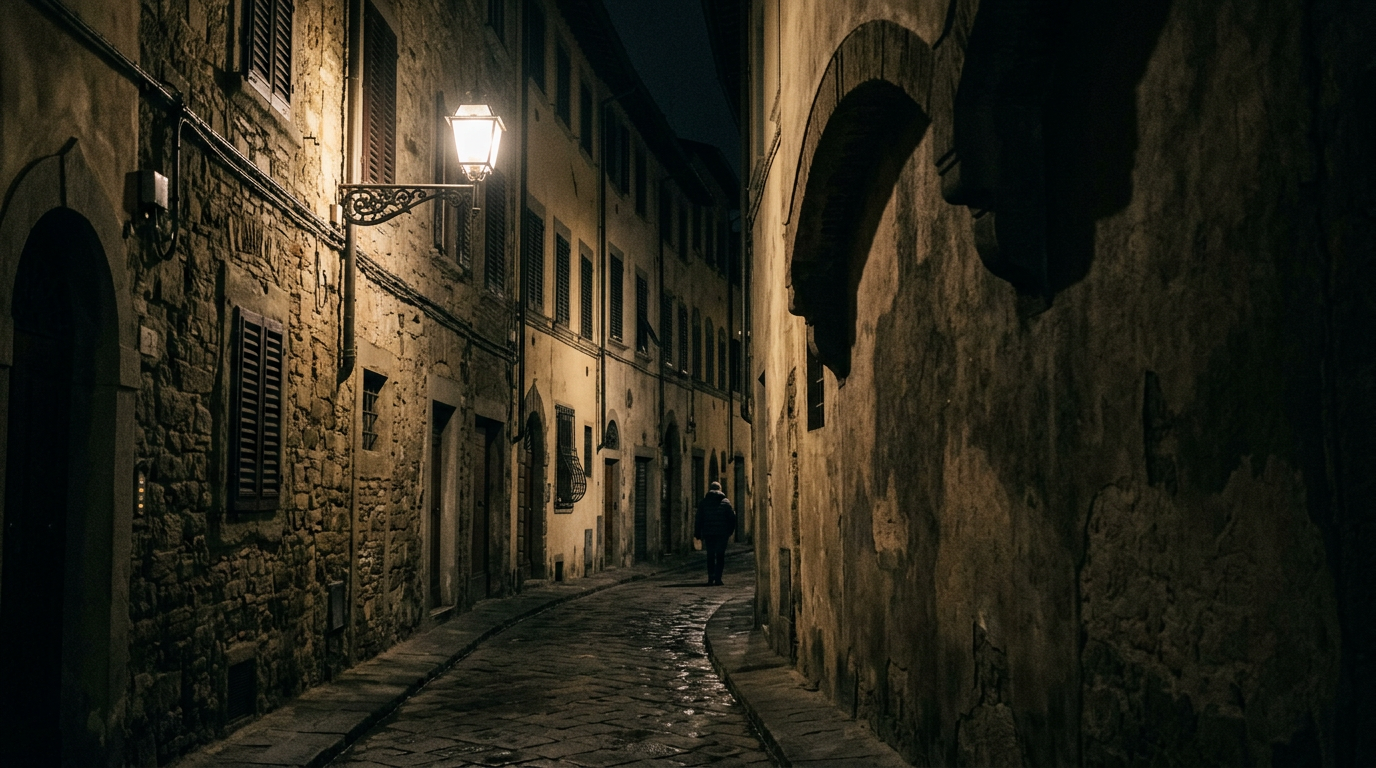
Walking Oltrarno after 9:00 pm, particularly the older streets between Via dei Bardi and Via dei Serragli, involves the same physical experience that generated these stories: stone walls with no windows at ground level, alleys wide enough for two people abreast, the sound of footsteps amplified by the buildings on both sides. The conditions that produced the legends are structurally unchanged.
Where to stay
The neighbourhood where the stories described here took shape is walkable in an evening. Palazzo Pitti, the Brancacci Chapel, the alley of the vellutini, and the former routes of the confraternities are all within fifteen minutes of each other. De’ Medici is in Oltrarno, in the neighbourhood where the physical context for these legends remains intact and where the streets after dark still carry something of the weight of history they have accumulated over eight centuries.