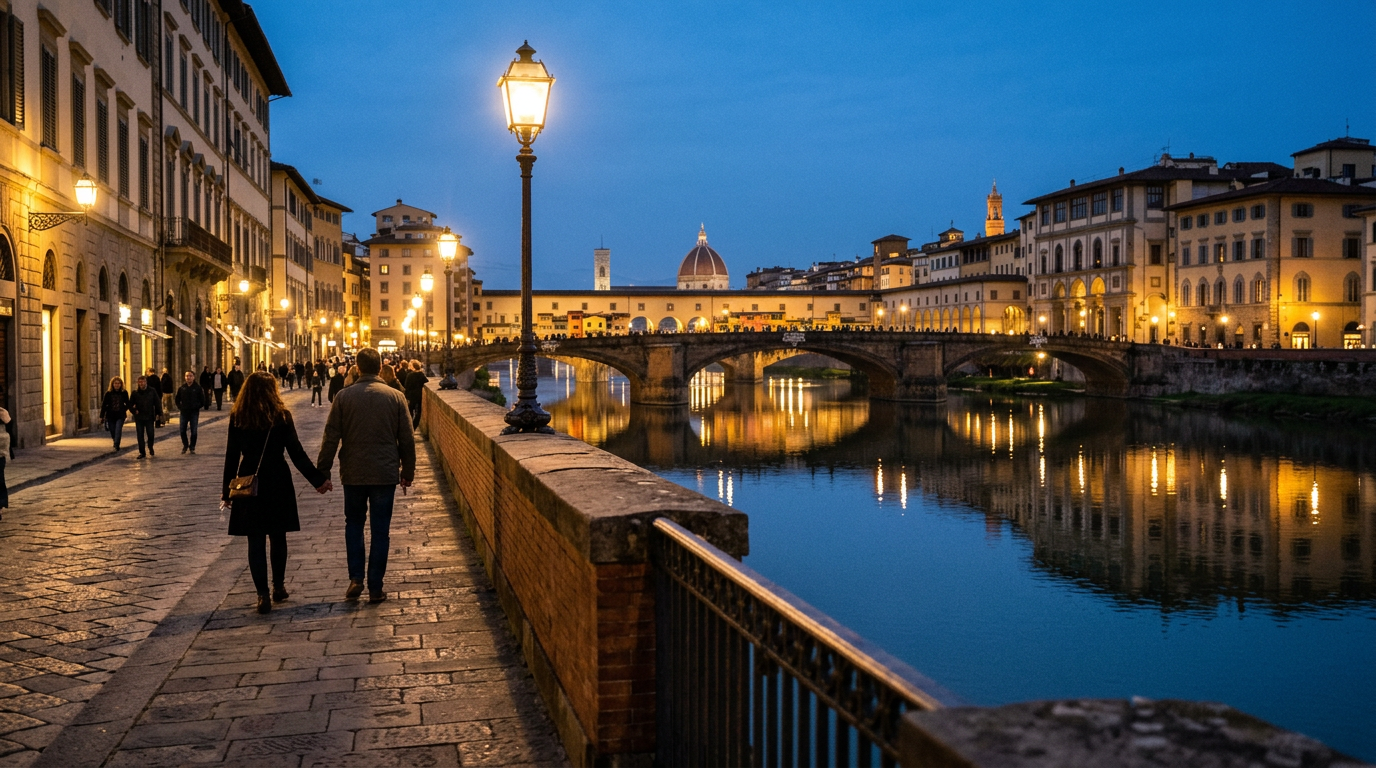
Evening walk along the Florence Lungarno: full guide
The Arno in the evening: what actually happens
Between June and October, the south bank of the Arno in Florence functions as a spontaneous public space from approximately 7:00 pm until midnight. The transformation is physical and social simultaneously. The stone of the Lungarno releases the heat stored from eight hours of direct sunlight, creating a narrow thermal band at street level that is warmer and more comfortable than the shaded streets one block back. The light shifts from white to amber starting around 7:30 pm, reaching its most intense angle at roughly 8:10 pm in July and 7:30 pm in September. At that moment, the Arno reflects the entire north bank facade, the 16th- and 17th-century palaces of Lungarno Corsini, the arcaded base of the Uffizi seen through the gap at Ponte Vecchio, at a colour temperature that no filter approximates.
The residents who appear at this hour are not the day’s tourist population, which is eating dinner by 7:00 pm in the restaurants north of the river. They are the people who live in Oltrarno and San Frediano: office workers finished for the day, older residents who have walked this stretch for decades, teenagers occupying sections of the low stone wall, parents with strollers moving slowly east from Ponte alle Grazie toward the wider pavement at Lungarno Serristori. The Lungarno belongs to different people in the evening than it does in the afternoon, and the difference is noticeable within minutes of arriving.
The specific stretches and what distinguishes them
Lungarno Torrigiani begins at Ponte Vecchio and runs east to Ponte alle Grazie, a distance of approximately 900 metres. The pavement here is at river level, separated from the water by a low iron railing. The buildings on the south side of the street are predominantly residential, inhabited palazzi from the 17th and 18th centuries, with no tourist commerce at street level. The dome of Santa Maria del Fiore is visible above the roofline on the north side. This is the central stretch of the south-bank walk: it sees the highest density of evening pedestrian traffic from among Oltrarno residents.
Lungarno Serristori continues east from Ponte alle Grazie toward Ponte San Niccolò, a further 600 metres. The pavement widens here. The low stone wall is broad enough to sit on comfortably, wide enough for two people side by side with space between. Groups of young residents occupy sections of the wall from 8:00 pm onwards. The view east from this section looks toward Ponte San Niccolò against the silhouette of the hills, with the water reflecting both bridges. By 9:30 pm in summer, the density of people sitting on the wall here is comparable to a park in good weather.
Lungarno Benvenuto Cellini runs east from Ponte alle Grazie along a narrower, tree-lined stretch where the pavement meets the embankment wall directly. Almost no tourists reach this section. The street becomes a proper neighbourhood road rather than a riverside promenade, and the trees, planted in the 20th century, create shade that makes the midday walk here possible too. Walking this section after dark, the sound of the river is more present and the lights of the north bank less prominent. It ends at the Piazza Poggi junction, where a stairway climbs to the Kaffeehaus pavilion and the Giardino delle Rose.
On the north bank, Lungarno Corsini, between Ponte Amerigo Vespucci and Ponte Santa Trinita, is the quieter and more architecturally significant stretch. The 17th-century palazzo facades here are largely intact. The pavement is wide. The north bank in general is more photographed and more touristed, but this specific stretch between the two bridges sees notably less commercial activity than the section near the Uffizi.
Where to drink: costs and locations
Locale Firenze on Lungarno delle Zecca Vecchia has a rooftop terrace one floor above the street with a direct sightline to Ponte Vecchio and the Arno. Spritz costs €9, prosecco by the glass €8. The terrace opens at 6:00 pm and reaches capacity quickly in summer, typically by 7:30 pm. If you arrive after 7:00 pm and find the terrace full, there is a waiting list system operated by the door staff. The terrace is worth the price once; the view at sunset justifies the premium.
Golden View Open Bar on Lungarno dei Tempi has occupied its riverside position for over twenty years. The interior is split-level with a terrace extending to the river wall. Wine by the glass starts at €6 to €7 for standard labels, €10 to €15 for better selections. The clientele is mixed: local regulars alongside visitors who found it in a guidebook. The food menu is competent but not the reason to come.
For the lowest prices in the most local atmosphere, the Conad supermarket near Ponte alle Grazie sells canned beer (€1.50 to €2.50) and bottles of local wine from approximately €5. The purchase requires no pretence of being anything other than what it is: buying a drink and carrying it 200 metres to the broad wall at Lungarno Serristori. Dozens of people do exactly this every evening in summer. No one interprets it as unusual.
At Piazza Poggi, a seasonal kiosk positioned at the foot of the stairway to the Giardino delle Rose sells cold drinks from around €2.50 and operates until approximately 11:00 pm from May through September. The small square has benches and a direct view east along the Arno. It is well-known to residents and almost unknown to visitors.
How to structure the evening walk
Leave from central Oltrarno, Piazza Santo Spirito or Via dei Serragli, and walk south to the Lungarno, arriving at the corner of Ponte Vecchio at or just after 7:00 pm. Turn east and walk at whatever pace feels right, all the way to Piazza Poggi, which takes approximately twenty-five minutes without stopping. Stop once on the wall at Lungarno Serristori for fifteen minutes. Look west toward the setting sun. Look east toward Ponte San Niccolò.
Walk back west, this time on the river side of the street rather than the building side, a different perspective on the same route. Stop at a bar or buy something from the Conad and return to a section of wall. Stay until 9:30 pm or 10:00 pm. At this hour the light is entirely gone, the street lamps are reflected in the water, and the temperature has dropped to something comfortable.
Finish the evening by leaving the Lungarno and walking north one block into Oltrarno. Via dei Serragli, Borgo San Frediano, or Via Maggio each have multiple restaurants and wine bars open past 10:00 pm. These streets are five minutes from the river and have a completely different character: narrow, neighbourhood-scale, with the sound of cooking and conversation rather than the open air and water of the Lungarno.
The walk as described covers roughly 3 kilometres in total, takes about two hours with stops, and costs between €0 and €18 depending on where you drink. It requires no booking, no reservation, and no knowledge of Italian beyond the ability to say what you want from a bar.
Where to stay
The south-bank Lungarno begins, functionally, at the residential streets of Oltrarno that feed directly into it. To arrive at Ponte Vecchio for the 7:00 pm light, you need to be south of the Arno to begin with. De’ Medici is in Oltrarno, less than five minutes on foot from Lungarno Torrigiani, which means the evening walk is accessible without any logistics.