Hidden facts about the Medici in Florence
The Medici were not aristocrats
This is the central fact about the Medici that popular accounts consistently obscure. The family’s origins were in wool trading and money-changing. Giovanni di Bicci de’ Medici (1360–1429) established the bank that made the family wealthy; his son Cosimo il Vecchio (1389–1464) expanded it into the leading financial institution in Europe, with branches in sixteen cities. Neither man held a title. Cosimo’s political authority in Florence was real and comprehensive, but it was exercised through the mechanisms of the republic, stacking electoral committees, controlling who was selected for which office, maintaining a network of personal obligations, rather than through formal rank.
The family’s eventual acquisition of titles, Lorenzo II received the title of Duke of Urbino from Pope Leo X (himself a Medici) in 1516, and Alessandro became Duke of Florence in 1532, came two generations after the height of their cultural patronage. Cosimo I received the title of Grand Duke of Tuscany from Pope Pius V in 1569. By that point, the family had been the effective rulers of Florence for over a century, but their original social position was that of wealthy merchants, not hereditary nobles. The distinction matters because it shaped how they understood and deployed cultural patronage: not as a birthright of the ruling class but as a competitive strategy in a city where multiple powerful families were doing the same thing.
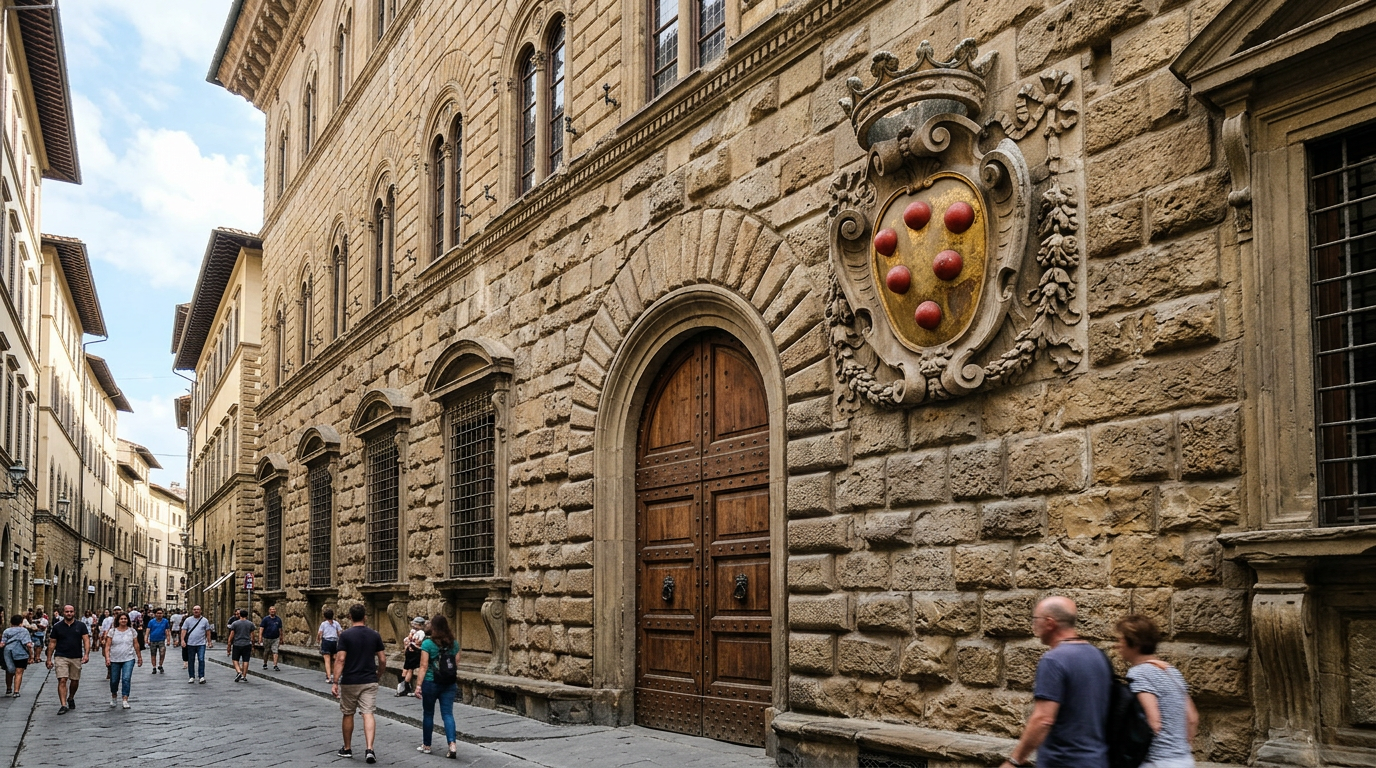
The name itself encodes this origin. De’ Medici uses the Italian partitive genitive, “of the Medici family group”, a grammatical construction more common for surnames derived from professions or associations than for noble titles. The six balls on their coat of arms have been interpreted variously as pills (referencing the medical origin of the family name, medici meaning physicians), as bezants (gold coins, referencing banking), and as an older heraldic device. No single interpretation is authoritative.
What the Medici actually collected
The Uffizi Gallery contains approximately 3,000 paintings. Of these, roughly 2,000 have their origins in the Medici collection. The collection was not assembled according to an aesthetic programme but through the accumulation of multiple distinct processes: purchase, commission, gift, loan security from clients who defaulted, diplomatic exchange, and inheritance.
Lorenzo il Magnifico’s personal collection was focused on antiquities rather than paintings. His holdings in ancient gems, cameos, and carved hardstone vessels were the most significant in Florence and had direct influence on the work of artists given access to them. Michelangelo lived in the Medici household between 1489 and 1492, with daily access to the objects in Lorenzo’s collection. The influence on his understanding of classical form and his feel for material surface is documented by the Anonimo Gaddiano, an early biographical source.
The Lapis Lazuli Vase in the Uffizi, a Roman cameo glass vessel in blue and white with the initials LAUR MED scratched on the base, is the most tangible surviving object from Lorenzo’s personal use. He inscribed his name on it in the same way that he inscribed the manuscripts in his library: as ownership marks that communicated both possession and deep personal attachment. The object is not displayed prominently; it requires seeking out in the Goldsmith’s work room.
Cardinal Leopoldo de’ Medici (1617–1675), the brother of Ferdinando II, began systematically collecting artists’ self-portraits in the 1660s and 1670s by writing directly to the leading painters of the day, Rembrandt, Velázquez, Nicolas Poussin, requesting their likenesses. The collection of self-portraits now in the Vasarian Corridor is the most significant in the world specifically because of Leopoldo’s methodical correspondence campaign and because Anna Maria Luisa’s 1743 bequest kept it in Florence.
Patrons who were not Medici
The identification of Florentine Renaissance art entirely with Medici patronage erases significant contributions from other families. Domenico Ghirlandaio’s fresco cycle in the Tornabuoni Chapel of Santa Maria Novella (1485–1490) is one of the most extensive and technically accomplished painting commissions of the Quattrocento. It was paid for by Giovanni Tornabuoni, head of the Roman branch of the Medici bank, but as a private commission, in his own name, for his family chapel. The young Michelangelo was working in Ghirlandaio’s workshop during part of the execution period, almost certainly involved in minor portions of the painting.
Leon Battista Alberti designed the marble facade of Santa Maria Novella for the Rucellai family, completed in 1470. The commission came from Giovanni Rucellai, a wealthy cloth merchant who had read Alberti’s treatise on architecture and wanted a facade that demonstrated the application of classical proportional theory to a real building. The facade is the first in Florence to deploy a complete system of classical pilasters across multiple storeys in a harmonious geometric grid. The Medici had nothing to do with it.
Filippo Strozzi began construction of Palazzo Strozzi in 1489, the same year Lorenzo il Magnifico was at the height of his influence. The palace, designed by Giuliano da Sangallo and Benedetto da Maiano, was explicitly conceived to rival and exceed Palazzo Medici in scale and architectural ambition. Florentine patronage was a competitive field. The Medici participated vigorously, but they did not define its terms alone.
The dynasty’s most consequential and least celebrated member
Anna Maria Luisa de’ Medici was born in 1667, the daughter of Cosimo III, the last Grand Duke before the male line ended. She married Johann Wilhelm, Elector Palatine, in 1691 and spent two decades at the court of Düsseldorf before returning to Florence after his death in 1716. She spent the remaining twenty-seven years of her life in Palazzo Pitti, the last Medici in the palace her ancestor Cosimo I had occupied in 1549.
When she died on 18 February 1743, she left the entire Medici art collection, paintings, sculpture, archives, gems, scientific instruments, furniture, and decorative arts accumulated over three centuries, to the city of Florence through a deed called the Patto di Famiglia, executed in 1737. The deed contained a specific condition: nothing could be removed from Florence or from the state of Tuscany. The collection was effectively nationalized and made permanently local.
The deed was negotiated with the Habsburg-Lorraine dynasty that had already agreed to succeed the Medici as rulers of Tuscany. Without it, the new dynasty would have been legally entitled to distribute the collection according to its own interests, selling it, transferring it to Vienna, or breaking it up among family members. This is what happened to comparable collections elsewhere in Europe after dynastic extinctions. Florence’s museums exist in their current form because of this single legal document and the woman who insisted on it.
Where to visit the Medici legacy in Florence
Palazzo Medici Riccardi on Via Cavour 3 was the family’s primary residence from 1444 to 1540, when Cosimo I moved to Palazzo Vecchio. The Cappella dei Magi, on the first floor, contains Benozzo Gozzoli’s fresco cycle painted between 1459 and 1461: a procession of the Magi that contains portraits of the Medici family and their allies. Entry costs €10; open Monday to Sunday except Wednesday, 9:00 am to 7:00 pm.
The Cappelle Medicee at San Lorenzo contain Michelangelo’s New Sacristy (begun 1520), with the tombs of Lorenzo, Duke of Urbino, and Giuliano, Duke of Nemours. The allegorical figures on the tombs, Dawn and Dusk on Lorenzo’s, Day and Night on Giuliano’s, remain among the most discussed sculptural works in the world. Entry costs €9; open Tuesday to Saturday, 8:15 am to 1:50 pm.
Palazzo Pitti and the Boboli Garden represent the dynasty’s final and most extensive architectural investment. Cosimo I moved here in 1549; the building continued to expand until the 18th century. The combined ticket for the palace and garden costs €22 in 2026 and covers the Palatine Gallery, the Treasure of the Grand Dukes, the Gallery of Modern Art, the Boboli Garden, the Porcelain Museum, and the Costume Gallery.
Where to stay
The architecture of Oltrarno, its 16th- and 17th-century palazzi, its churches, its hillside gardens, was built by families who followed the Medici Grand Dukes to the south bank and wanted proximity to power. The neighbourhood is the most direct physical context for understanding what the dynasty actually built. De’ Medici is positioned in Oltrarno, steps from Palazzo Pitti, the neighbourhood where the Grand Ducal court established its centre for over two hundred years.