Florence Sunday antique market: complete guide
Florence as an antique market city
The material conditions that make Florence exceptional for antiques are structural, not accidental. Six centuries of concentrated wealth, Medici banking, grand-ducal court culture, 19th-century aristocratic households, produced an enormous quantity of high-quality domestic objects: silverware, furniture, ceramics, textiles, prints, paintings, instruments, and documents. That accumulation was distributed through the markets slowly and continuously as estates were divided, fortunes changed, and families left the city. The result is a supply pipeline that has not been exhausted despite decades of international dealing.
Florence is also a city where provenance is often traceable. The Florentine state archive, one of the most complete in Italy, contains household inventories, notarial records, and merchant accounts dating back to the 13th century. A serious dealer can sometimes document where a piece has been for the past three hundred years. This traceability adds value and separates the serious end of the Florence market from comparable markets in cities with thinner historical records.
The practical consequence for a buyer is that Florence rewards preparation. Knowing what you are looking for, what genuine examples look like, and what the market price range is for your category gives you a significant advantage over arriving without a plan and browsing for something appealing.
The second-Sunday market at Piazza Santo Spirito
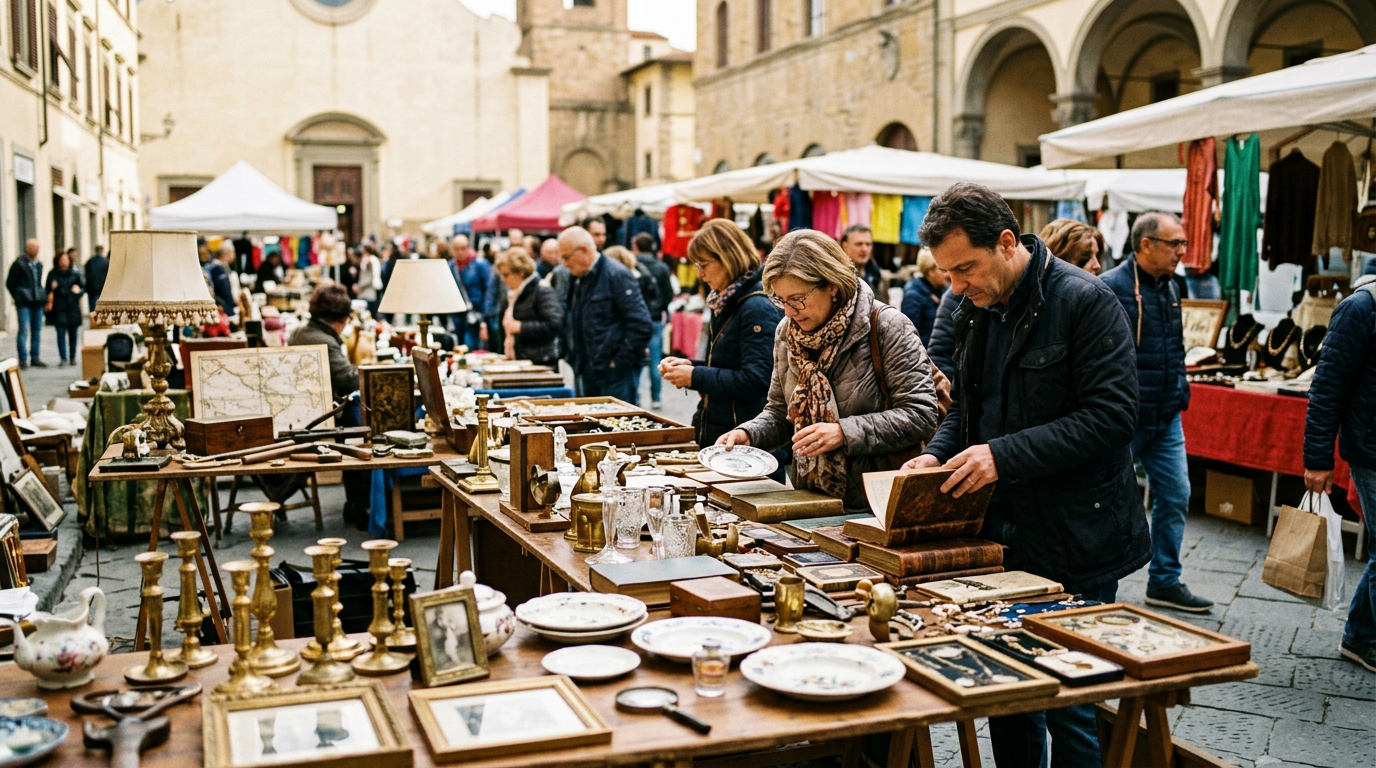
The antique market held in Piazza Santo Spirito occupies the north and central sections of the square on the second Sunday of every month. Stalls set up from 8:00 am and pack down between 1:30 pm and 2:00 pm. On the same Sunday, an organic food market fills the southern end of the square, with producers from the Chianti, the Casentino, and the Valdarno selling cheese, cured meats, honey, wine, and vegetables.
Between forty and sixty dealers attend on a typical second Sunday. Categories covered include: prints and maps, silverware, ceramics and majolica, jewellery, linen and embroidered textiles, books and ephemera, small furniture and decorative objects, glass, and militaria. The chronological range runs from the 17th century through the 1970s. Quality is uneven across the stalls and requires direct evaluation.
The dealers who set up regularly in the northern section of the square, nearest the facade of Santo Spirito, tend to specialise more narrowly and price more accurately than the generalists toward the centre. Specialists in Tuscan ceramics, or in 18th-century Florentine silverwork, will know their material and will not misprice it significantly in either direction. Generalists, who buy from estate clearances in bulk, sometimes carry exceptional pieces at low prices alongside mediocre ones at inflated prices, because they cannot evaluate everything they sell.
Arriving at 9:00 am gives you access to the best pieces before the crowd arrives at 10:30 am. The most experienced buyers in Florence are at the stalls by 8:30 am. Arriving at 11:00 am means the market is full but the best objects have already moved.
Via Maggio, running south from the Lungarno toward Piazza Santo Spirito, is the city’s principal street of established antique dealers. Most shops open on Sunday mornings from 10:00 am. Walking the street after the market and examining window displays, or entering shops, extends the experience from an hour to a half-day.
The Piazza dei Ciompi flea market
Piazza dei Ciompi is a small square in the Sant’Ambrogio neighbourhood, approximately 1.2 kilometres northeast of Ponte Vecchio on the north side of the Arno. The permanent flea market here has operated since the 1960s. It runs Tuesday to Sunday from roughly 9:00 am to 7:00 pm; Monday most stalls are closed.
The price range is significantly lower than at Santo Spirito. Common categories include: second-hand books in Italian and other languages, Soviet-era and East European mechanical watches (€20 to €150 depending on movement and condition), vintage clothing from the 1950s through the 1980s, postcards and old photographs, kitchenware, small tools, electrical components, and decorative objects from the post-war decades.
The last Sunday of each month, the market expands substantially. Additional dealers arrive from outside the city and set up in the streets surrounding the square, Borgo La Croce and Via Pietrapiana. The expanded market includes larger furniture, framed pictures, and more valuable objects that the regular permanent stallholders do not carry.
The nearby Mercato di Sant’Ambrogio, open Monday to Saturday mornings, is one of the best daily food markets in Florence. Combining a visit to the Ciompi stalls with breakfast or lunch from the Sant’Ambrogio market is a straightforward Florentine morning. Trattoria da Rocco inside the market building serves simple, inexpensive cooked lunches, pasta, secondi, contorni, for under €12 per person. It fills up from 12:00 pm and runs out of food by 1:30 pm.
Bargaining: the actual protocol
Bargaining is expected at outdoor market stalls, at Santo Spirito, at Ciompi, and at the expanded last-Sunday version of Ciompi. At established antique shops on Via Maggio, negotiation is possible but handled differently: not at a market stall, with a quick exchange of offers, but in a more deliberate conversation that implies you are a serious buyer and have done your research.
At a stall, the sequence is: ask the price, pause, offer 70 to 80 percent of it. If the dealer accepts immediately, you have not necessarily done something wrong, they set the price and you negotiated from it. If they counter, agree on a number between your offer and their counter. Two exchanges is normal. Three is the maximum before the negotiation becomes uncomfortable.
Buying two or more items from the same stall in a single transaction gives you leverage to reduce individual prices, because the dealer prefers to move multiple items. This works reliably. Suggesting that a piece is overpriced or damaged in order to reduce the price is not effective and will make the dealer unwilling to negotiate at all. The Italian antique market tradition treats this as bad manners. Approach from a position of appreciation, not depreciation.
Cash is the medium of exchange. Cards are sometimes accepted at established dealers but never at outdoor market stalls. Having small denominations helps: offering a €50 note for a €22 object at a small stall is genuinely inconvenient for the seller.
What to buy and what to leave
Printed maps and topographic engravings are among the best value categories in Florence. The city was a centre of cartographic production from the 16th century, and maps of Tuscany, Florence, Rome, and the cities of the grand duchy circulate consistently through the markets. A genuine 18th-century engraved map of Florence, with good printing and some original colour, costs between €40 and €120 at Santo Spirito depending on size and condition. The same object in a specialist shop on Via Maggio would start at €150.
Sterling silver is assessed by weight plus a dealer margin. Italian silver from the 19th century through the 1950s is typically marked with two stamps: the metal purity mark (800, 925, or the fascist-era tower mark indicating 800 fineness) and the maker’s cartouche. If both are absent on a piece described as silver, the metal is plated. Ask to look at the back of the piece in good light before buying.
Tuscan majolica, the glazed ceramic production of Montelupo Fiorentino, 25 kilometres west of Florence, and of the Florence workshops, is a reliable purchase category if you stick to early 20th-century and pre-1960 pieces rather than the reproduction work sold alongside it. Genuine pieces show crazing in the glaze, slight irregularities in the painted decoration, and wear on the base that cannot be faked convincingly.
Avoid oil paintings unless you know the field well. The supply in Florence includes genuine works of various periods, period reproductions made as originals, and modern reproductions made for the tourist trade. The risks are high and the expertise required to navigate them is substantial.
Where to stay
Piazza Santo Spirito and its second-Sunday antique market are at the centre of Oltrarno, a neighbourhood that has been a continuous market and craft district since the medieval period. Via Maggio’s antique shops are five minutes’ walk from the square. De’ Medici is in Oltrarno, positioned so that the 9:00 am start at the second-Sunday market requires walking three minutes from the door.