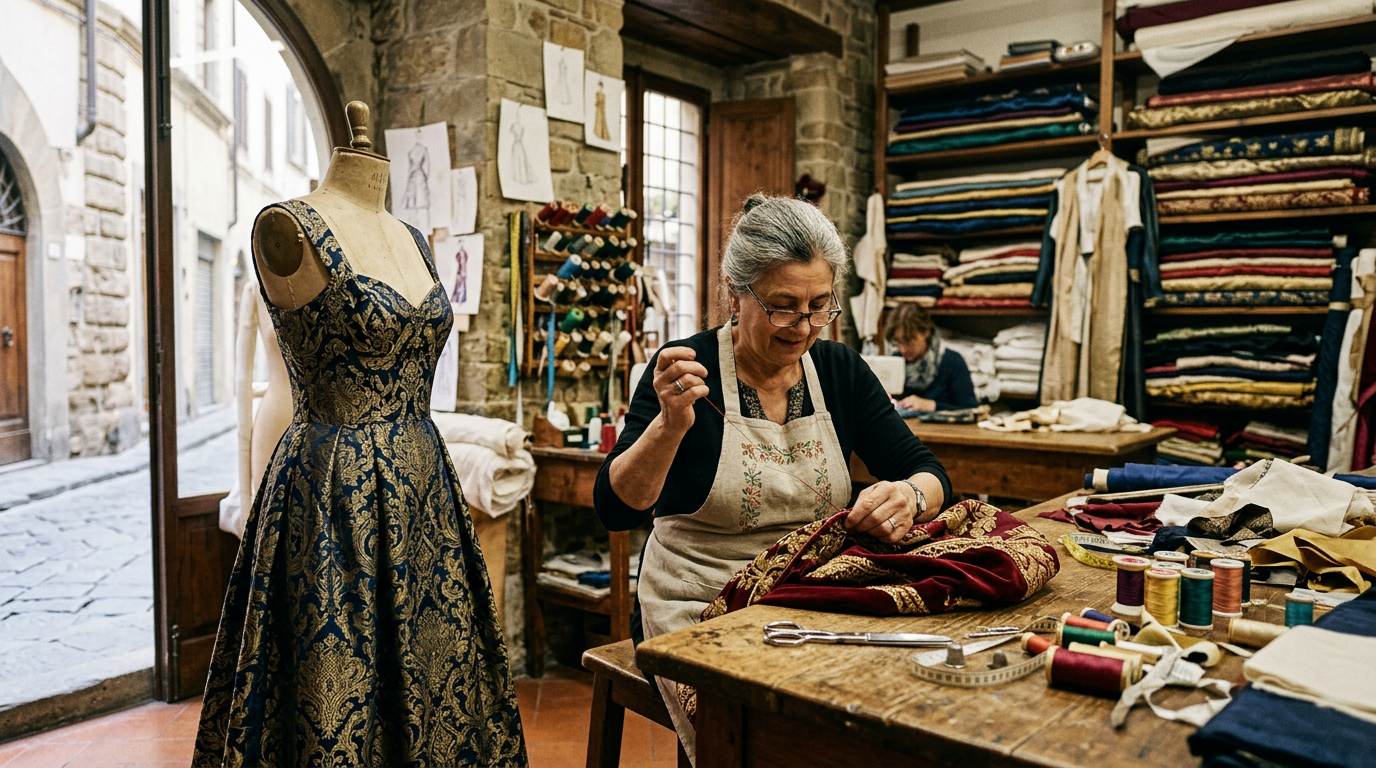
Artisan fashion in Florence: tailors and local designers
Florence before Milan: the historical context
The common assumption that Italian fashion has always been centred in Milan ignores the specific history of the 1950s. Giovanni Battista Giorgini, a Florentine entrepreneur with connections to American department stores, organised the first coordinated presentation of Italian fashion at Villa Torrigiani on Via de’ Tornabuoni in February 1951. The buyers from Bergdorf Goodman, Saks Fifth Avenue, and I. Magnin who attended went on to place the orders that launched Italian ready-to-wear internationally. Florence was the original international address of Italian style for a decade before the industry migrated to Milan.
That window closed in the early 1960s when the larger Milanese manufacturing base and more aggressive commercial infrastructure pulled the industry north. What remained in Florence was a different tradition: the sartoria, the workshop producing single garments for individual clients using traditional cutting and construction techniques that have no industrial equivalent. This tradition predates the 1950s by centuries. The Arte della Lana and the Arte della Seta, the medieval wool and silk guilds, were among the most technically sophisticated craft organisations in Europe. Their accumulated knowledge of fibre, dyeing, weaving, and finishing shaped the context in which Florentine tailoring developed.
That context still exists. Florence has working tailors who cut full bespoke patterns from scratch, maintain client records across decades, and produce garments whose construction methods, canvas interlining, hand-padstitching, hand-sewn buttonholes, are unchanged from the methods described in 18th-century tailoring manuals. These workshops do not rely on tourists and do not advertise prominently. Finding them requires effort, but the effort is proportional to the quality of the result.
Historic sartorie: what to know before visiting
A full bespoke suit in a Florentine sartoria requires three to four fittings. The first establishes body measurements and posture analysis. The second, at the basting stage, is a fitting in the garment’s rough assembled form, before the lining is inserted. The third is a fitting after the main construction is complete but before final pressing and finishing. A fourth fitting, while not always necessary, allows minor adjustments after the garment has settled. Total elapsed time from first fitting to collection: eight to twelve weeks.
The total investment for a full bespoke suit, two-piece, from a fabric specified by the client, ranges from €1,200 at the entry level of serious Florentine tailoring to €4,000 for the most established names with international waiting lists. The price range reflects the cost of the fabric (typically €25 to €80 per metre for suit weight cloth, requiring four to five metres), the time invested in cutting and construction, and the reputation of the maker. The entry-level suit at €1,200 is not a compromise on construction quality; it is a reflection of lower overhead and smaller reputation premium.
Semi-bespoke, in which an existing house pattern is modified to the client’s measurements, is less expensive and faster. A semi-bespoke jacket costs between €400 and €900. The fit is not as precise as full bespoke because the structural geometry of the pattern is not rebuilt from the individual body, but the result is significantly better than any ready-to-wear garment. Two to three fittings over four to six weeks.
The established tailors in the historic centre, most concentrated on Via dei Serragli, Via Maggio, and the streets around Via de’ Tornabuoni, are not well represented in online search results. Florentine families who use them have done so for generations; the relationship is maintained through personal contact. The most effective way to locate a good traditional sartoria is to ask at a high-quality local hotel, a menswear shop not oriented toward tourism, or a barber in the Oltrarno or Santa Croce neighbourhoods.
Emerging designers in Oltrarno: the current situation
The past decade has produced a visible cluster of younger independent designers in Oltrarno, concentrated along Borgo San Frediano, Via dei Serragli, and the streets connecting them to Piazza del Carmine. These are not boutiques in the commercial sense. They are production studios with a retail component: the designer works on the premises, sells from a selection of ready pieces, and accepts commissions for custom work.
The production scale is deliberately small, limited runs of ten to thirty units per style, which puts each piece close to handmade regardless of whether it technically qualifies as bespoke. Fabrics are typically sourced from the Prato textile district, 18 kilometres northwest of Florence, which has been producing quality cloth for European designers since the medieval period and currently supplies fabric to Italian and international fashion houses alongside independent designers. Several Oltrarno studios source directly from specific Prato mills, sometimes working with mills to produce fabric to their own specifications at minimum quantities of fifty metres.
The aesthetic common to these studios is difficult to generalise, but a few tendencies recur: natural fibres as a default (linen, wool, silk, cotton), cuts that prioritise fit over fashion seasonality, minimal branding, and production that can be tracked to a specific maker. Prices reflect the real cost of this production model: a jacket from an Oltrarno independent designer costs between €350 and €900, depending on the fabric and complexity. This is more than a comparable H&M piece and less than a comparable item from a designer brand using the same production methods under a larger marketing budget.
Commissioning bespoke work: the practical process
The first requirement is knowing what you want. A shirt, a jacket, and a full suit are different investments in time and money; discussing them as abstract possibilities without a specific objective wastes everyone’s time. Decide in advance what you need, what occasion it is for, and what your constraints are on time and budget. This information allows the tailor to tell you immediately whether what you want is achievable.
Contact before you visit. Italian craftspeople work by appointment. Walking into a sartoria unannounced is technically possible but implies a lack of seriousness that starts the relationship poorly. An email or phone call the day before, explaining what you want and asking whether a brief initial consultation is possible, is the correct approach. Most tailors will respond within twenty-four hours.
At the first meeting, bring physical fabric samples or reference images if you have preferences. These are not required but accelerate the conversation past general description. Discuss the fabric weight and weave for the application you have in mind, a jacket worn in July in Florence requires different cloth than one worn in November in London. A knowledgeable tailor will guide the discussion if your requirements are unclear; a good tailor does not simply execute instructions but contributes professional judgment about what will and will not work.
The fitting process cannot be compressed. Bespoke work requires physical presence at multiple stages. If you cannot return to Florence for all fittings, discuss this directly at the first meeting. Some tailors have experience working with international clients who make two visits, one at the beginning and one at collection, and accept intermediate feedback by photograph and video. Others require physical presence at each fitting stage and will not compromise on this. Know which category your tailor falls into before committing.
What things cost in 2026
A bespoke shirt from a Florentine sartoria: €150 to €400, depending on the cotton quality (poplin, sea island, Egyptian long-staple), the number of fittings, and the maker’s standing. Production time: four to six weeks. This is a fundamentally different object from an off-the-shelf shirt, the collar, cuff, and placket are cut to your specific dimensions and posture, but the visual difference to an observer is subtle. The benefit is entirely felt by the wearer.
A bespoke jacket: €600 to €2,000. Production time: eight to twelve weeks. A bespoke two-piece suit: €1,200 to €4,000. For both, the fabric cost is included in the quoted price at most Florence tailors; some separate the fabric cost and quote construction only.
Semi-bespoke shirt: €80 to €200. Semi-bespoke jacket: €400 to €900. These are available from tailors who have developed house patterns adapted to common body types, which they then modify for the individual.
Commission from an independent Oltrarno designer: €120 to €900 for garments ranging from a blouse to a jacket, depending on the design and material. Production times vary; most accept commissions with a two- to four-week turnaround for pieces not requiring complex construction.
Where to stay
The working studios and commission-based fashion operations of Oltrarno are concentrated within a fifteen-minute walk of each other and of the historic-centre tailors on Via de’ Tornabuoni and Via dei Serragli. Commissioning bespoke work requires multiple visits to the same studio; staying in the neighbourhood makes the logistics of fitting appointments straightforward. De’ Medici is in Oltrarno, positioned between the independent designers of Borgo San Frediano and the established tailors of the historic centre.