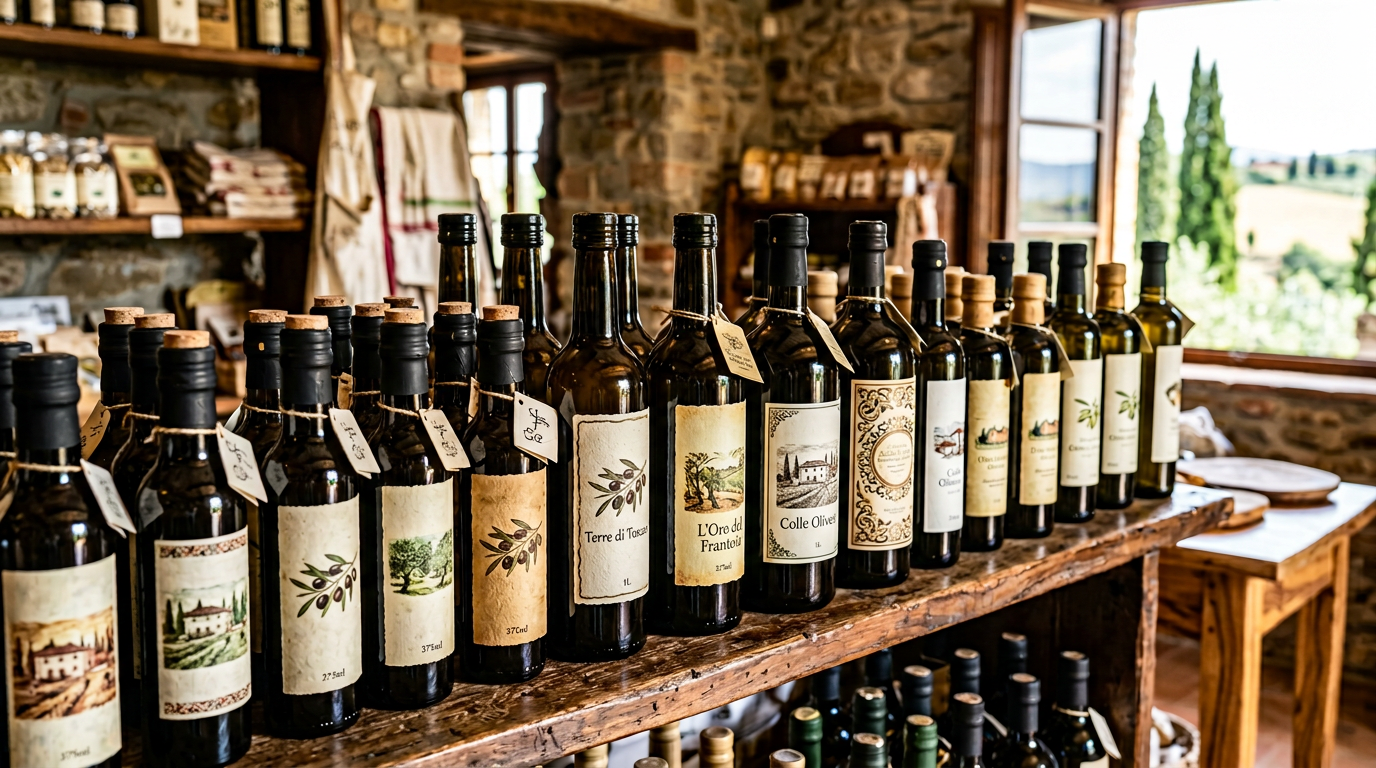
How to buy extra virgin olive oil well in Florence
Why Tuscan oil tastes the way it does
Tuscany produces extra virgin olive oil with a chemical and sensory profile that diverges substantially from oils made in southern Italy, Spain, or Greece. Three factors account for the difference: varietal composition, harvest timing, and processing speed.
The dominant varieties in Tuscany are Frantoio, Moraiolo, and Leccino. Frantoio and Moraiolo, in particular, produce oils with high polyphenol concentrations, the bitter, pungent compounds responsible for the characteristic bite at the back of the throat that Tuscan oil delivers in ways that oils from warmer, drier climates rarely do. Polyphenols are both the flavour compounds and the antioxidant agents of olive oil. The stinginess at the throat is not a defect; it is an indicator of freshness and of high-quality raw material. Oils that have lost their polyphenol intensity through age or poor storage taste flat and round by comparison.
Tuscan olives are also harvested early, before they reach full physiological maturity. Most Tuscan producers harvest from mid-October through early November, when the fruit is still turning from green to black. Early-harvest oil is greener in colour from chlorophyll, more bitter and pungent, and more intensely aromatic than oil from fully ripe fruit. The yield is lower, the olive contains less oil at this stage, but the quality of what is extracted is higher. Immediately after pressing, the raw oil is cloudy from suspended olive tissue and the natural wax of the skin. This cloudy state, which clears within weeks of pressing, is the olio nuovo that Florentines dress on grilled bread in November.
Processing speed matters because olive oil quality degrades rapidly after the fruit is harvested. Olives left in sacks for forty-eight hours after picking begin to ferment, which introduces flavour defects (fermented notes, vinegar-like aromas) that cannot be removed from the finished oil. Quality producers press within twenty-four hours of harvest, often within twelve. This requires on-site or very nearby milling capacity. The distance between grove and press is a practical quality indicator: a large commercial oil labelled “Product of Italy” with olives from five regions processed at a central industrial mill weeks after harvest is a different product from an oil pressed at a single estate’s own frantoio the same day.
Reading labels accurately
The label of a bottle of olive oil contains more usable information than most buyers extract from it. The most important elements to look for, in order of diagnostic value:
Harvest date: a specific month and year of harvest (not “best before” alone). Good producers list this prominently because freshness is their competitive advantage. Extra virgin olive oil at twelve months from pressing retains most of its character. At eighteen months it is declining. At twenty-four months it has lost the aromatics and much of the polyphenol intensity that justified buying it in the first place. If the label shows only a best-before date two years from now, the oil could be twelve months old already.
DOP Toscano: the Protected Designation of Origin for Tuscan olive oil guarantees that the olives were grown and processed within the Tuscany region. It is a geographic minimum, not a quality ceiling. Some DOP Toscano oils are exceptional; others are merely acceptable. But DOP eliminates the oils blended from cheaper material outside the region, which make up the majority of what is sold as “Italian olive oil” in export markets.
Single estate or named producer: an oil that names a specific farm and lists the olive varieties used is traceable to a specific source. A labelled oil from “Tenuta di Nozzole, Greve in Chianti, Frantoio and Moraiolo 80%, Leccino 20%, harvested October 2025” tells you something specific. A generic label saying “Tuscan extra virgin olive oil” with no farm name tells you almost nothing beyond the geographic origin.
Smell and taste: if the shop allows it, and serious oil shops should, smell the oil from an open bottle before buying. Quality Tuscan extra virgin has a recognisable aromatic profile: fresh-cut grass, artichoke, green tomato skin, almonds. The aromatic compounds that create these impressions are volatile and fade over time. An oil that smells of nothing, or smells stale, is past its best regardless of what the label claims.
Where to buy in Florence
The Oltrarno neighbourhood has several alimentari and specialty food shops on Via dei Serragli and Via Sant’Agostino that stock oils sourced from producers the owners know directly. These shops are small, their turnover is modest, and they tend to carry a limited selection that is replaced seasonally. This is the best practical arrangement for a buyer: the shops know their stock, the oil is fresh, and you can ask specific questions about the producer. Prices are typically €15 to €28 per litre for quality DOP Toscano oils in these shops.
For a wider selection, the area around the Mercato Centrale on the north side of the Arno has a concentration of specialty food shops. Competition keeps prices slightly lower here than in tourist-facing shops. Several shops near the market carry oils from different Tuscan zones, Chianti Classico, the Valdarno, the Lucchesia, the hills around Siena, which allows comparison between regional styles within the same broad Tuscan category.
The most direct route to the best oil is visiting a working frantoio during or just after the harvest in October and November. The Frantoio di Santa Tea in Reggello, 30 kilometres southeast of Florence via the Valdarno, is one of the largest and most technically sophisticated mills in the region and sells directly. The Frantoio Franci, in Montenero d’Orcia in the Maremma (approximately 150 kilometres south of Florence), produces oil regularly cited by specialist publications as among the finest in Italy. A visit during the harvest period, olives being weighed in, centrifuges running, the smell of pressed fruit filling the mill, is an experience with no equivalent in a shop.
What to take home: formats and logistics
The 500-millilitre tin is the most travel-practical format. Tins are opaque (light degrades oil), impact-resistant, and fit easily in checked luggage. A 500-millilitre tin of quality DOP Toscano oil weighs approximately 700 grams packed. A litre tin is heavier but more economical per unit of oil.
Glass bottles in 500- and 750-millilitre sizes are more common in shops and are fine for travel if packed with care. The practical procedure: wrap each bottle in several layers of clothing, place at the centre of a soft bag, and put the whole wrapped bundle inside a sealed zip-lock bag in case of breakage. Dark glass is better than clear glass; if your chosen oil comes in a clear bottle, store it away from light once you are home.
Price reference for 2026: a litre of quality Tuscan extra virgin from a specialist shop or direct from a producer costs €15 to €35. The same oil from a tourist shop near the Duomo costs €35 to €50. The oil in the bottle is identical. The variable is the location’s overhead and the margin extracted from buyers who have not done any comparison. A 250-millilitre tasting-size bottle from a known producer costs €8 to €18 and is a practical way to try a specific oil before committing to a larger format.
The 5-litre tin is used by professional kitchens and serious home cooks. A 5-litre tin of estate-bottled DOP Toscano costs €60 to €120 directly from a producer or at a specialist shop. The value per litre is the best available format, but the logistics of transport require checking and careful packing. Producers who sell direct often offer shipping for orders above a minimum, which may be more practical than transporting the tin yourself.
Where to stay
The specialist food shops of Oltrarno, the neighbourhood’s small alimentari, the dedicated oil and wine retailers on Via dei Serragli, are the most convenient and most reliable source for genuine Tuscan olive oil bought at fair prices. They are not the only option, but they are the most immediate one for someone staying in the south bank neighbourhood. De’ Medici is in Oltrarno, close to the shops where local residents buy their oil, at prices that reflect the neighbourhood rather than the tourist economy.