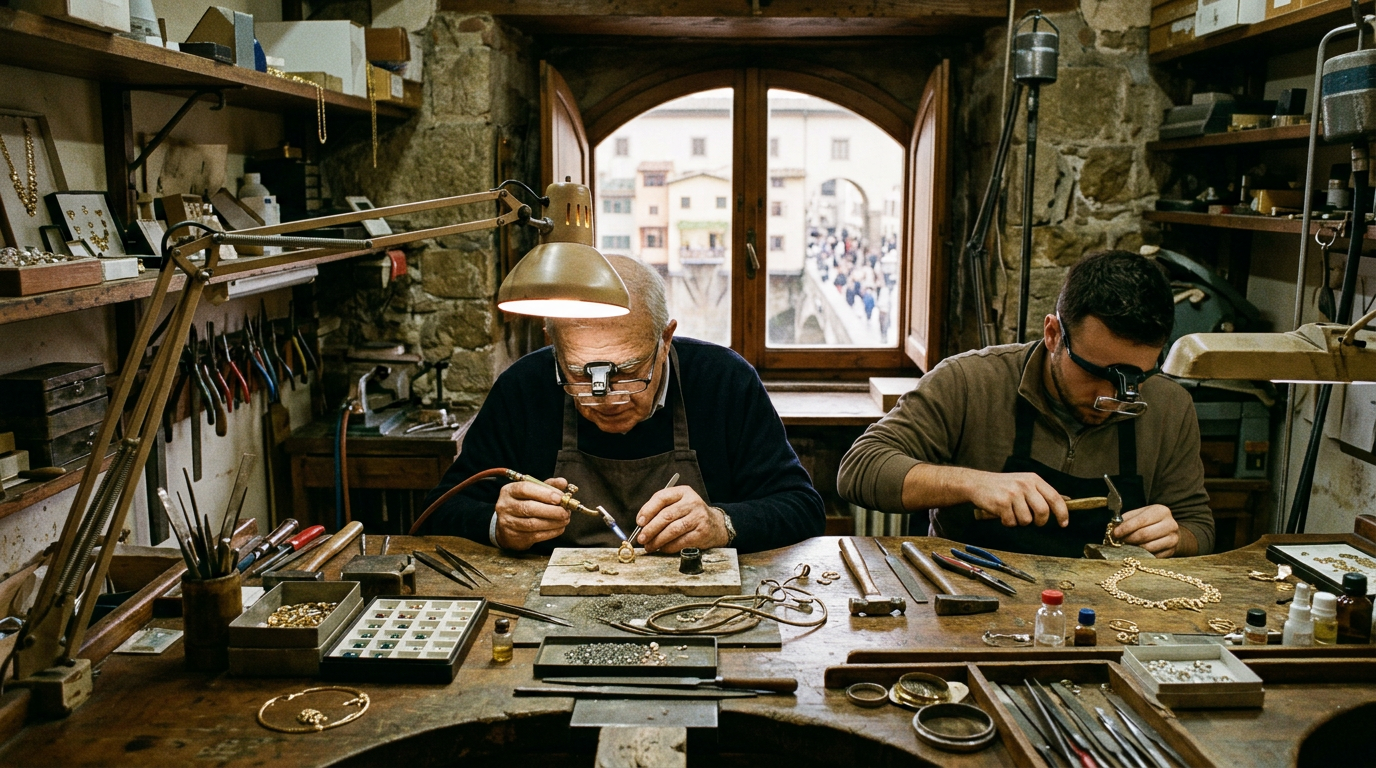
Florence goldsmiths: shops near Ponte Vecchio
Ponte Vecchio: the decision that shaped the bridge
For most of its medieval history, Ponte Vecchio was occupied by butchers, tanners, and fishmongers. The waste they generated, offal, curing brine, fish scraps, went directly into the Arno. In 1593, Grand Duke Ferdinando I de’ Medici issued a decree expelling all of them and reserving the bridge’s shop spaces for goldsmiths and jewellers. The official justification was the smell. The political logic was also real: goldsmiths who worked in precious materials on the most visible bridge in the city were easier to tax and supervise than the dispersed artisan trades they replaced. The Corridoio Vasariano, which Vasari had built along the top of the bridge in 1565 to allow Grand Ducal movement between Palazzo Vecchio and Palazzo Pitti, passed directly above the new tenants, a surveilling presence as much as a practical passage.
The arrangement established in 1593 has survived in form, if not in detail, for over four hundred years. The current occupants of the bridge’s shops are jewellers, but the character of the businesses ranges enormously. Some are working goldsmiths who cut, solder, set, and finish by hand in the spaces you can see through their windows. Others are retail operations selling industrially cast pieces at prices justified by the address rather than the production method. The visitor’s task is to distinguish between them.
The history behind the craft
Florence’s connection to precious metalwork precedes the bridge’s current configuration by several centuries. The Arte del Fabbro, the iron- and metalworkers’ guild, was one of the most significant trade organisations in medieval Florence. Gold and silver work were documented in the city from at least the 12th century, but the period of greatest international influence was the 15th century, when Florentine goldsmiths were supplying courts across Europe.
The goldsmith’s workshop in Renaissance Florence was not simply a production space. It was the primary training ground for artists before the term “artist” existed as a separate category. Lorenzo Ghiberti, who spent twenty-one years designing and casting the bronze doors of the Florence Baptistery between 1403 and 1424, began his career as a goldsmith. Andrea del Verrocchio, sculptor, painter, and teacher of Leonardo da Vinci, ran a goldsmithing workshop in Florence in the 1460s and 1470s. Benvenuto Cellini, the most famous goldsmith of the 16th century, left a first-person account of his Florentine training in his Autobiography, one of the most vivid documents of Renaissance workshop practice.
The specific techniques developed and refined in Florence include granulation, the application of tiny gold spheres to a surface, requiring an alloying and heating process that bonds them without solder flowing between them, and niello, the inlaying of a black sulfide alloy into engraved metal surfaces. These techniques require tools and skills distinct from standard bench jewellery work. A goldsmith who demonstrates genuine granulation or niello work is not improvising; they have spent years acquiring that specific competence.
Via Por Santa Maria and where to find working workshops
Via Por Santa Maria runs approximately 350 metres from Piazza della Repubblica south to the north entrance of Ponte Vecchio. Historically one of the main commercial streets in the city, connecting the cloth and silk markets to the bridge, it is now a luxury retail corridor. The ground-floor units house internationally known jewellery brands, smaller independent jewellers, and a few genuinely working goldsmiths.
The difference between a working goldsmith and a retail jeweller is observable before you enter. A working goldsmith’s space has a bench visible from the street or the door, with a flat or slightly inclined working surface, a series of tools arranged on a rack or in drawers (gravers, hammers, pliers, flex-shaft drill), and usually a small soldering torch within reach. The material smell of flux and metal is distinct from the neutral, air-conditioned atmosphere of a retail jewellery shop. If someone is bending over a bench when you look through the window, that is a craftsperson.
Moving off Ponte Vecchio onto Borgo Santi Apostoli to the west or onto Via Por Santa Maria itself reduces the rent gradient significantly. Shops on the bridge pay among the highest commercial rents in Florence; every piece they sell carries a corresponding location premium. The same quality of work, from a goldsmith in a first-floor workshop on Borgo Santi Apostoli, is priced differently because the overhead is lower.
Oltrarno, directly south of the bridge, also has working metalworkers on streets including Via Toscanella, Borgo San Jacopo, and Via dei Bardi. These are not tourist destinations and do not advertise themselves as such. They do occasional retail alongside commission work for local clients. A patient inquiry in these workshops often leads to a more direct relationship with a working craftsperson than is possible in any of the bridge-facing spaces.
Identifying handmade versus cast work
All precious metal objects sold in Italy are required by law to carry hallmarks. Italian hallmarks since 1968 consist of a purity stamp, 750 for 18-carat gold, 925 for sterling silver, 585 for 14-carat gold, and a maker’s mark identifying the producer. These marks are punched into the metal. Absence of hallmarks on a piece described as precious metal or “antique” should prompt questions; it does not always indicate a problem (antique pieces pre-dating the hallmarking regime exist and are legitimate), but it requires explanation.
Handmade fabricated jewellery differs from cast jewellery in ways that require close examination in good light to see clearly. Fabricated work is assembled from sheet metal, wire, and tube that has been cut, formed, and soldered together. The surfaces retain subtle tool marks, the slight planishing texture of a hammer, the fine scratches of a file, the radiused marks left by a burnisher. These are visible at a grazing angle. The forms have small intentional irregularities because they were made by a human hand against a reference template, not in a mould.
Cast jewellery starts from a wax model that is invested in plaster, burned out, and replaced with molten metal by centrifugal or vacuum casting. The surfaces are uniform in a way that fabricated work is not. The forms repeat exactly between multiple pieces because they come from the same mould. Cast work is not inferior jewellery, casting is the correct production method for complex organic forms, but it is not artisan handwork in the traditional sense, and the price should reflect the difference.
Ask directly: “Was this made in this workshop?” A genuine craftsperson will answer specifically and confidently, often explaining the process without being asked. A retailer selling cast production pieces may claim artisan origin they cannot substantiate. If the response is vague, treat that vagueness as information.
What commissions and purchases cost in 2026
A simple fabricated gold band ring from a working Florentine goldsmith, in 18-carat gold, with a plain polished finish: €120 to €300, depending on the weight of metal and the maker. The same ring with engraved surface decoration: €180 to €400. A ring incorporating filigree work, fine wire twisted and soldered into openwork patterns, requires additional skill and takes additional time: €200 to €600.
Silver jewellery is significantly lower in entry cost. A handmade sterling silver pendant, cut from sheet and finished by hand: €40 to €120. A silver ring with a bezel-set natural stone: €60 to €180. Silver is the appropriate entry point for buying from a genuine artisan workshop if budget is a constraint.
Custom commissions are the most direct form of engagement with the craft. The process involves a first conversation describing what you want, discussion of form, metal, stones if any, and dimensions, followed by production and collection. For a simple custom ring in 18-carat gold with no stone, the commission cost starts at approximately €300. For a piece incorporating a stone setting and surface decoration, expect a starting point of €600. For complex multi-part pieces, the goldsmith will price after understanding the full brief. Production time for a custom piece is typically one to two weeks for a simple ring and three to four weeks for more complex work.
For antique and period jewellery from the 18th through early 20th century, the dealers on Via Maggio in Oltrarno and in the antique market area near Piazza della Repubblica carry legitimate pieces. These require different knowledge to evaluate, hallmarking conventions, period construction techniques, natural versus synthetic stones, and are purchased on a different basis from contemporary craft work.
Where to stay
The workshop district connected to Ponte Vecchio extends south into Oltrarno, where working goldsmiths and metalworkers operate on the streets parallel to the Lungarno. The bridge itself is a five-minute walk from central Oltrarno. Via Por Santa Maria is two minutes further. De’ Medici is positioned in Oltrarno, in the neighbourhood where the craft’s production side is based, a short walk from the retail and workshop spaces of the bridge and the streets leading to it.