Where to find local food producers in Florence
What the land around Florence produces
Florence is an urban centre in the middle of an intensively farmed and forested landscape. Within 50 kilometres of the city, the range of agricultural production is unusual for a European metropolitan area of this size. Chianti wine, Brunello di Montalcino, and Vernaccia di San Gimignano are the most internationally recognised outputs. But the everyday agricultural economy of the region produces at a different scale and with a different character.
The Mugello valley, north of Florence across the Apennine ridge, is a bowl of cultivated land at around 300 metres elevation. Its cooler climate and heavier soils produce vegetables, potatoes in particular, with a density of flavour that distinguishes them from the irrigated market-garden vegetables available in supermarkets. Mugello potatoes are used in the better Florentine restaurants and are rarely sold in tourist shops. Finding them at a market stall run by a Mugello producer is the kind of contact the city’s formal retail system does not facilitate.
To the south, the olive groves of Chianti begin almost immediately outside the city boundary. The hills visible from Piazzale Michelangelo support groves that have been producing oil continuously for centuries. The first pressing of the new harvest, the olio novo or olio nuovo, arrives in November, bright green, intensely peppery, and available at the highest quality only for the first weeks before it begins to oxidise and settle.
Other products of the immediate territory include honey from the wooded hills between Florence and Pistoia, chestnut flour from the beech forests of the Mugello and Casentino, dried porcini from the same forests in September and October, and pecorino from the sheep farms of the Crete Senesi about 70 kilometres south. Lardo di Colonnata, cured fatback from the marble-quarrying town near Carrara, 100 kilometres northwest, is technically outside the Florentine agricultural zone but available at specialist stalls and shops throughout the city.
Farmers’ markets and direct-sale events
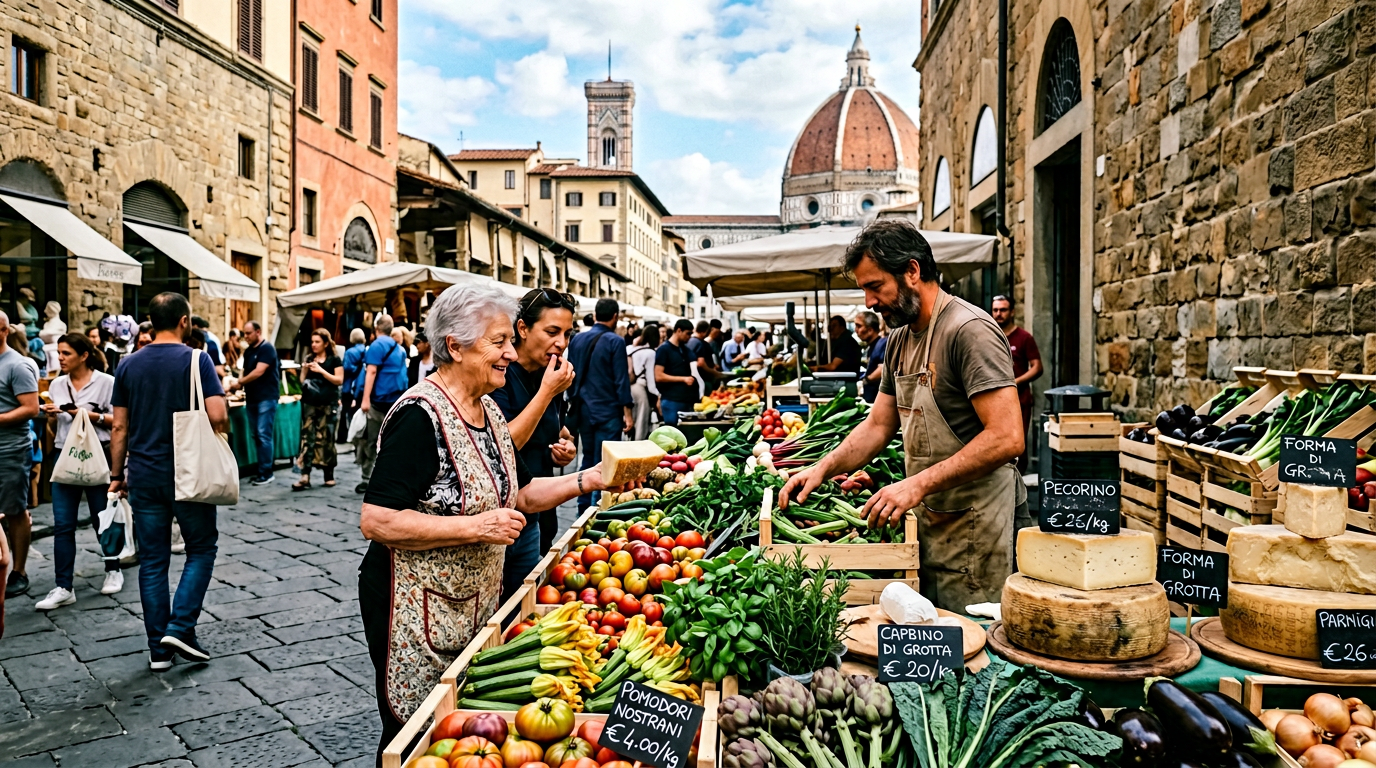
The Mercato dei Contadini at the Cascine park, the large public park along the north bank of the Arno, two kilometres west of the city centre, operates on selected Sundays throughout the year, with concentrated activity in spring (April–May) and autumn (September–November). The market brings together producers from within roughly 100 kilometres of Florence. Everything at a producer stall was made or grown by the person behind the table.
Getting there from Oltrarno: walk west along Lungarno Soderini for about 25 minutes, or take bus 17C from Piazza della Repubblica (approximately 10 minutes). The market runs from around 9:00 to 13:00. Producers begin selling out of key items by 11:30, so arriving before 10:00 gives the best selection.
The Mercato di Sant’Ambrogio operates Monday through Saturday in Piazza Ghiberti, east of Santa Croce. It is a traditional neighbourhood market, not a farmers’ market, but several stalls source directly from local producers. The Mercato Centrale in San Lorenzo has a downstairs level (as distinct from the tourist food hall upstairs) where the traditional market vendors, some of whom have operated in the same spaces for decades, sell produce from regional suppliers with genuine provenance.
The Oltrarno Artigianato market, held on the third Sunday of each month in Piazza Santo Spirito, occasionally includes food producers alongside artisan vendors. The mix is inconsistent, but when local food producers are present, they tend to be small-scale operators who sell nowhere else in the city.
How to identify real local products
The tourism-supply chain has produced a substantial industry of Tuscan-branded products that have no connection to local production. Olive oil in decorative ceramic jugs. Chianti in fiasco bottles. Truffle products, pasta, oil, salt, cream, in quantities that bear no relation to actual Tuscan truffle harvests. The packaging signals Tuscany; the content often signals industrial production.
Real local products are typically sold without elaborate packaging. A good olive oil from a Chianti producer at a market stall arrives in a plain unlabelled bottle or a basic tin. The producer can tell you the grove, the cultivar (typically Moraiolo, Frantoio, and Leccino in combination for Florentine oils), the harvest date, and the pressing method. An oil that arrives in a beautiful bottle with a design label and a story about a 15th-century villa is unlikely to be more than a vehicle for the bottle.
Truffle products deserve particular caution. Real white truffle from the San Miniato area (40 kilometres west of Florence) is available from October through December and costs between €2 and €5 per gram at direct sale. It is sold fresh, used immediately, and not preserved in oil. Any product in a jar described as white truffle oil is made with synthetic truffle aroma (2,4-dithiapentane) rather than actual Tuber magnatum Pico. The difference is measurable in both price and quality.
Buying at a market stall
The mechanics of buying at a Florentine market stall require no special knowledge. Approach the stall, look at what is on display, and if you want to taste before buying, ask: “Posso assaggiare?”, Can I try? At a genuine producer stall, this request is welcomed. Samples are cut or poured without hesitation.
Most producer stalls at the Mercato dei Contadini accept cash only. Some accept cards. Bring €10 and €5 notes. Asking for change from €50 for a €4 purchase is technically possible but slows the market down. If you intend to spend €60 across three or four stalls, arrive with exact change or close to it.
For quantities above what you can carry on a flight, wine cases, olive oil in 5-litre tins, large rounds of aged cheese, ask the producer directly whether they ship nationally or internationally. Tuscan wine producers routinely ship within Italy from €8 to €12 per case of six bottles. International shipping to northern Europe and the US is available from most producers with online shops; typical cost for a six-bottle case to the UK is €25–35.
Specialist food shops that source locally
Several food shops in Florence operate as aggregators for local producers without the farmers’-market format. They buy directly, sell in a permanent retail space, and can tell you where each product comes from. These are not shops that sell Tuscan aesthetics. They are working food businesses.
The Mercato Centrale’s downstairs level (separate from the upstairs food hall) has cheesemakers and charcuterie vendors with genuine regional sourcing. A vendor who can name the specific farm where a pecorino or a prosciutto originated is a vendor worth dealing with.
Neighbourhood wine shops (enoteche) in Oltrarno, there are several on Via dei Serragli and Borgo San Frediano, often carry small-production local wines that do not reach export markets. A good enoteca owner is a practical guide to the local wine economy. Ask what they drink themselves and what they recommend under €12 a bottle.
Where to stay
The neighbourhood markets of Oltrarno and the Cascine farmers’ market on the Arno’s north bank are both accessible on foot from the south bank in under thirty minutes. A base in the neighbourhood puts you within range of the city’s most productive direct-sale food encounters without any transport planning. De’ Medici is a guesthouse in Oltrarno, from which the Sant’Ambrogio, Santo Spirito, and Cascine markets are all reachable in half an hour or less.