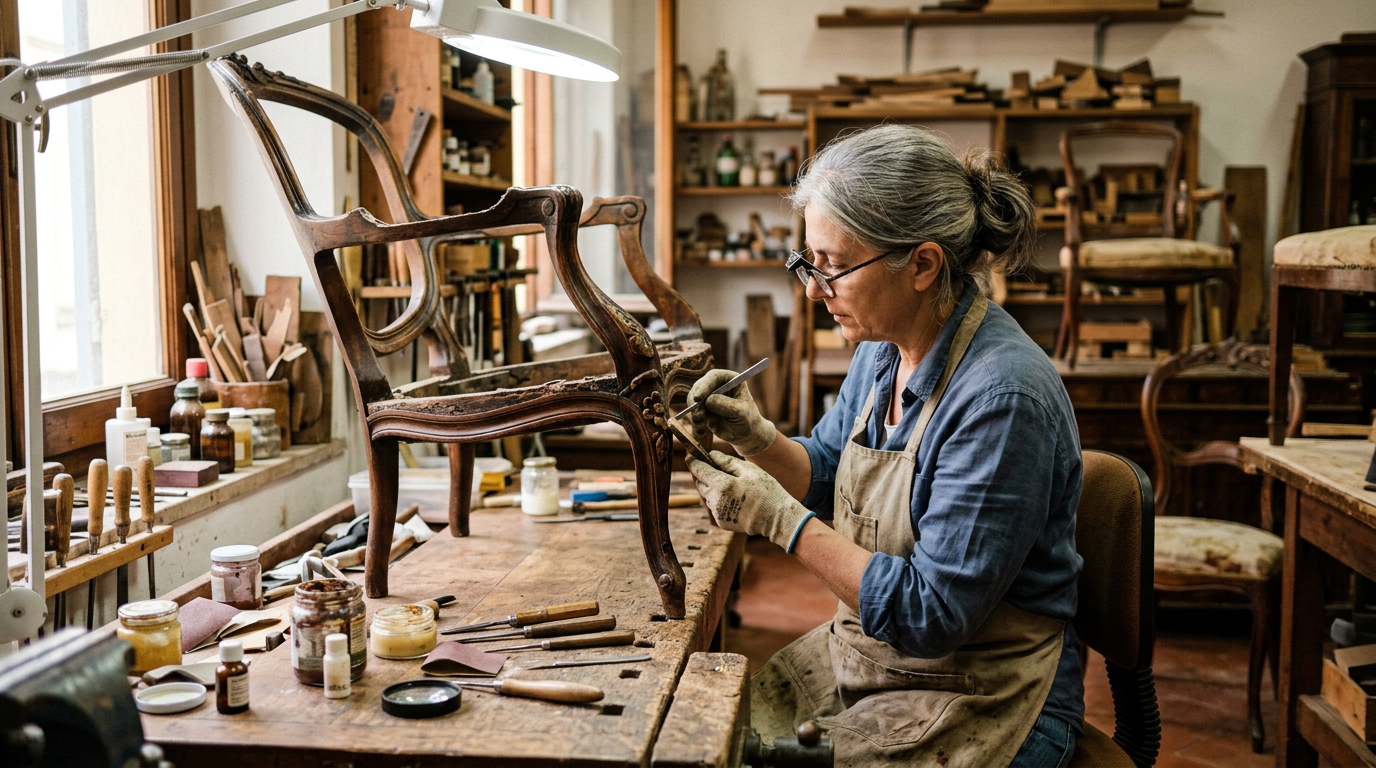
Antique object restorers in Florence Oltrarno
Florence as a restoration centre
The density of historic art in Florence is unmatched in any European city of comparable size. Within the boundaries of the historic centre there are, by conservative count, over forty significant public museums, more than a hundred churches with notable artworks, and several thousand objects in state, institutional, and private collections. Each of these objects requires periodic conservation treatment. The demand for skilled restorers is, consequently, structural and continuous.
This demand produced, over centuries, one of the world’s most concentrated communities of conservation professionals. The 1966 flood, which caused catastrophic damage to paintings, sculpture, manuscripts, and decorative objects throughout the city, acted as a catalyst. International conservators arrived to help stabilise the damaged works. Many trained locally and stayed. Research programmes in materials science and conservation methodology were established, partly at the Opificio delle Pietre Dure, the state conservation institute founded in 1588 on Grand Ducal orders, and partly at the Università degli Studi di Firenze. Florence became not only a place where restoration happened but a place where restoration science developed.
Today the Florentine restoration community numbers in the hundreds. Most work privately, for individual clients, antique dealers, or institutions. Their workshops are concentrated in Oltrarno, where the combination of relatively affordable commercial rents, good natural light, and proximity to the antique dealing district of Via Maggio has made the neighbourhood the practical centre of the trade.
Training and specialisation
The Opificio delle Pietre Dure on Via degli Alfani, near San Marco, offers the most rigorous formal training in conservation available in Italy. The five-year course accepts a small cohort annually, typically ten to fifteen students per discipline, and covers paintings on panel and canvas, stone and mosaic, metalwork, ceramics, and textiles. Entry requires a portfolio review and examination. Graduates from the programme are employed by state institutions and major museums across Italy and internationally.
The specialisations within restoration are far deeper than the public typically understands. A restorer who works on Florentine panel paintings of the 14th and 15th centuries needs a command of tempera technique, Florentine wood preparation methods, gold leaf application and punching, the chemistry of animal-skin glues, and the visual history of the relevant period. None of this translates to competence in restoring an 18th-century oil painting on canvas, which requires a different set of technical and historical knowledge.
The same depth of specialisation applies across every category. A textile conservator works on woven silk, embroidered linen, and cut velvet using techniques specific to each material structure. A book restorer deals with different paper stocks, different binding structures, and different types of environmental damage. A stone conservator in Florence, where the primary building material is pietra forte sandstone, develops expertise in a specific set of deterioration mechanisms, salt crystallisation, biological colonisation, structural fatigue, that are irrelevant to a marble conservator working in Carrara.
Apprenticeship remains an important secondary training route. Several established Florentine restorers, particularly in furniture, gilded frames, and metalwork, train assistants over periods of three to five years in an essentially pre-industrial transmission of skill. These practitioners often do not advertise. Their clients find them through the antique trade or through word of mouth in the neighbourhood.
How a restoration commission proceeds
An object arrives at a workshop with a history: previous owners, previous repairs, known damage, and sometimes documentation of its original condition. The restorer’s first task is examination. Under raking light, ultraviolet fluorescence, and sometimes infrared reflectography (for painted objects), the restorer establishes what is original, what is later addition, what is active deterioration, and what has been treated before.
This examination phase is diagnostic and non-interventive. It produces a condition report and a treatment proposal. For objects of significant value, the condition report may include photographic documentation and chemical analysis, sampling of paint binders, wood species identification, textile fibre analysis. These tests are carried out in collaboration with conservation science laboratories. The Opificio delle Pietre Dure laboratory provides analytical services to private restorers working on significant objects.
The treatment proposal sets out exactly what will be done, in what sequence, with what materials, and at what estimated cost. Reversibility is a central principle: every material used in treatment must be removable by future restorers without damaging the original. This principle is not merely ethical; it is the practical basis of the whole profession. Objects that survive for centuries will receive multiple rounds of treatment by different practitioners. Each treatment must leave the original accessible.
For a furniture piece requiring structural consolidation, veneer re-adhesion, surface cleaning, and minor inpainting of losses, a realistic timeline in a Florence workshop is three to five months and a cost in the range of €800 to €3,000 depending on the scale and condition. Major paintings can take a year or more. The cost of treating a significant 17th-century canvas with extensive paint losses, lining damage, and surface oxidation may exceed €10,000.
Workshops in the Oltrarno neighbourhood
Via Maggio is the most useful street for understanding the intersection of the antique trade and restoration. The street runs north–south through the middle of Oltrarno, lined with antique dealers who sell furniture, paintings, decorative objects, and jewellery from the 16th through early 20th centuries. Many of these dealers have working restorers in the back of their premises or in adjacent buildings. The relationship is close: dealers send objects to restorers, restorers recommend clients to dealers, and both depend on the same community of collectors and institutions.
The streets immediately surrounding Via Maggio, Sdrucciolo de’ Pitti, Via dello Sprone, Via dei Serragli, and the passages around Piazza della Passera, contain working workshops visible from the street. Furniture restorers tend to keep their ground-floor spaces open during working hours. The smell of stripping solvents, wood wax, and linseed oil is recognisable. A workshop that has been active for twenty years in the same premises tends to have a visible accumulation of raw materials, partly finished pieces, and the patina of continuous use that distinguishes a working space from a display one.
Painting restorers and paper conservators typically work in upper-floor studios or back rooms with controlled light and stable humidity. They are less visible but equally present. The Associazione Restauratori d’Arte in Florence maintains a register of member practitioners with their specialisations. The register is accessible online and is a useful starting point for anyone needing a referral.
Making contact for a commission
Approaching a restorer directly for a commission works best if you have a specific object and a realistic understanding of what you are asking. Restorers in Florence do not typically offer free consultations for vague enquiries. But an approach that begins with “I have a specific object, here is its condition, here is what I need”, and ideally includes photographs, is likely to generate a response.
The antique dealers on Via Maggio are a practical channel for referrals. A dealer who sells 17th-century Florentine furniture knows who restores it well. Asking for a recommendation from a dealer is a normal part of the business relationship.
If you are bringing an object from abroad, be aware that importing and exporting works of art, even objects of modest value, involves Italian customs regulations and, for objects over a certain age, export licence requirements under the Codice dei Beni Culturali. For objects above a threshold of approximately €13,500 (adjusted periodically), an export licence from the Ministero della Cultura is required. Restorers familiar with the international client market are accustomed to navigating these requirements.
Where to stay
The restoration workshops of Oltrarno are distributed through the neighbourhood’s residential and commercial fabric, concentrated between Via Maggio and the streets around Piazza della Passera. Walking slowly through this part of Oltrarno on a weekday morning, looking through the open doors and the ground-floor windows, gives a direct impression of a profession that has operated in this specific quarter of Florence for five centuries. De’ Medici is a guesthouse in Oltrarno, at the centre of this neighbourhood, where the artisan trade is still visibly alive.