Where to eat authentic ribollita in Florence Oltrarno
What ribollita actually is
Ribollita is not a soup. This is the first and most important clarification. The dish is described in menus as a zuppa, and it begins as one, but by the time it reaches the table in a restaurant that makes it correctly, it has passed through a transformation that moves it closer to a solid than a liquid. You eat it with a fork. If a spoon is the only available implement, something has gone wrong.
The name describes the process: ribollita means reboiled. A vegetable and bean base, cannellini or borlotti beans, cavolo nero, potato, carrot, celery, onion, is cooked the first day. The following morning, stale unsalted Tuscan bread is added and the whole pot is reheated. The bread absorbs the cooking liquid and the residual starch from the beans, swelling and dissolving into the mass. The texture becomes thick, almost gelatinous in parts. The flavour deepens as the bread absorbs the oils and juices of the previous day’s cooking.
This is not a refinement technique. It is a practical method for extending a meal across two days, for making use of bread that would otherwise be wasted, and for feeding more people from the same ingredients. The unsalted bread of Tuscany, which the rest of Italy finds strange and which goes stale within a day of baking, is in this context not a deficiency but a raw material. Its lack of salt means it absorbs flavour without adding its own. Its rapid staling means it breaks down completely when reheated in liquid. It was designed, functionally, for exactly this purpose.
The history of a peasant dish
The ingredients of ribollita, bread, beans, dark leafy greens, olive oil, are the foundational ingredients of Tuscan peasant cooking from at least the medieval period. They require no refrigeration, they can be stored through winter, and they are calorie-dense. Cavolo nero, the dark Tuscan kale that is the defining green of ribollita, grows through the cold months when other vegetables are unavailable, and its flavour improves after the first frost. This biological fact explains why ribollita is categorically a winter dish.
The first written references to something recognisable as ribollita appear in late 17th and early 18th century Tuscan cookbooks. Pellegrino Artusi, whose 1891 cookbook La scienza in cucina e l’arte di mangiar bene set the basis for modern Italian home cooking, included a version under the name minestra di pane alla fiorentina, Florentine bread soup. He specified that it must rest overnight and be reheated before serving.
The dish’s trajectory from farmhouse food to restaurant offering follows the broader movement of Tuscan rural workers to urban centres in the early 20th century. Florence’s Oltrarno neighbourhood, historically the district of artisans and workers, received a significant influx of families from the surrounding countryside between 1920 and 1960. They brought their cooking with them. The osterie and trattorie of Oltrarno began serving ribollita as a lunch staple, and it acquired the cultural legitimacy of restaurant cooking while retaining the logic of home cooking.
The right season and why it matters
Ribollita made in July is a different dish from ribollita made in November. The cavolo nero available in July is summer-grown, lighter in colour, thinner in leaf, and without the concentrated sweetness that cold weather induces in Brassica crops. The flavour is acceptable. The characteristic density and depth of the winter version are absent.
October and November mark the beginning of the best season. The cavolo nero harvested after the first cold nights of autumn has a bitterness that cooks out slowly during the long simmer, leaving a complex savoury base. The new-harvest olive oil, pressed in November from the Chianti and Florentine hill groves, is bright green, intensely peppery, and at maximum flavour. Poured over a bowl of ribollita, it adds a dimension that the previous year’s oil cannot replicate.
November is also the month when dried beans from the summer harvest are relatively young. Older dried beans, kept from the previous year or acquired through unspecified commercial channels, take longer to cook and have a slightly chalky, less creamy texture when done. New-season beans cook in two hours, become completely soft, and add a velvety body to the ribollita that is noticeably different.
A ribollita eaten in Florence in the second week of November, made with that year’s cavolo nero and that year’s olive oil, is one of the most complete expressions of Tuscan seasonal cooking. The experience is practical rather than romantic: it is simply the point in the calendar when all the component ingredients are simultaneously at their best.
What distinguishes the real version from the imitation
The tourist version of ribollita presents as a bowl of green-tinted broth with softened vegetables and some pieces of bread floating in it. It arrives within fifteen minutes of ordering. It can be drunk from a glass. It costs €14 at a restaurant near the Uffizi.
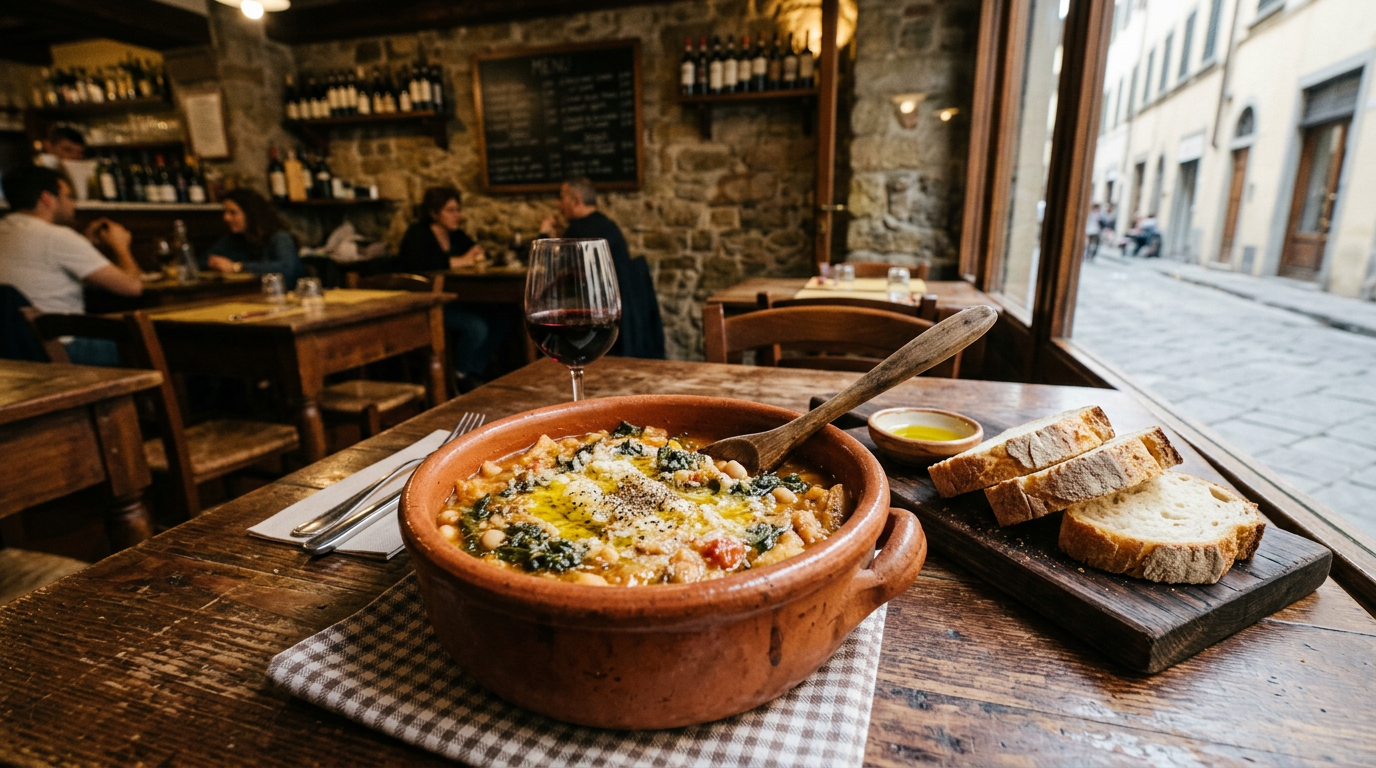
The real version arrives in a ceramic bowl or terracotta coccio as a dark mass, almost black from the cavolo nero, that holds the shape of the ladle when turned out. The surface shows a pooling of olive oil. No separate broth is visible because the bread has absorbed it all. The texture is close-grained. A fork pressed into the centre encounters resistance.
The practical indicators of a genuine version, assessable before ordering: Is it listed as a seasonal dish rather than a year-round feature? Does the menu specify cavolo nero by name rather than generic “green vegetables”? Is the portion size substantial, at least 350 grams? Is the price between €7 and €12? Does the kitchen produce a finite number of portions daily that can sell out?
If a trattoria serves ribollita in the same quantity throughout service, it is making it to order rather than reheating a pot. That is technically not ribollita. The reboiling is definitional.
Where to eat it in Oltrarno
The neighbourhood of Oltrarno concentrates most of Florence’s remaining genuine trattoria cooking in its side streets, removed from the tourist pressure of the Via Guicciardini and the Ponte Vecchio area. The places that still make ribollita correctly tend to be small, under thirty covers, with handwritten menus, short wine lists, and no signage in English on the exterior.
Prices for a first course of ribollita in 2026 run from €7 to €11 in a genuine Oltrarno establishment. Anything priced below €6 suggests compromised ingredients. Anything above €14 suggests a tourist location.
The best way to find a real ribollita in Oltrarno is to walk Via dei Serragli, Borgo San Frediano, and the streets around Piazza del Carmine at midday between October and March. Look for full rooms, handwritten boards, and places where the only English being spoken is at one or two tourist tables. Ask what the ribollita is made with. In a genuine kitchen, the answer will be immediate and specific.
Where to stay
In autumn and winter, when cavolo nero is in season and the new olive oil has been pressed, Oltrarno’s trattoria cooking is at its best. The neighbourhood’s genuine working-class food tradition, which gave ribollita its place in the Florentine kitchen, is most accessible from within the neighbourhood itself. De’ Medici is a guesthouse in Oltrarno, from which the trattorias that still make a proper ribollita are within a few minutes on foot.