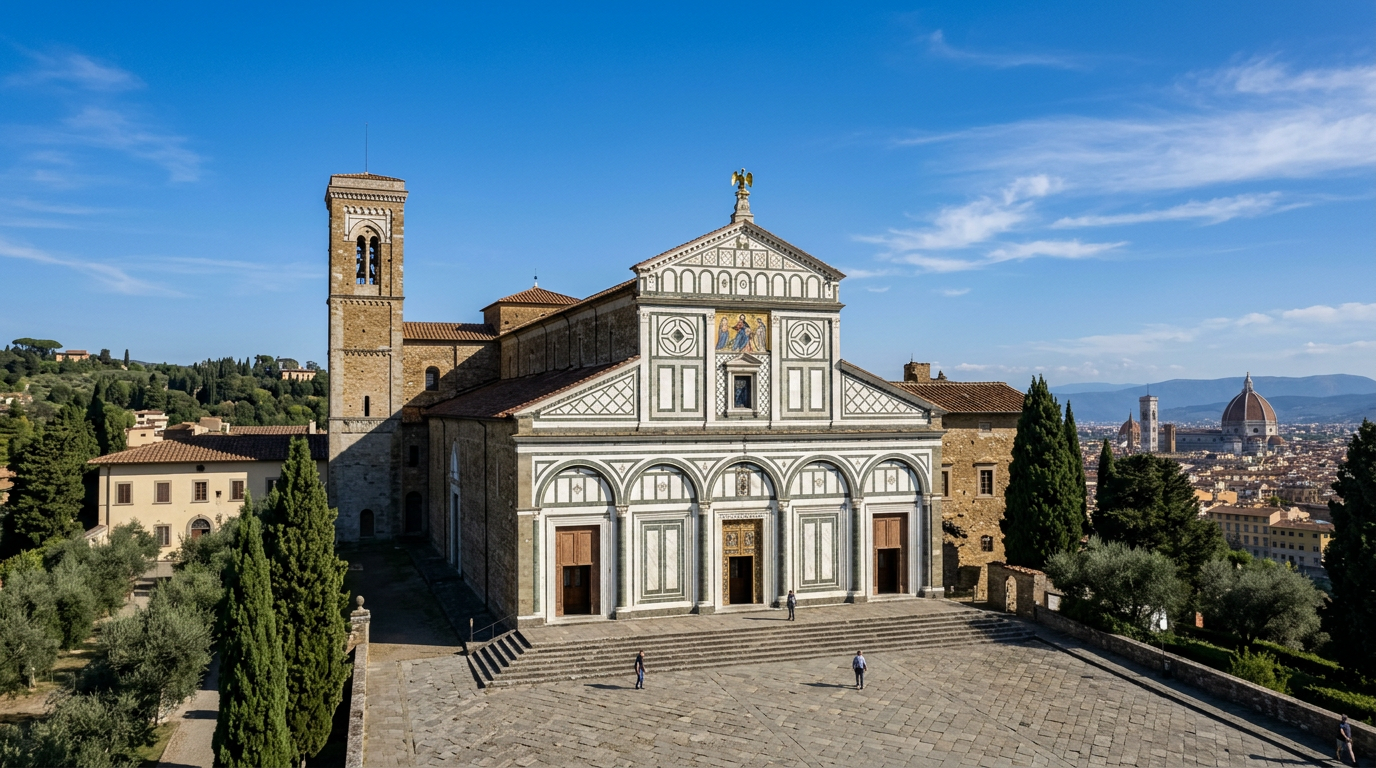
Complete guide to San Miniato al Monte in Florence
A church that has stood for nearly a thousand years
San Miniato al Monte was built on the hill above the Arno between 1013 and 1062. At that date, the Romanesque style was new in Tuscany, and the building’s ambitious use of white Carrara marble and green Prato serpentine, arranged in geometric patterns across both the facade and the interior, was a deliberate statement of ecclesiastical wealth and theological confidence. The building has been in continuous use since its consecration. It is not a restored monument or a repurposed shell. The Benedictine monks of Monte Oliveto have maintained it as a working monastery and active church without interruption.
This continuity is what distinguishes San Miniato from most of the famous religious buildings in Florence. The Duomo is a cathedral administered by a state-linked body. The Baptistery is partly a museum. San Miniato is a monastery that receives visitors, not a destination that employs monks. The difference is perceptible in every aspect of the experience.
The route from Oltrarno to the hill
The basilica sits approximately 90 metres above the level of the Arno. From the Lungarno in Oltrarno, it is visible on clear days as a pale shape against the wooded hillside, catching the light from mid-morning.
The most direct walking route begins at Piazza Poggi, at the base of the Rampe del Poggi, the staircase and ramp system built by Giuseppe Poggi as part of Florence’s post-unification urban reorganisation in the 1860s. Poggi’s design created a series of terraced gardens ascending the hillside, punctuated by fountains and resting points. The climb from Piazza Poggi to Piazzale Michelangelo takes approximately fifteen minutes at a moderate pace.
Piazzale Michelangelo, at 105 metres above sea level, is the most photographed viewpoint in Florence. In summer it is also one of the most crowded: from 10:00 onwards, it is shared with tour groups, souvenir stalls, and a line of coaches on the road below. Come before 8:30 or after 20:00 if you want the view without the noise.
Above Piazzale Michelangelo, the tourist crowds thin immediately. A second stair flight rises through a double row of cypress trees to the church of San Salvatore al Monte, a late 15th-century building designed by Cronaca and referred to by Michelangelo as his “bella villanella”, pretty country girl, for its unaffected, proportional simplicity. The church is usually unlocked and worth entering for five minutes.
From San Salvatore, a gravel path continues uphill for about three minutes alongside the wall of the Cimitero Monumentale delle Porte Sante. The cemetery, opened in 1854, contains the graves of notable Florentines including Carlo Collodi (d. 1890), the author of Pinocchio. The gates are open during daylight hours and the cemetery is worth a short visit.
The interior of the basilica
The nave floor is one of the finest floors in Tuscany. Laid in 1207 in polychrome marble intarsia, white Carrara, green Prato serpentine, and occasional red Verona marble, the panels represent the signs of the zodiac, eagles, lions, and geometric patterns. The Cosmatesque technique of cutting and inlaying marble in complex geometric arrangements was primarily a central Italian form, and the San Miniato floor is its most accomplished Tuscan example.
The raised choir terminates in an apse covered in mosaic. The central image, Christ between the Virgin and San Miniato, dates from 1297 and follows the Byzantine iconographic programme established in Florentine mosaics of the previous two centuries, most importantly the Baptistery ceiling. The gold ground and the rigid, hieratic figure style would look archaic in painting of this period, but in mosaic they remain the correct technique; Byzantine mosaic conventions persisted in Italian church decoration long after painting had moved to naturalism.
The Chapel of the Cardinal of Portugal, inserted into the south aisle in 1461 as a funerary monument for Jacopo di Lusitania (Cardinal of Portugal, d. 1459 in Florence at age 25), is one of the four or five finest Renaissance memorial chapels in Italy. It was designed by Antonio Manetti, completed by Antonio Rossellino, and features painted altarpiece roundels by Alesso Baldovinetti and ceiling medallions in glazed terracotta by Luca della Robbia. The architectural integration of painting, sculpture, and ceramic work in a single decorative programme is the building’s most remarkable single achievement.
The crypt beneath the raised choir floor dates from the 11th-century construction. Low barrel-vaulted ceilings, columns with reused Roman capitals, and the marble tomb of San Miniato create a space that is compressed and deliberately simple. Oil lamps burn continuously. The monks sing vespers in the crypt daily at 17:30, a service open to all visitors. The chant is Gregorian monody, performed without accompaniment. The session lasts approximately thirty minutes.
The panorama from the terrace
The terrace in front of the basilica entrance is slightly higher and further back from the city than Piazzale Michelangelo, which gives it a different quality of view. Rather than looking across the city from a distance, you look slightly downward across it, with the Arno visible as a distinct horizontal feature and the hills of Fiesole and Settignano forming the northern horizon.
The major landmarks are identifiable without optical aid: the Duomo and Brunelleschi’s dome, Giotto’s campanile immediately to its right, the Palazzo Vecchio tower 700 metres to the south of the Duomo, the slender campanile of the Badia Fiorentina behind it, and the dome of San Lorenzo to the northwest of the cathedral complex. On clear winter days, the Apennines are visible as a grey profile to the north.
The optimal time for the view is late afternoon between September and November, when the sun descends toward the southwest, behind the hills of Chianti, and illuminates the facades of the north bank buildings from a low angle. The period between 17:00 and 18:30 in October produces conditions that cannot be replicated in other seasons.
Practical information and monastery shop
San Miniato al Monte is open daily. Morning hours: 9:30 to 13:00. Afternoon hours: 15:00 to 19:00 in summer (May–October), 14:30 to 18:00 in winter (November–April). These hours are set by the monastery, not by a public body, and may vary during religious festivals or retreat periods.
Entry to the basilica and terrace is free. Donations at the entrance help fund ongoing maintenance of the building.
Dress requirements apply: covered shoulders, no shorts above the knee, no sleeveless tops. A light scarf or jacket carried for this purpose is sufficient for summer visits.
The monastery shop opens during basilica hours. It sells products made by the monks and by affiliated Benedictine communities: honey (acacia, chestnut, mountain flower), herbal teas, grappa, liqueurs, soaps, and cosmetics. These are not tourist products. The honey and herbal preparations are made with genuine attention to quality and are cheaper here than at specialty food shops in the city. A 500g jar of chestnut honey costs approximately €8–10.
Where to stay
San Miniato al Monte is 25 minutes on foot from Oltrarno, a walk that rises from the neighbourhood through Piazzale Michelangelo and the cypress avenue to the basilica terrace. The most rewarding version of this visit, arriving for the late-afternoon light and staying for vespers at 17:30, begins and ends in the neighbourhood below. De’ Medici is a guesthouse in Oltrarno at the foot of that hillside, a practical base from which the basilica is a straightforward afternoon excursion without transport.