Authentic guide to San Nicolo neighbourhood Florence
The neighbourhood pressed between the river and the hill
San Niccolò occupies the easternmost section of Oltrarno. It begins at Ponte alle Grazie and runs east along the south bank to Ponte San Niccolò, a distance of roughly 900 metres. On the north side, the neighbourhood borders the Arno. On the south side, the Colle di San Miniato rises steeply, limiting the neighbourhood’s depth to a strip of roughly 200 metres between the water and the hillside. This compression has shaped its character.
The main artery is Via San Niccolò, which runs the full length of the neighbourhood parallel to the Lungarno at about 60 metres from the river. The street is residential throughout. Ground floors hold a butcher, a pharmacy, a baker, a hardware shop, a couple of small bars, and a handful of specialist retailers. There are no international brand outlets and no tourist-facing businesses. The few restaurants on the street set their menus in Italian and price their food for the families who live in the surrounding buildings.
Property prices in San Niccolò are lower than in the more central parts of Oltrarno, the area around Piazza Santo Spirito and Via Maggio, which has preserved the social composition of the neighbourhood. The residents are a mix of older Florentine families, many of whom have lived here for multiple generations, and a younger population of students and professionals attracted by the relative calm and the lower rents. Artists and craftspeople occupy a modest fraction of the neighbourhood’s workshops.
The church of San Niccolò sopr’Arno
The neighbourhood takes its name from the church of San Niccolò sopr’Arno, on the south side of Via San Niccolò. The church was founded in the 11th century and substantially rebuilt in the 14th. The current building retains its Gothic proportions, a single nave with side chapels, under a 15th-century coffered ceiling.
The interior contains altarpieces from several periods and a sacristy with fresco decoration attributed to the workshop of Michelozzo, the 15th-century architect who designed the Palazzo Medici Riccardi on Via Cavour. The frescoes are in moderate condition and receive relatively few visitors. The church is usually open in the morning from 8:30 to 12:00 and again in the afternoon from 15:30 to 18:30; hours vary and it is worth checking before making a special journey.
The square outside the church, small and irregularly shaped, functions as a neighbourhood gathering point without any tourist infrastructure. A bench or two, a few bicycles locked to the iron railings, and the quiet sound of the Lungarno traffic fifty metres north are the entire setting.
The Torre di San Niccolò and the city walls
The Torre di San Niccolò stands at the western end of the neighbourhood, at the junction of Via San Niccolò and Lungarno Serristori. It is the only surviving tower from Florence’s 14th-century city gate system that remains at close to its original height, approximately 30 metres. The tower was built in 1324 as part of the third circuit of city walls, the same construction programme that produced Porta Romana. It is constructed in pietra forte sandstone, with walls 1.5 metres thick.
Unlike the city gates in the wall circuit, which were designed primarily as controlled passages, the Torre di San Niccolò was a defensive structure positioned to monitor movement on the river and to provide fire cover over the approach to the Ponte alle Grazie crossing. Its visual field covered both the Arno and the road along the south bank approaching the bridge from the east.
In summer, the Comune di Firenze opens the tower to guided visits on a seasonal schedule. The climb involves approximately 120 steps on a narrow internal staircase. At the top, a small wooden platform allows views over the San Niccolò rooftops to the Lungarno, the river, and the north bank of Florence. The views are modest but the climb through the interior of a 700-year-old military tower is instructive in its own right.
The Bastione di San Giorgio, the massive artillery fortification above San Niccolò on the hillside, was designed by Michelangelo in 1529. Florence was besieged that year by the forces of Clement VII (Giulio de’ Medici) and the Holy Roman Emperor Charles V. The Florentine republic commissioned Michelangelo, who was then serving as the city’s chief military engineer, to design emergency fortifications on the Oltrarno hillside. The Bastione di San Giorgio was one result.
The bastion is a pentagonal earthwork with masonry revetments, designed to absorb artillery fire and provide stable platforms for the city’s own artillery. It is accessible from Porta San Miniato, the small gate at the east end of Via San Miniato, via a footpath that climbs through the gardens for about ten minutes. The Giardino Bardini and the hillside gardens adjoin the bastion on the west side.
Bars and eating places
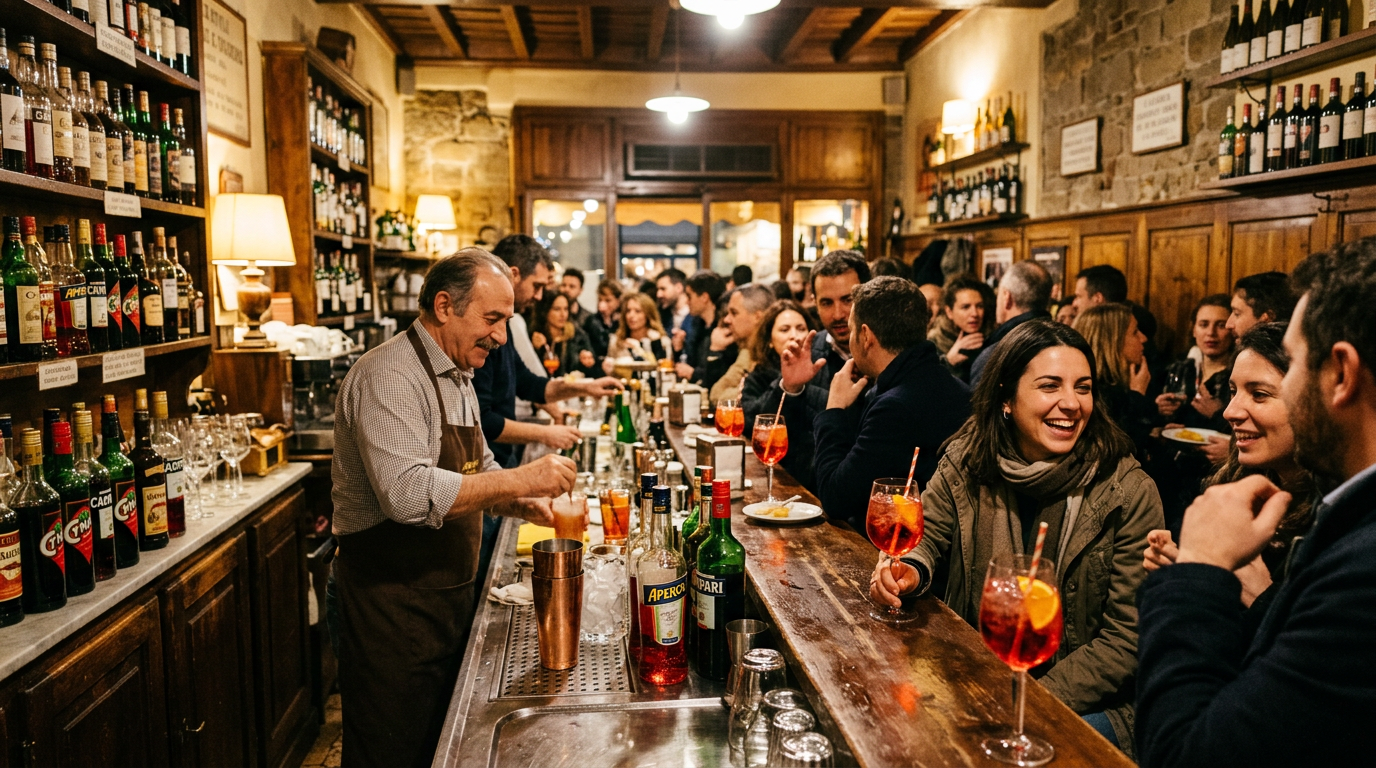
Bar Il Rifrullo at Via San Niccolò 55 is the neighbourhood bar in the full sense: open from morning for coffee, through the afternoon, and into a proper aperitivo from 18:00. The outdoor terrace on the street is used from April through October by local residents as a public living room. On warm evenings it is full and loud. A coffee costs €1.10, a spritz €5, a glass of Chianti Classico from a decent producer €5–7.
Zoe at Via dei Renai 13, one street south of the Lungarno, serves cocktails to a younger and slightly more mixed crowd. The drinks list is more curated than a standard neighbourhood bar, small-batch spirits, house bitters, but the atmosphere remains informal. Cocktails cost €8–12. There is a light aperitivo spread from 18:30.
The Osteria del Cinghiale Bianco on Borgo San Jacopo, immediately west of San Niccolò at the junction with the rest of Oltrarno, is a traditional Florentine restaurant serving wild boar, cinghiale, as a pappardelle sauce and as a stew. The menu changes with the seasons and the supply of game. A full dinner with wine runs to €35–45 per person. No tourist adjustments are made to the menu.
For morning coffee, Bar San Niccolò at the corner of Via San Niccolò and Via dei Renai has no seating and about twelve people standing at any given point between 7:30 and 9:30. A coffee is €1.10. The bar is the working-day infrastructure of the surrounding streets, not a destination.
Workshops and the craft tradition
The density of artisan workshops in San Niccolò is lower than in the central parts of Oltrarno around Via Maggio, but several significant practitioners have worked here for decades. A picture-framing workshop on Via San Niccolò makes frames in the traditional Florentine style: carved lindenwood, gesso preparation, oil gilding with 23.75-carat gold leaf applied over a clay bole. The process takes weeks for a single frame. The workshop has been in the same space since the 1980s.
A furniture restorer on Via dei Renai takes commissions from Florentine residents and from clients who bring pieces from abroad. The workshop is visible from the street: pieces in various states of disassembly occupy a long workbench facing the window.
A bookbinder on Via San Niccolò produces hand-bound notebooks and albums using traditional Florentine marbled paper in the Ebru style. The shop is open Tuesday through Saturday, 10:00 to 13:00 and 15:30 to 19:00. Notebooks range from €15 to €45 depending on size and paper stock.
The Lungarno in the evening
The stretch of Lungarno Serristori between Ponte alle Grazie and Ponte San Niccolò is one of the better evening walks in the city. In summer, residents of San Niccolò sit on the low stone wall facing the river with bottles bought from local bars or the small supermarket on Via San Niccolò. There is no organised aperitivo, no background music, and no tourist-facing infrastructure. People sit where they like and talk to whoever is adjacent. This is the neighbourhood’s most characteristic social moment.
Standing on Ponte San Niccolò at 19:30 in October and looking west gives a view of the full south bank of the Arno, Ponte alle Grazie, Ponte Vecchio, Ponte Santa Trinita, and Ponte alla Carraia in sequence, with the city’s medieval skyline rising behind the north bank. The light at that hour is nearly horizontal and slightly amber. The view is unobstructed. The bridge itself is functional rather than beautiful, but its position is excellent.
Where to stay
San Niccolò is the easternmost extension of the Oltrarno south-bank district, connected to its western neighbour by the Lungarno and by the network of residential streets that run parallel to the river. Staying in Oltrarno puts you within a twenty-minute walk of everything described in this guide. De’ Medici is a guesthouse in Oltrarno, and the streets of San Niccolò are a direct extension of the neighbourhood it occupies.