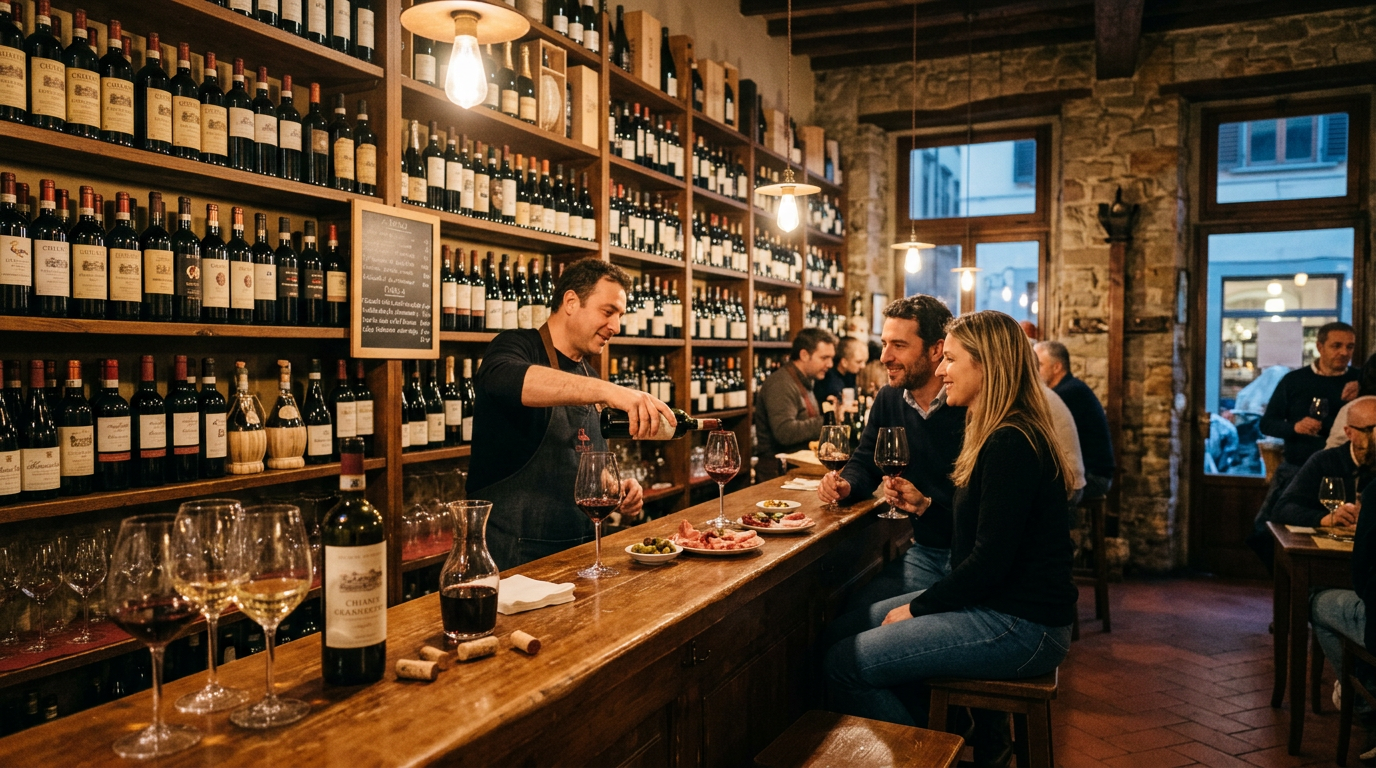
Natural wine bars in Florence Oltrarno: where to go
How natural wine arrived in Oltrarno
The natural wine movement did not originate in Florence. Its intellectual foundations are in France, in the Loire Valley, in Beaujolais, and among a generation of producers in the 1980s and 1990s who reacted against the industrialisation of wine production. Italy picked up the thread in the 1990s and 2000s, primarily in Piedmont, Campania, and Friuli, where growers had strong indigenous grape varieties and traditions of farming without chemicals.
Florence came later. The shift is traceable roughly to 2010 to 2015, when a cluster of young wine bars opened in Oltrarno that explicitly oriented themselves around organic, biodynamic, and low-intervention producers. Several of the people behind these businesses had worked in other Italian cities or abroad and returned with different ideas about what a wine bar should offer. The neighbourhood’s existing culture of artisan production, craft over industrial output, knowledge over volume, made it receptive to this orientation.
By 2026, Oltrarno has five or six wine bars that seriously engage with natural wine, plus a broader number of restaurants and enotecas that include it on their lists. This is not a mass phenomenon: most of the neighbourhood’s simpler wine bars and trattorias still pour conventional Chianti from large producers. But the concentration of serious natural wine establishments within a single neighbourhood of roughly 1.5 square kilometres is notable.
The producers these bars carry are mostly small: 10,000 to 50,000 bottles per year is a typical scale. Many are from Tuscany, Maremma, Val d’Orcia, and the area around Montepulciano have become productive zones for natural production. Significant quantities also come from Sicily, Campania, and the Veneto, as well as from France, Austria, and Slovenia.
What distinguishes natural wine
The term has no protected legal definition under Italian or EU law. In practice, wine bars that describe their list as “natural” typically apply criteria across several categories. In the vineyard: no synthetic pesticides, herbicides, or fertilisers; hand harvest; organic or biodynamic certification or equivalent practice. In the cellar: fermentation with indigenous yeasts rather than commercial additions; no or minimal sulfur dioxide at bottling; no concentration, acidification, or enzyme additions; and no filtration or fining with animal-derived products.
The result of these constraints is wine that varies more from bottle to bottle and year to year than conventional wine. A natural red from a Tuscan producer might be noticeably different between the 2021 and 2022 vintages not just in flavour profile but in clarity, structure, and stability. This variability is considered by proponents as evidence of authenticity and terroir expression. Detractors argue that some of it is simply faulty winemaking that has been aestheticised.
Both positions contain truth. Some natural wine is genuinely excellent: precise, expressive, and unlike anything produced conventionally. Some natural wine is oxidised, cloudy, and volatile in ways that reflect poor technique rather than deliberate choice. A good wine bar will not serve you the second category, but being able to identify the difference helps you have better conversations with the person behind the counter.
The orange wine category, white wine made with extended skin contact, resulting in amber colour and tannin, is a significant subset of the natural wine offering in Oltrarno bars. These wines come primarily from Georgia, Slovenia, the Friuli region of northeast Italy, and increasingly from Tuscan producers experimenting with indigenous white varieties. A well-made orange wine from, for example, a Malvasia di Candia producer in Lazio or a Trebbiano producer in Tuscany is a different sensory experience from conventional white wine and pairs unusually well with the richer Florentine food traditions.
Wine bars worth visiting in Oltrarno
The wine bar landscape in Oltrarno changes slowly but does change. The following is accurate for 2026 based on current knowledge, but individual establishments’ quality and focus can shift.
The area around Piazza Santo Spirito and the streets immediately west of it, Borgo Tegolaio, Via dell’Orto, Via dei Serragli, has the highest concentration of wine-oriented establishments in Oltrarno. Several wine bars in this area operate on a similar model: a list of 50 to 150 bottles oriented around small Italian and European producers, a short food menu of boards and cooked plates, and an informal atmosphere that is equally friendly to a solo glass at the counter and a longer evening at a table.
A glass of natural wine at these establishments typically costs between €6 and €10. Bottles to take away range from €12 to €35 for most of the list, with a small number of more sought-after producers priced higher. Some wine bars charge a slightly higher price for wine consumed on the premises, as is standard in Italian licensing law, but the difference is usually €2 to €3 per bottle.
The hours of natural wine bars in Oltrarno are generally afternoon and evening: most open between 17:00 and 19:00 and close at midnight or 01:00. Several are closed on Sunday or Monday. Checking current hours before visiting is sensible, as these are small independent businesses that adjust their schedules seasonally.
Tuscan producers worth knowing
For visitors who want to understand the natural wine movement in the context of Tuscany specifically, a few producers are worth researching before visiting wine bars, because their wines appear frequently and understanding what they do helps orient the conversation.
Stefano Amerighi in Cortona makes Syrah from certified biodynamic vineyards at around 400 metres altitude. His wines are some of the most precisely made natural wines in Tuscany and demonstrate that the category is compatible with precision. Prices in wine bars: around €15 to €20 per glass for his single-vineyard Syrah.
Il Paradiso di Frassina in Montalcino is a Sangiovese producer whose methods include the use of classical music played in the vineyard, a practice that has attracted both serious scientific attention and considerable mockery. Whatever the mechanism, the wines are excellent: structured, long, and expensive (€25 to €40 at wine bars for current releases).
In Maremma, several producers working with Ciliegiolo, Vermentino, and Ansonica are producing wines that represent excellent value and are not yet widely known outside Italy. A Ciliegiolo Maremma Toscana from a small producer costs €12 to €18 in most Oltrarno wine bars and is a more interesting choice than default Sangiovese for visitors who want to understand the range of what Tuscany produces.
Where to stay
Oltrarno’s wine bar culture is best experienced over multiple evenings rather than a single rushed visit. A base in the neighbourhood allows you to walk between establishments and return to the same bars on different nights. For accommodation in this part of Florence, De’ Medici is well situated for the wine bars and enotecas of the Piazza Santo Spirito area.