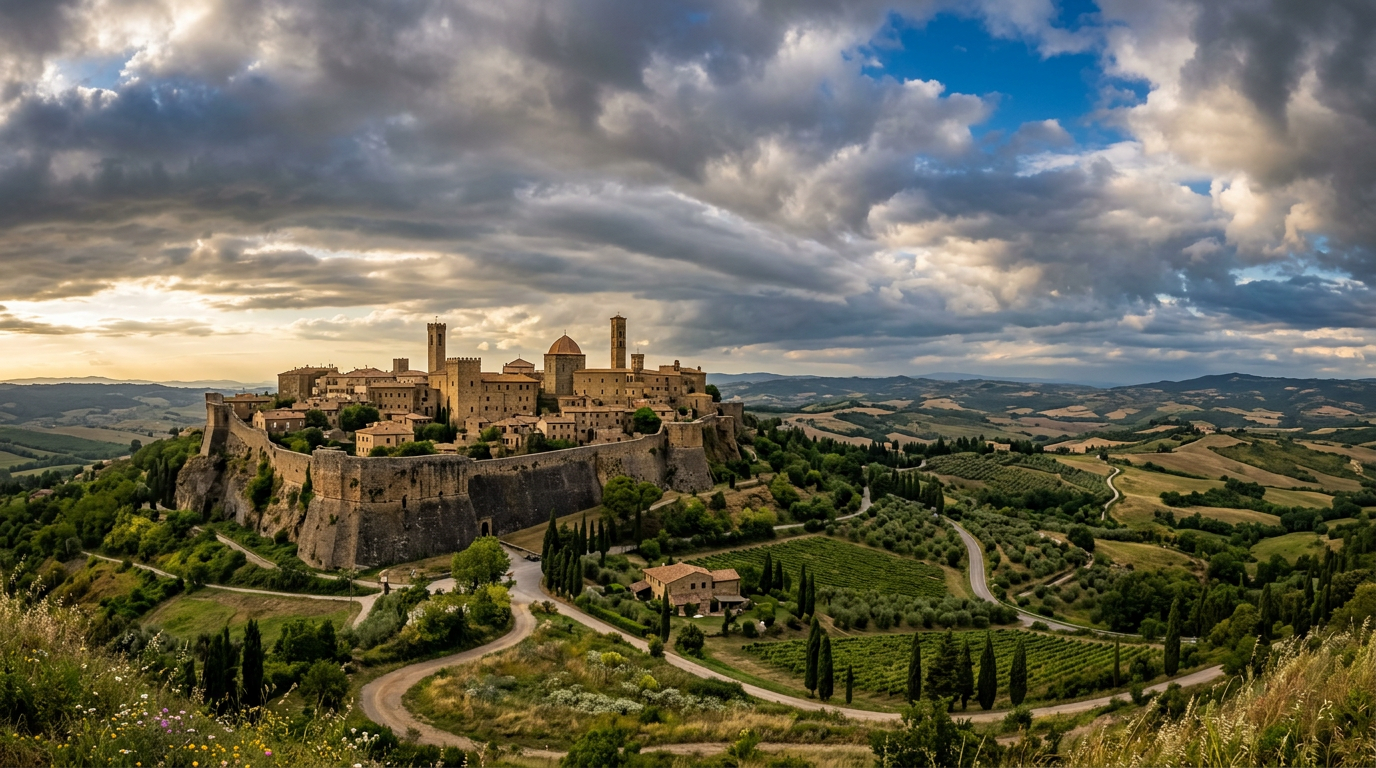
What to see in Volterra: complete travel guide
Getting to Volterra from Florence
Volterra sits on a plateau roughly 550 metres above sea level, about 75 kilometres southwest of Florence. It is not on a direct rail line, which shapes the visit significantly. The most practical access from Florence is by car via the SGC Fi-Pi-Li motorway toward the coast, turning south at Empoli or Pontedera onto the SR429 and SR68. The drive takes approximately 1 hour 15 minutes in normal traffic. Parking outside the city walls is free and accessible; the main car park is at Piazzale Lucio Maramaldo just outside Porta San Francesco.
Without a car, the most practical route is a combination of train and bus. Trains from Florence Santa Maria Novella to Saline di Volterra (on the Cecina–Saline di Volterra branch line, changing at Empoli) take approximately 1 hour 30 minutes and cost around €8 to €10 one way. From Saline, the CTT bus to Volterra takes a further 30 minutes and costs approximately €2. The total journey is around two hours. The last bus back to Saline from Volterra in the evening typically runs before 20:00; checking the current CTT timetable before visiting is essential.
Day-trip operators from Florence offer guided bus tours to Volterra, usually combined with San Gimignano, costing €50 to €80 per person including entry fees. These tours are efficient but compress the visit into three to four hours, which is enough for the main monuments but not for the slower pace the town rewards.
The Etruscan city
The Etruscans established Velathri, their name for the site, by at least the 8th century BC, though occupation of the plateau may be considerably earlier. The city was one of the twelve leading cities of the Etruscan civilisation and controlled extensive territory in central Tuscany, including access to mineral resources in the Colline Metallifere range to the south.
The Porta all’Arco, on the south side of the historic centre, is the most visible surviving evidence of this Etruscan presence. The gateway was constructed in the 4th or 3rd century BC. The basalt voussoirs, the tapered stones forming the arch, are original Etruscan construction. The three carved heads on the facing stones are eroded beyond identification but are thought to represent Etruscan deities. The walls flanking the arch were rebuilt in Roman and later medieval periods, but the arch itself has stood for over 2,300 years. The gate is not fenced or protected by glass; you can walk through it, which remains one of the more direct physical encounters with Etruscan architecture available in Tuscany.
The Etruscan walls that once enclosed a much larger city are partially visible on the slopes below the current historic centre. The perimeter of the original Etruscan city covered approximately 70 hectares, compared to the roughly 11 hectares of the current medieval centre. Sections of the wall are visible at the Parco Archeologico Enrico Fiumi, located just outside the current walls near the hospital. The park is open daily with no entry charge and contains a Roman theatre, Etruscan wall sections, and a small Etruscan acropolis.
The Museo Etrusco Guarnacci
The Museo Etrusco Guarnacci at Via Don Minzoni 15 is the most important institution in the city for anyone interested in Etruscan civilisation. Founded in 1761 on the basis of a collection donated by Canon Mario Guarnacci, it is one of the oldest museums in Europe to have been established as a public institution from the outset.
The collection contains approximately 600 cinerary urns from the Etruscan necropolis around Volterra, produced between the 3rd and 1st centuries BC. The urns are carved in alabaster, terracotta, and tufa, with relief panels depicting mythological scenes, funerary banquets, and journey-to-the-underworld narratives. The consistency of the iconographic program across hundreds of objects allows close study of how Etruscan craftspeople interpreted the same subjects across different skill levels and material grades.
Two objects in the collection are particularly significant. The Urna degli Sposi (Urn of the Couple) is a terracotta piece showing a husband and wife reclining together on the lid in a posture of domestic intimacy unusual in Etruscan funerary art. The Ombra della Sera (Shadow of the Evening) is a bronze votive figure of extraordinary elongation, the body stretched to several times normal human proportions, that looks strikingly similar to the elongated figures of Alberto Giacometti, whom it predates by 2,300 years. Both are in the main hall and are always well attended.
Entry to the Guarnacci museum costs approximately €8 in 2026. Combined tickets with the Palazzo dei Priori civic museum and the Ecomuseo dell’Alabastro cost around €13. Opening hours are generally 9:00 to 19:00 in summer, 10:00 to 16:30 in winter.
The medieval historic centre
The medieval city overlays the Etruscan and Roman foundations, and the compression of eras is visible in the stones themselves. Piazza dei Priori, the central square, is flanked by the Palazzo dei Priori (1208–1254, one of the oldest civic government buildings in Tuscany), the Palazzo Pretorio with its distinctive tower, and several 13th and 14th-century private palaces.
The Palazzo dei Priori facade displays terracotta medallions of Florentine governors dating from the 15th and 16th centuries, reflecting Volterra’s absorption into the Florentine state after 1472. Inside, the council chamber preserves fresco decoration from the 14th century. Entry costs approximately €5. The top of the tower offers views of the balze (erosion cliffs), the valleys below, and on clear days the sea to the west.
The Cathedral (Santa Maria Assunta) on Piazza San Giovanni was built in the 12th century and remodelled extensively in the 13th. The interior retains several important medieval works including a Deposition group in polychrome wood from the 13th century, attributed to sculptors from the Pisan tradition, and a ciborium with reliefs attributed to Mino da Fiesole. The baptistery adjacent to the cathedral is an octagonal structure of 1283, a relatively pure example of Pisan Romanesque in Tuscan green and white marble.
Eating in Volterra
The restaurants in Volterra reflect the city’s relative isolation from the mass tourism circuits that have standardised dining in San Gimignano or Montepulciano. Several establishments serve food that reflects the local agricultural economy: wild boar (cinghiale), pork-based salumi, truffles from the surrounding hills in season (October to December primarily), and the mushrooms of the surrounding forests.
Lunch in a sit-down restaurant in Volterra costs between €18 and €30 for a two-course meal with water. A full lunch with wine typically falls between €25 and €40 per person. The handful of restaurants on and around Piazza dei Priori charge toward the upper end of this range given their location; equivalent food is available for less in the streets east of the cathedral.
The local cheese worth seeking is the pecorino from the surrounding hills, sold at the few alimentari (grocery shops) still operating in the centre. A 300-gram wedge of aged pecorino di Volterra costs approximately €6 to €9 and travels well. The local salumi shop on Via Gramsci typically carries cured products from farms within 20 kilometres of the town.
The balze and the city’s geological vulnerability
The balze, the erosion cliffs on the west and north sides of the plateau, are one of the most visually striking features of Volterra. The gullying of the clay and silt underlying the plateau has been active for millennia and has consumed sections of the Etruscan city, the medieval walls, and even buildings from more recent centuries. The Badia Camaldolese, a medieval monastery, is partially collapsed into the balze on the northwest edge; the surviving section of its cloister hangs over the erosion edge in a state of long-term threat.
Looking at the balze from the Parco Enrico Fiumi gives a concrete sense of the scale of erosion and the extent of the Etruscan city that has been lost. The stratified clay walls, cutting to depths of 50 to 80 metres, expose geological layers spanning millions of years. The erosion is still active; sections of the cliff edge move and shed material annually.
Where to stay
Volterra is best visited as a day trip from Florence rather than as an overnight base, given its limited accommodation infrastructure and the travel time involved. Returning to the city for dinner and the following day’s exploration is practical and efficient. For a comfortable Florence base well positioned for this and other Tuscan day trips, De’ Medici is located in Oltrarno, within easy reach of the routes south and west toward the Tuscan interior.