Day Trip from Florence to Empoli: What to See
Empoli: distance, access, and logistics
Empoli is 30 kilometres west of Florence along the Arno valley, at an altitude of 28 metres above sea level. It is the main commercial and transport hub of the Empolese Valdelsa area, with a population of approximately 48,000. The drive from Via Pisana 191 via the FI-PI-LI superstrada takes 25 to 35 minutes depending on traffic. Free parking is available at Piazza della Vittoria and along the embankments of the Arno at the southern edge of the town.
The train is faster and more reliable than driving if you are visiting the centre. Trains from Florence Santa Maria Novella to Empoli run every 15–30 minutes throughout the day; the journey takes 25 minutes on a fast regional service. The cost of a single ticket in 2026 is approximately €4.40. From Empoli station, the historic centre and Piazza Farinata degli Uberti are about 700 metres on foot, a ten-minute walk through the main commercial street, Via Roma.
A day trip from Florence to Empoli can be completed comfortably in four to five hours, leaving enough time to visit the museum, the collegiate church, and eat lunch before returning to the city.
The Museo della Collegiata di Sant’Andrea
The primary art destination in Empoli is the Museo della Collegiata di Sant’Andrea, accessed from the right side of the collegiate church at Piazza della Propositura 3. The collection is housed in the former baptistery and adjoining rooms of the church complex and contains works spanning the thirteenth to seventeenth centuries, most of which were produced for local churches and confraternities.
The collection’s most important work is the tabernacle of the Madonna del Manto by Francesco Botticini (1446–1497), a Florentine painter who spent much of his career working for patrons in the Arno valley. The tabernacle, painted in tempera on panel, shows the Virgin of Mercy sheltering members of a confraternity under her cloak, a compositional type common in fifteenth-century central Italy. The gold-ground altarpiece format and the precise draughtsmanship of the individual figures show Botticini’s close study of Botticelli and Ghirlandaio, both of whose workshops were influential in this period.
Also notable is a painted cross by Masolino da Panicale (c.1383–1440/47), one of the few documented works by this painter in the area. Masolino collaborated with Masaccio on the Brancacci Chapel in Florence in the 1420s, and the Empoli cross shows the transition from the late Gothic tradition to the new spatial and figural conventions of the early Renaissance. Entry to the museum costs €7 in 2026 (reduced €5). Hours are Tuesday to Sunday, 9:00–12:00 and 16:00–19:00, with slightly different winter hours; confirm before visiting.
The Collegiate Church of Sant’Andrea
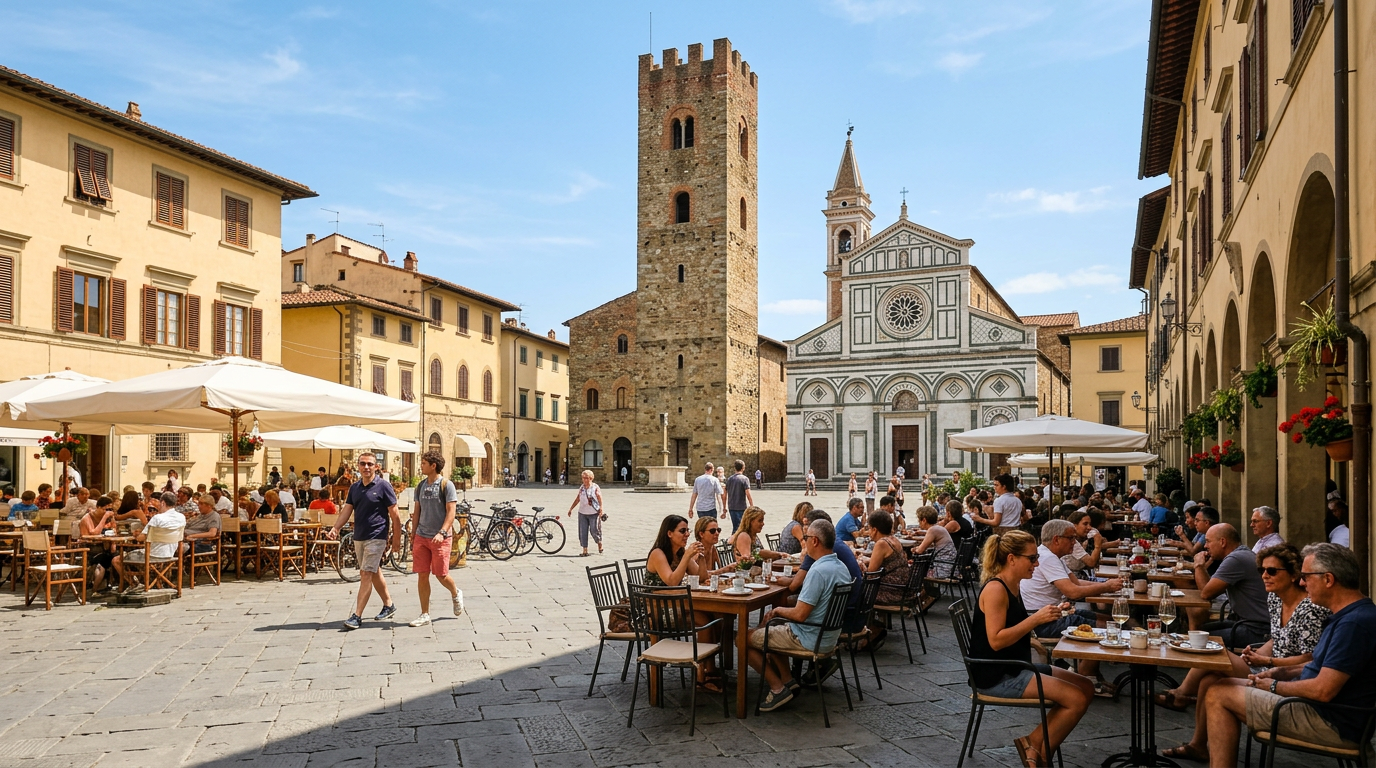
The Collegiata di Sant’Andrea faces Piazza Farinata degli Uberti with a facade in white and green marble following the Florentine Romanesque formula established by San Miniato al Monte and the Florence Baptistery. The lower section of the facade is the oldest visible element, dating from 1093, though the church itself incorporates parts of an earlier structure. A substantial restoration in the nineteenth century rebuilt the upper portion of the facade.
Inside, the nave is divided by grey pietra serena columns, and the side chapels contain works by a series of local and Florentine artists spanning several centuries. The Cappella dei Magi on the right side retains a fresco cycle that was partially detached and reinstalled during the twentieth century. The presbytery holds a choir with carved wooden stalls from the sixteenth century, which are in better condition than similar examples in many larger churches.
Entry to the church is free. It is open 9:00–12:00 and 15:30–18:30 daily, with variations on Sunday and during services.
The historic centre and Piazza Farinata
Piazza Farinata degli Uberti is named after the Ghibelline military leader Farinata degli Uberti, who was born in Empoli around 1212 and appears in Dante’s Inferno (Canto X) among the heretics. The piazza is the historic and commercial centre of the town, with porticoed buildings on three sides and the collegiate church facade on the fourth.
The piazza and the pedestrianised streets around it, Via Roma, Via Giuseppe del Papa, Via Ridolfi, form the active commercial core. Several older buildings survive with their ground-floor colonnades intact, a sign that the medieval city structure persisted through the later urban expansions. The Teatro Shalom, the municipal theatre, is housed in a nineteenth-century building on Via Ridolfi and occasionally presents events visible from the outside.
Walking the perimeter of the historic centre takes about thirty minutes at a slow pace. The quarter between the church and the Arno embankment, known as Pontormo, the birthplace of the Mannerist painter Jacopo da Pontormo (1494–1557), is a short walk south from the piazza. A commemorative plaque marks the approximate location of his birth.
Glass, industry, and local identity
Empoli has a documented history of glass production dating from the seventeenth century, when local furnaces began producing the characteristic dark-green flask (fiasco) used to contain Chianti wine. The green glass became so associated with the area that Empoli glass (vetro di Empoli) became a recognised industrial category, distinct from the decorative glass traditions of Murano.
Industrial glass production in Empoli peaked in the mid-twentieth century and has contracted significantly since then, but several manufacturers and retail outlets remain in the area. The Museo del Vetro di Empoli, formerly housed in the tower of the former Ospedale di Sant’Andrea, is undergoing relocation as of 2026; check the municipality’s website for current access arrangements.
The local identity connected to glass is still strong. Several shops in the centre sell locally made glassware at prices that reflect production costs rather than tourist markups: a handmade fiasco in dark green glass costs approximately €8–€14 depending on size.
Where to eat
Empoli has a functioning restaurant infrastructure oriented toward the working population rather than tourism.
Ristorante da Roberto on Via Giuseppe del Papa serves standard Florentine and Empolese plates, ribollita, pappardelle with hare, grilled meats, at prices around €10–€16 per main in 2026. It operates at lunch and dinner and does not require a reservation on weekdays.
Trattoria del Cenacolo near Piazza della Vittoria is a simpler lunch-only operation with a daily changing menu. The fixed-price lunch (primo, secondo, water, wine) costs approximately €13 in 2026. It is popular with local workers and fills quickly after 12:30.
The Mercato Coperto on Via del Giglio operates Tuesday through Saturday, 7:30–14:00, and has fresh produce, cheese, and meat from the surrounding agricultural area. It is a functional market, not a showcase.
Where to stay
For a day trip to Empoli, Florence is the sensible base. The train connection is fast and cheap. Staying in the Oltrarno area, close to the FI-PI-LI superstrada exit and the Santa Maria Novella station, minimises transit time in both directions. De’ Medici on Via Pisana 191 is approximately eight kilometres from Empoli, the shortest practical driving distance from any central Florence accommodation.