Lesser-Known Oltrarno Churches in Florence: a guide
Why Oltrarno has a disproportionate density of churches
The neighbourhood south of the Arno known as Oltrarno was, for much of Florence’s medieval and Renaissance history, a separate administrative and ecclesiastical district. The great mendicant orders, Augustinians, Carmelites, and later the Augustinian Hermits, established their Florentine convents here in the 13th and 14th centuries, building churches that were designed to accommodate large congregations of working people. This is why a neighbourhood of less than two square kilometres contains more significant medieval church architecture than many entire Italian cities.
The practical result for visitors in 2026 is a cluster of churches within walking distance of each other, most of them free to enter, most of them receiving a fraction of the visitor numbers at Santa Croce or Santa Maria Novella, and several containing artwork of genuine importance. What they lack is the marketing infrastructure of the major Florentine museums: few have audio guides, interpretive signage is minimal, and opening hours reflect liturgical schedules rather than visitor demand.
The information below is based on conditions in mid-2026. Hours at smaller churches change seasonally and without notice. A practical rule: arrive before noon and again after 4:00 p.m., which are the periods when even churches that close for lunch tend to be open.
Santo Spirito: the unfinished masterpiece
Filippo Brunelleschi designed Santo Spirito in 1428, late in his career, and it was not completed until after his death in 1446. The exterior, facing Piazza di Santo Spirito, one of the most functional and lived-in squares in Florence, is famously bare, a plain plaster facade that Brunelleschi intended to receive a stone cladding that was never applied. The interior is the inverse: a rigorously ordered sequence of grey pietra serena columns on white plaster walls, the spatial geometry Brunelleschi used to resolve the proportional problems he had set himself in San Lorenzo.
The church contains approximately forty altarpieces from Florentine workshops of the 15th and 16th centuries, most of them in good condition, none of them famous. The Filippino Lippi Madonna and Child in the Nerli Chapel (right transept) is among the most accomplished. Admission is free; the sacristy, which contains a crucifix attributed to Michelangelo made when he was seventeen, charges €2. The church is open Monday and Tuesday 10:00–13:00; Wednesday to Saturday 10:00–13:00 and 15:00–18:00; Sunday 11:30–13:30. These hours applied in July 2026 but are subject to change during religious observances.
Santa Felicita: the Pontormo room
Santa Felicita, on Via de’ Guicciardini immediately south of Ponte Vecchio, contains one of the most unsettling paintings in Florence in a small side chapel to the right of the entrance. The Cappella Capponi, designed by Filippo Brunelleschi and decorated by Jacopo Pontormo between 1525 and 1528, holds his Deposition from the Cross and Annunciation, along with four roundels of the Evangelists. The Deposition is remarkable for its unnatural colours, pinks, acid yellows, a pale blue-green, and its rejection of rational spatial organisation in favour of emotional compression. It was painted during the Mannerist period as the certainties of High Renaissance composition were beginning to fracture.
The church itself is small and rarely crowded. Admission is free. Note that the Vasari Corridor, built in 1565 to allow the Medici to pass from the Palazzo Vecchio to Pitti Palace without descending to street level, passes through the building above the entrance, and the small windows visible in the gallery wall are the ones through which the Medici family attended Mass in private.
San Miniato al Monte: the highest point
San Miniato al Monte is technically outside Oltrarno proper, it sits on the hillside above Piazzale Michelangelo, approximately 3 km from Via Pisana 191 by foot via Via del Monte alle Croci. The walk takes thirty-five minutes, with a consistent uphill gradient from the Porta San Miniato. Alternatively, bus line 12 from Porta Romana (ten minutes from Via Pisana) climbs to a stop near Piazzale Michelangelo, leaving a ten-minute walk to the church.
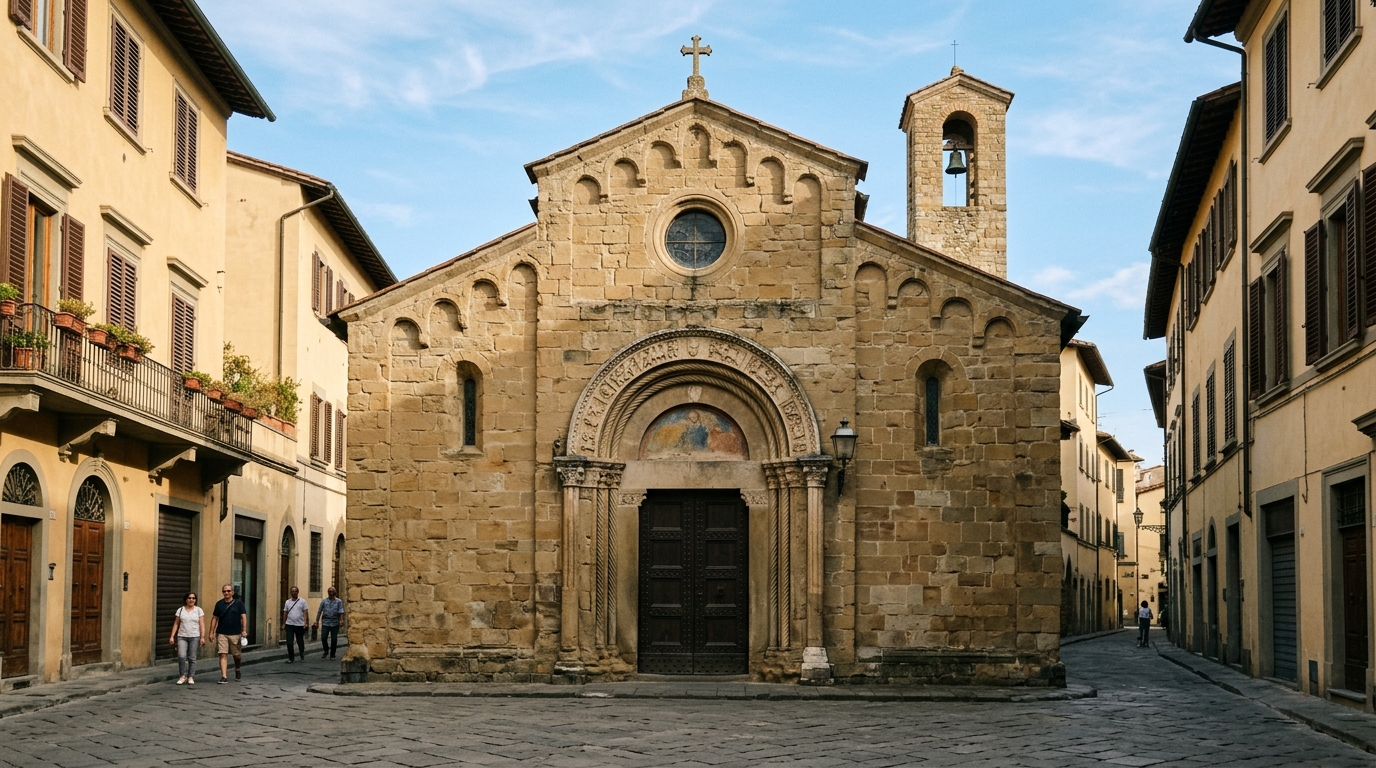
The facade dates from the 11th to 12th century and is considered one of the best-preserved examples of Florentine Romanesque architecture. The interior retains an intact medieval floor in geometric inlaid marble, a mid-15th-century tabernacle by Michelozzo, and frescoes by Spinello Aretino in the sacristy dating to 1387. The church is free; a small Benedictine monastic community maintains it and sells honey and herbal products at the gift counter. Hours are 8:00–20:00 in summer (April–October), 8:00–19:00 in winter.
The Brancacci Chapel in Santa Maria del Carmine
Santa Maria del Carmine on Piazza del Carmine, in the western Oltrarno, is externally undistinguished, it was heavily rebuilt after a fire in 1771. The Brancacci Chapel, however, in the right transept, contains the frescoes by Masaccio, Masolino, and Filippino Lippi that constitute one of the most important bodies of painted work of the early 15th century. Masaccio’s Expulsion of Adam and Eve, his Tribute Money, and the cycle of scenes from the life of Saint Peter established a new language for representing space and human emotion in paint.
Admission to the chapel is separate from the church: €10 in 2026, timed entry, reservable online at the Comune di Firenze Musei website. Maximum sixty visitors per session. Sessions run in approximately twenty-minute slots. The restriction means the chapel is rarely crowded in the way that the Sistine Chapel is, and it is possible to spend genuine time with the paintings. The church itself is free and open standard hours.
Smaller churches worth finding
Santa Monaca on Via Santa Monaca, a narrow street between Piazza del Carmine and the Arno, is an active Augustinian convent with a church open to visitors in the mornings. It contains a 15th-century wooden crucifix and a small collection of devotional paintings that have never been catalogued in a major museum context. It is fifteen minutes on foot from Via Pisana 191. Entry is free.
Santa Maria della Spina on the Lungarno Gambacorti in Pisa is often cited in this category, though it is in fact in Pisa rather than Florence, a common confusion caused by the similarly named church-type. The correct Florentine example is the Oratorio dei Buonomini di San Martino, on Piazza San Martino near the Bargello in the historic centre. This tiny oratory, administered by a charitable confraternity established in 1441, contains frescoes by Ghirlandaio and Davide Ghirlandaio illustrating acts of mercy. Admission is free; hours are irregular.
Where to stay
Oltrarno’s churches are best explored with a base in the neighbourhood itself, which allows for early-morning visits before tourist arrivals and returns in the late afternoon when churches reopen after the midday closure. The walking distances involved, most are within fifteen minutes of each other, make a central Oltrarno location far more efficient than any hotel north of the Arno. De’ Medici is positioned directly in this walking circuit and provides the proximity needed to explore these sites without planning each visit as a dedicated excursion.