The art of gilded frames: Florence frame-makers
Florence and the frame-making tradition
The Florentine frame-making tradition is inseparable from the city’s painting tradition. From the 14th century onwards, workshops producing altarpieces and panel paintings in Florence routinely included frame production as an integrated part of the commission. The frame was not an afterthought, it was the architectural envelope that determined how the painting related to the wall, the altar, and the viewer. Several major Florentine paintings now displayed in international museums are incomplete without their original frames; the frames were sometimes commissioned from the same bottega that produced the painting.
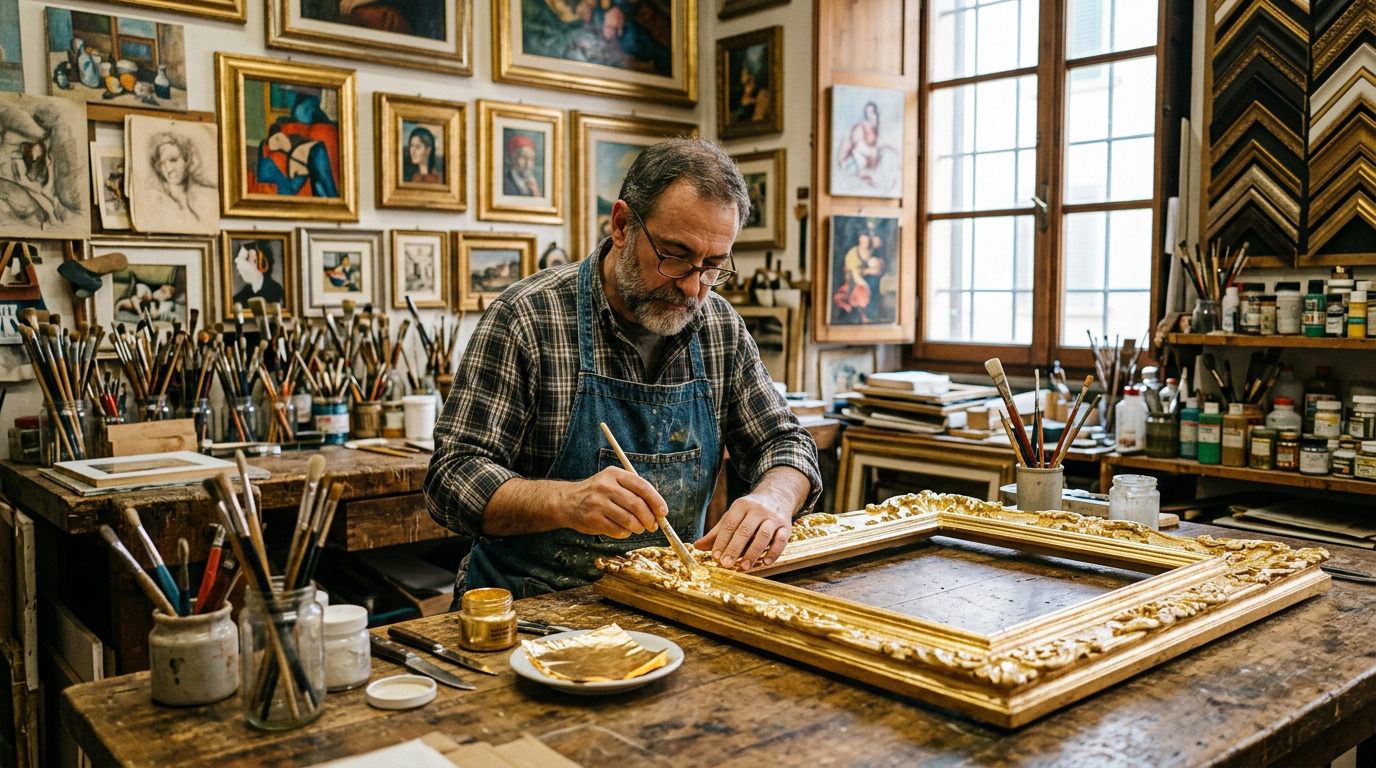
Gold-leaf gilding, the technique most associated with Florentine frames, requires a sequence of operations that takes several days even for an experienced maker. The wooden substrate, poplar, lime, or walnut, depending on the period and the desired finish, is first carved or moulded into the frame profile. It is then coated with multiple layers of gesso (a mixture of calcium sulphate and rabbit-skin glue), sanded between coats to a near-perfect surface. The bole, a clay-based layer, typically Armenian bole in a terracotta colour, is applied over the gesso. Then, and only then, is the gold applied, in sheets thinner than 0.1 micrometres, using a gilder’s cushion, a broad soft brush, and a gilder’s tip. The gold adheres by the moisture in the bole. Finally, burnishing with a polished agate stone creates the reflective surface characteristic of water gilding.
This process, essentially unchanged since the 15th century, produces the only truly reflective gold surface available in framing. Oil gilding, the faster alternative used for commercial frames, uses oil-based mordant instead of water-bole, and the resulting surface is more durable but less luminous. A trained eye can distinguish them immediately.
Active corniciai workshops in Oltrarno
Cornice Sauro on Via del Campuccio in the western Oltrarno, approximately 600 metres from Via Pisana 191 heading east, has been operated by the same family since 1978. The workshop produces both period reproduction frames and contemporary versions using traditional techniques. A commission for a standard water-gilded frame for a painting measuring 40 × 50 cm begins at €320–€450 in 2026, depending on the complexity of the carved profile. Production time is typically four to six weeks.
The workshop also restores historical frames, removing later overpaints, re-gilding worn sections, and consolidating lifted gesso, which accounts for a significant portion of its income from museum and private clients. Visitors can enter the workshop during business hours (Monday–Friday 9:00–13:00 and 15:00–18:00) and observe the gilding process; the owners are accustomed to explaining the technique and are willing to do so in basic English.
Bottega Gori on Borgo San Jacopo, midway between Ponte Vecchio and Ponte Santa Trinita, is a smaller operation run by a single craftsman. The specialty is 17th and 18th-century Florentine frame reproductions, specifically the heavy baroque profiles with deep coves and elaborate carved ornament that were the standard format for altarpieces in that period. A reproduction of a typical Florentine Seicento frame for a medium-format painting costs €500–€800. The quality of the carving is high; the production time is long (eight to twelve weeks for complex profiles).
The gesso and bole process in detail
The gesso process requires eight to twelve separate coats, each dried and sanded before the next is applied. The gesso mixture, calcium sulphate suspended in warm rabbit-skin glue, must be applied at a specific temperature (the glue gels on cooling) and must be kept at approximately 40°C during application. Too hot, and it soaks into the wood; too cool, and it drags and forms bubbles. The sanding between coats creates a surface so smooth that it shows fingerprints.
The bole layer, typically Armenian bole, a fine clay mined in Armenia and Turkey that has been used in gilding since antiquity, is applied in three coats over the gesso. It is the bole that gives the final gilded surface its colour depth: a warm terracotta bole produces a gold with reddish undertones, while a grey bole creates a cooler gold. This is why the same gold leaf produces different visual results on different frames.
After burnishing, many Florentine gilders apply a light wash of wax or diluted beeswax over sections of the frame to create tonal variation, a technique called “antiquing” that differentiates the highlights from the recessed areas and gives the impression of age. The original 15th and 16th-century frames that this technique imitates have acquired their tonal variation through centuries of oxidation and handling; the process simulates in hours what time produces over decades.
Reproduction versus restoration
The distinction between reproduction and restoration matters for buyers considering a commission. A reproduction frame is a new object made using traditional methods, intended to house either a copy of an old painting or a new painting that the owner wants to display in a period-appropriate manner. A restoration frame is an original object, old wood, old gesso, old gold, that has been repaired to stabilise and present its original surface.
Restoration is generally more expensive per unit area than reproduction, because the craftsman must work around the existing condition of the object rather than building from a clean substrate. It also requires different skills: identifying the original bole colour, matching the original gold with period-appropriate leaf (gold leaf is available in multiple karats and tones), and consolidating fragile existing surfaces without damaging them.
Several Florentine frame-makers do both, and the same workshop that makes reproduction frames for new paintings will also take in historical frames for stabilisation. If you have a painting with a damaged original frame, it is worth bringing photographs to any of the Oltrarno workshops for an estimate before committing to a full strip-and-regild, which destroys original material.
Buying ready-made gilded frames
Not every buyer needs a custom commission. Several shops in Oltrarno sell ready-made water-gilded frames in standard sizes. These are produced in workshops, often in quantities, from fixed profiles, and cost significantly less than custom work. Expect €60–€180 for a ready-made water-gilded frame in sizes up to 40 × 50 cm, depending on the profile complexity and the finish.
The antique market at Piazza dei Ciompi, held on the last Sunday of each month in the San Giovanni neighbourhood (2 km from Via Pisana via Ponte alle Grazie), regularly includes dealers selling original antique frames. These are not gilded to order but are period objects, 18th and 19th-century frames in various conditions, priced from €40 for simple small frames to €600–€1,200 for large ornate examples with original gold intact.
Where to stay
The concentration of active frame-making workshops in Oltrarno, most within a ten-minute walk of Ponte Vecchio, makes the neighbourhood the obvious base for anyone visiting Florence with an interest in traditional craftsmanship. The workshops open during regular business hours, and the proximity to the Uffizi (twenty minutes on foot across the river) means you can compare the original historic frames in the museum collection with what the living workshops produce. De’ Medici sits in the heart of this craftsman’s district and is the natural starting point for this kind of itinerary.