Walking guide to Dante's Florence: places to visit
Dante and Florence: what the historical record says
Dante Alighieri was born in Florence in May 1265, in the San Martino parish near the Bargello, and died in Ravenna in 1321, never having returned to Florence after his exile in 1302. What survives of his Florentine life is largely the urban fabric of a medieval city that has changed substantially but not beyond recognition: the Baptistery he described in the Inferno still stands, the district where he grew up is still dense with medieval tower houses, and several of the specific topographic references in the Commedia can still be walked.
The biographical evidence for Dante’s life in Florence is thin. The primary sources, his own works, Giovanni Boccaccio’s Trattatello in laude di Dante (c. 1357), and Leonardo Bruni’s Vita di Dante (1436), agree on a limited set of facts: he was educated in Florence, he fell in love with Beatrice Portinari (traditionally identified as the daughter of Folco Portinari, a prominent Florentine citizen), he participated in the Battle of Campaldino in 1289 as a cavalry soldier, he held political office as one of the Priors of the guilds in 1300, and he was condemned to death in absentia by the Black Guelph faction in 1302.
The house in the San Martino district now marketed as the Casa di Dante at Via Santa Margherita 1 is a 19th-century reconstruction, not a surviving medieval building. This does not diminish its value as a museum, the permanent exhibition (€4 adult admission in 2026; open Tuesday to Sunday 10:00–18:00) provides solid documentation of Dante’s historical context, but visitors should know that the building itself is not where Dante lived.
The Baptistery: Dante’s specific reference
The Baptistery of San Giovanni on Piazza del Duomo is the building with the strongest documented connection to Dante. He was baptised here, references it repeatedly in the Commedia, and describes its octagonal form in the Inferno with enough architectural precision to confirm that his knowledge of the building was direct and detailed. In Inferno XIX, 17, he refers to the “belli fonti”, the baptismal fonts in the floor, breaking one open to rescue a drowning child, an episode that suggests intimate familiarity with the interior arrangement.
The Baptistery in Dante’s time looked substantially as it does now. The bronze doors were not yet complete, Ghiberti’s north and east doors were not commissioned until 1401 and 1425 respectively, but the Romanesque marble cladding, the octagonal cupola, and the interior mosaic ceiling (depicting, in its upper sections, the Last Judgment that surely informed Dante’s own eschatological imagination) were all in place. The mosaic ceiling is particularly relevant: the figure of Satan in the center of the Judgment mosaic, enormous and three-headed, consuming sinners, is one of the visual sources that scholars identify in Dante’s description of Lucifer in the final canto of the Inferno.
Admission to the Baptistery is included in the combined Duomo Opera pass: €20 in 2026, covering the Baptistery, the Cathedral, the Campanile, the Museo dell’Opera del Duomo, and the excavations of Santa Reparata beneath the Cathedral floor.
Santa Croce and the cenotaph
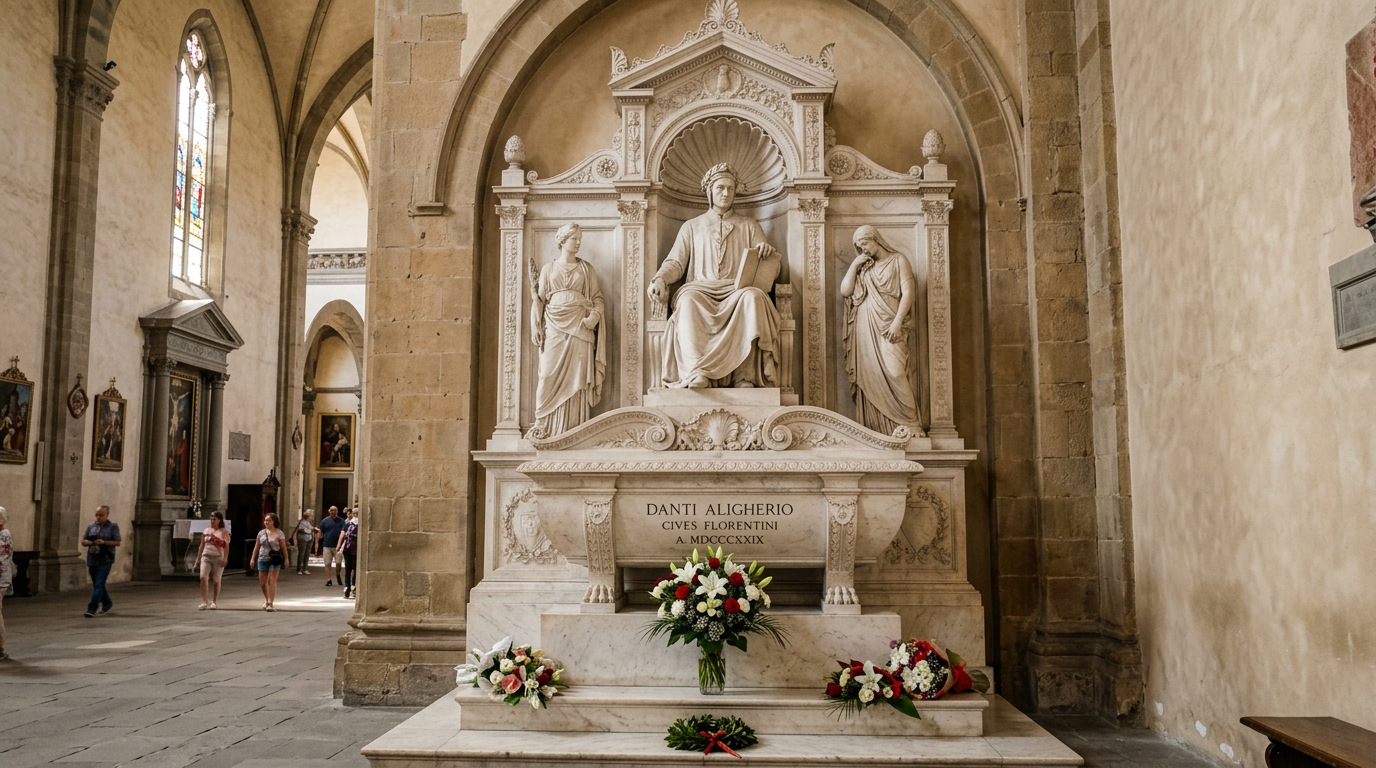
The Basilica di Santa Croce on Piazza Santa Croce contains a cenotaph to Dante, an empty tomb, erected in 1829 by the sculptor Stefano Ricci. The decision to build it reflects the campaign to recover Dante’s remains from Ravenna, a diplomatic effort by the Florentine government that failed repeatedly; Ravenna has refused to return the bones since 1519. The cenotaph sits in the nave’s right aisle, between the tombs of Michelangelo and Galileo, in the section that became known in the 19th century as the Pantheon of Italian national identity.
The piazza outside contains the large marble statue of Dante by the sculptor Enrico Pazzi, installed in 1865 to mark the 600th anniversary of Dante’s birth. The statue shows Dante in three-quarter length, his expression set and severe, wearing the laurel crown that was never actually awarded to him in life, Florence refused to crown him, and the ceremony his supporters hoped would take place never occurred.
The church interior also contains the Castellani Chapel, the Baroncelli Chapel with frescoes by Taddeo Gaddi, and the Bardi and Peruzzi chapels with the Giotto frescoes, all of them from a period close enough to Dante’s lifetime that his contemporaries would have seen earlier versions of what Giotto was beginning to build. Giotto and Dante were contemporaries; Dante mentioned him in the Purgatorio as the painter who had eclipsed his predecessor Cimabue. Admission to Santa Croce: €8 in 2026.
The Oltrarno connection: Beatrice Portinari’s parish
The Church of Santa Margherita de’ Cerchi, a tiny medieval oratory on Via Santa Margherita near the Bargello, between Dante’s neighbourhood and the Baptistery, is traditionally identified as the church where Dante met Beatrice Portinari, and where Beatrice’s family worshipped. The church is now managed as a Dante memorial site. Inside there is a small basket for love notes left by visitors, an informal custom that began sometime in the 1990s and has continued. The church is free and open most mornings; it is fifteen minutes on foot from Via Pisana 191 via Ponte Vecchio.
The Oltrarno connection to Dante is indirect but present. Boccaccio, who wrote the first biography of Dante and delivered a series of public lectures on the Commedia in Florence in 1373, lived in Certaldo (30 km south-west of Florence) but delivered his Florentine lectures at the church of Santo Stefano in Badia, which borders the Bargello complex. More directly, the Portinari family, Beatrice’s family, had property connections to both the San Giovanni district and the area near the Ponte Vecchio.
Walking the Dante route
A coherent Dante walking route in Florence takes approximately three hours at a moderate pace, covering roughly 4 km. Starting from Via Pisana 191, the route heads north along Via Pisana to Ponte alla Carraia (1.3 km, eighteen minutes), crosses to the north bank, then proceeds east along the Arno past Ponte Santa Trinita toward Ponte Vecchio.
From Ponte Vecchio, Via Por Santa Maria leads north to Piazza della Signoria (the square where Dante’s political career centred and where he was condemned). Via dei Calzaiuoli then connects north to Piazza del Duomo and the Baptistery. From the Baptistery, the short walk east to Via Santa Margherita passes the Casa di Dante museum and Santa Margherita de’ Cerchi. The route ends at Piazza Santa Croce (a further ten-minute walk east), where the cenotaph and the Pazzi statue provide the formal conclusion. The walk returns to Oltrarno via Ponte alle Grazie.
Where to stay
The Dante circuit described above is structured around entry and exit points from Oltrarno via the Ponte bridges. A base in Oltrarno makes the entire route walkable from both ends, and the proximity to Ponte Vecchio, Ponte alla Carraia, and Ponte alle Grazie allows for return routes that do not simply retrace the outward path. De’ Medici is located on Via Pisana, which places it at the natural western starting point for this walk and within easy reach of all the significant Dante sites in the city.