Best photography spots in Oltrarno Florence
Light conditions in Florence by season and time
Florence sits at latitude 43.77°N. In October, sunrise is at approximately 7:15 a.m. and the golden hour window, the period of low-angle, warm-toned light, extends until about 8:15 a.m. By December, sunrise shifts to 7:45 a.m. Summer golden hour in June begins before 6:00 a.m. and lasts until approximately 7:20 a.m., with the disadvantage that the city fills with visitors from about 9:00 a.m. onward. The October window is therefore the most practical for photographers who want quality light and manageable crowd levels simultaneously.
The Arno’s reflective surface amplifies light conditions. On clear days, the river reflects the sky and the southern facades of the buildings along the north bank, producing light from below that fills the shadows under the eaves and soffit lines. This is particularly evident in the thirty-minute period after sunrise, when the angle of incoming light and the brightness of the reflected surface are closely matched. Overcast days with high thin cloud produce even, diffuse light that eliminates the strong shadows that can flatten facade detail.
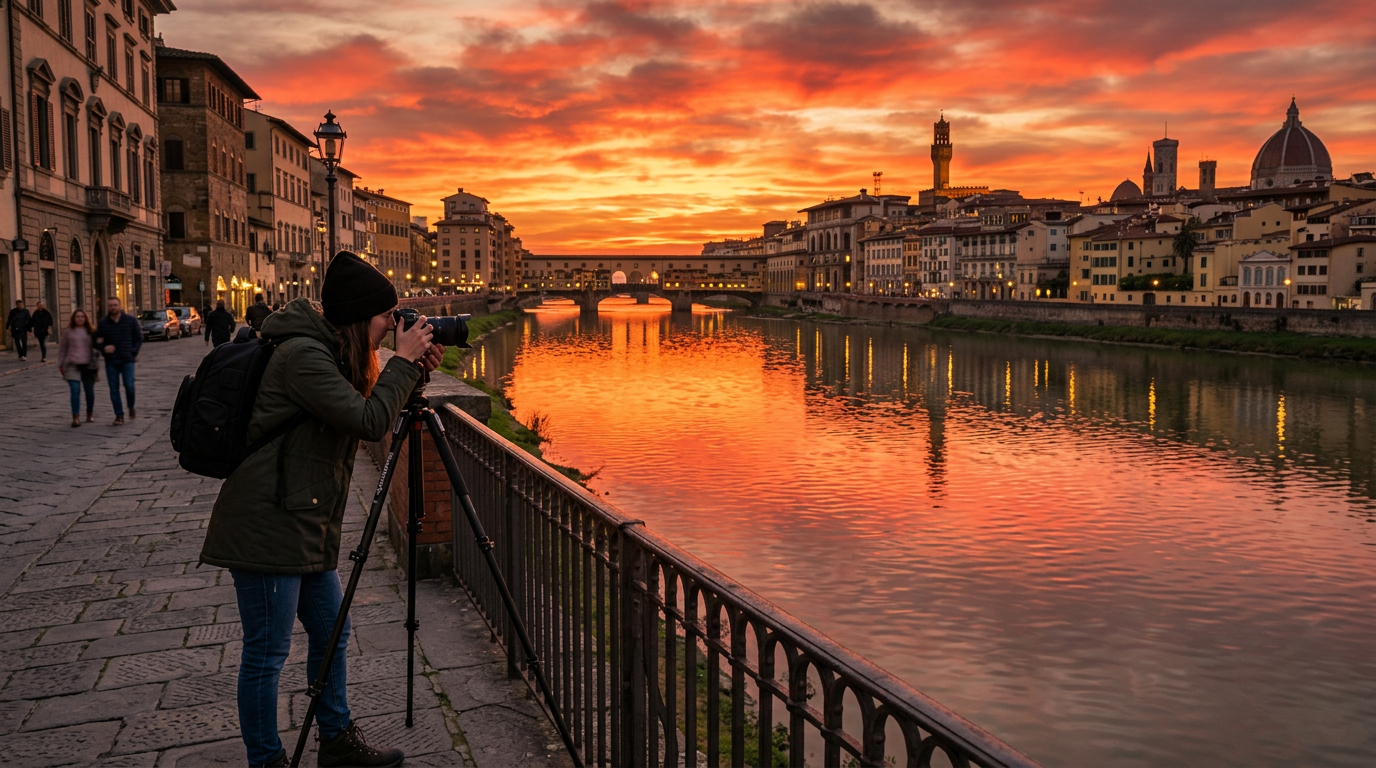
Blue hour, the twenty-minute period after sunset when ambient light is still sufficient but the sky is deep blue and artificial lighting has come on, is reliably the most productive shooting period for bridge views. The Ponte Vecchio’s shop lights, the warm sodium streetlights along the Lungarni, and the tower illuminations create a multi-layered light environment that works well with a slow shutter speed from a tripod.
The Ponte Vecchio and Lungarno shots
The standard Ponte Vecchio view, looking east from Ponte Santa Trinita, with the bridge centred and the Vasari Corridor visible above the shops, is one of the most photographed compositions in Italy and can feel exhausted as a subject. The less-used version is the reverse: standing on the Ponte Vecchio itself and shooting west toward Ponte Santa Trinita with the Arno receding to the right. This places the bridge’s support piers in the foreground and the spandrels of Santa Trinita as the background element. In flat light, this reads as a straightforward architectural shot; in directional morning light from the east, the eastern faces of Santa Trinita’s arches are brightly lit while the western faces are in deep shadow, creating a graphic contrast.
The view from Ponte alle Grazie, approximately 400 metres east of the Ponte Vecchio, shows all three of the central bridges simultaneously, Santa Trinita, Vecchio, and Alle Grazie itself, in recession, with the dome of Santo Spirito rising above the Oltrarno roofline on the right. This composition requires a moderate wide-angle lens (24–35mm equivalent on full-frame) and is best in the thirty minutes after sunrise when the eastern-facing facades of the north-bank buildings are lit and the bridges are backlit.
Lungarno degli Archibusieri, on the north bank east of Ponte Vecchio, provides the shooting position for the classic low-angled Ponte Vecchio view where the bridge’s downstream facade is reflected in a long lens compression. A 70–200mm lens at 135–200mm, from a position standing on the bank approximately 150 metres east of the bridge, compresses the distance and emphasises the yellow-and-ochre colour of the bridge shops.
Oltrarno backstreets: the photographic interior
The streets of Oltrarno west of Via de’ Serragli, roughly the corridor between Borgo San Frediano, Via Pisana, and the Arno, constitute the most photographically unprocessed part of central Florence. This is the section where the neighbourhood is still primarily residential rather than tourist-oriented, where laundry hangs between windows, where motorcycle workshops and small alimentari occupy ground floors next to residential entrances, and where the street fabric still resembles a working Italian neighbourhood rather than a preserved heritage district.
Borgo San Frediano itself, running east-west from the Porta San Frediano to the Ponte alla Carraia, has the proportions and character of a medieval commercial street: narrow, straight, with a continuous building line that creates a strong tunnel perspective at most focal lengths. Morning light enters from the east, striking the western end of the street and leaving the eastern section in shadow. This east-west orientation means the street is usefully lit for approximately one hour after sunrise.
Via dell’Orto, Piazza del Carmine, and the surrounding streets retain hand-painted shop signs, iron gate patterns, and the textural variety of a neighbourhood that has not been systematically renovated. The Carmine church’s plain pink facade on the piazza provides a large flat surface that changes character dramatically depending on the angle and quality of the light.
Elevated viewpoints: data and access
Piazzale Michelangelo is the dominant viewing platform above Florence, approximately 3 km from Via Pisana 191 by foot via Via del Monte alle Croci and the staircase up the hillside. The walk takes thirty-five to forty minutes at a moderate pace. The view covers the full sweep of the city from the Forte di Belvedere to the east towards Fiesole. The platform is at roughly 104 metres above sea level, compared to the city centre’s 50 metres.
The problem with Piazzale Michelangelo for photography is crowds: in summer and on weekends year-round, the platform is dense with visitors and the terrace railing is occupied from early morning. In practice, the most usable window is approximately 40 minutes before and after sunrise, when most visitors have not yet arrived or have already left. A tripod is essential for this purpose; arrive at least twenty minutes before your target light window to claim a position.
The Rose Garden (Giardino delle Rose) on the slope below Piazzale Michelangelo, accessible via a path from Via dei Bastioni, provides mid-elevation views of the city across the valley, slightly lower than the Piazzale and at a different angle. The garden opens at 9:00 a.m. (April–October) and is free; it is significantly less crowded than the Piazzale. The view from the northwest corner of the garden, shooting southeast, captures the Duomo, the campanile, and the river bend at once.
The Forte di Belvedere, further east along the hillside at Via di San Leonardo, is accessed from the Giardino di Boboli or from the Porta San Giorgio on Costa San Giorgio. The battlements offer a less standardised view of the city than Piazzale Michelangelo, looking northwest, with the dome in the middle distance and the western suburbs visible beyond. The Fort is open when there is a temporary exhibition in residence; entry costs €10–€14 depending on the exhibition.
Technical notes for street and architectural photography
Florence’s street photography presents two recurring challenges: extreme contrast between lit facades and shadowed streets, and the legal complexity of photographing private property. For the contrast issue, the practical solutions are either to work in flat overcast light that equalises the difference, or to expose for the shadows and accept burnt highlights in the sky, using RAW capture for recovery in post. A graduated neutral density filter is useful for bridge shots where the sky and the water surface have different exposure requirements.
On the legal question: Italy’s laws on photography of public facades, streets, and architectural works are more permissive than most visitors expect. The general rule is that photography of buildings visible from public space, for personal or journalistic use, does not require permission. Commercial photography, images used in advertising or sold, may require a permit from the property owner or the relevant soprintendenza. Street photography of people in public spaces is legal provided it does not constitute harassment and is not commercially exploitative.
Where to stay
Oltrarno provides both the low-elevation vantage points on the riverbank and the starting points for the uphill routes to Piazzale Michelangelo and the Forte di Belvedere. The early-morning light windows that matter most to photographers are most easily captured from a base within walking distance of the location, eliminating transit time and giving you direct access to the streets and viewpoints at the exact moment the light appears. De’ Medici is on Via Pisana, which positions you at the western entry point of Borgo San Frediano, one minute from Oltrarno’s most photogenic backstreets, and thirty-five minutes on foot from the summit of Piazzale Michelangelo.