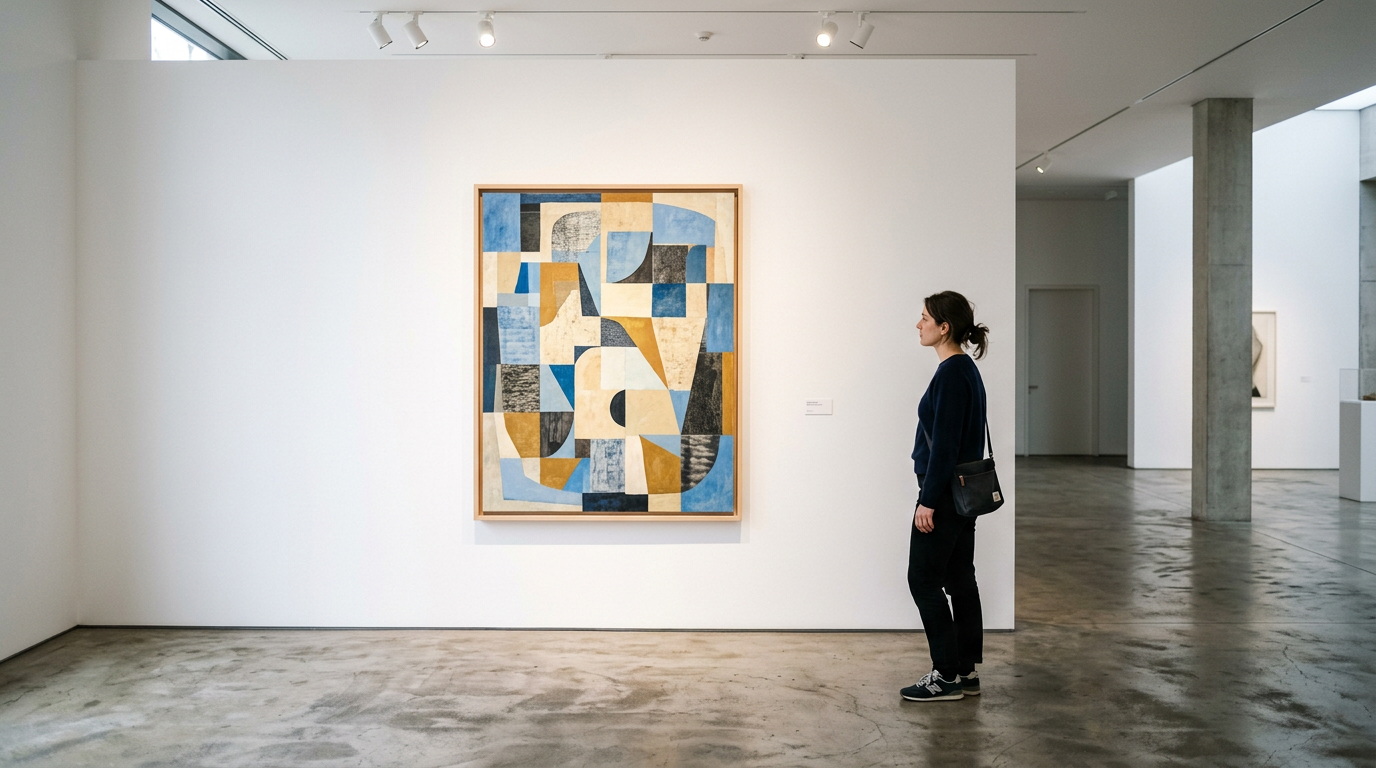
Contemporary art galleries in Florence Oltrarno
Contemporary art in Oltrarno: why the density matters
Oltrarno did not become a contemporary art district by accident or by the logic of gentrification alone. The neighbourhood south of the Arno had been home to artisan workshops for centuries before the first galleries opened here in the 1970s: frame-makers on Via Toscanella, gilders near Piazza Santo Spirito, stone-carvers on the slopes toward San Miniato. This existing culture of precision handwork created conditions that suited working artists, who found specialist suppliers, unusually high ceilings in converted workshops, and a community indifferent to the noise and smell of production.
The economic pull was real. Rents south of the Arno remained lower than in the historic centre through the 1980s and into the 1990s. That differential attracted first Italian artists looking for affordable studios, then a second wave of foreign painters and sculptors, American, French, British, German, who had come to Florence on scholarships or residencies and simply stayed. By 2010, the area bounded by Via dei Serragli, Borgo San Frediano, Via Maggio, and the Lungarno contained roughly twenty active gallery spaces and an unknown number of private studios, many of which opened during periodic city-wide open-studio events in spring and autumn.
Today the neighbourhood accounts for more square metres of active gallery space than any other district in the city. The Florentine contemporary art market is not large by international standards, it is not Milan or Rome, but within that modest scale, Oltrarno is the centre of gravity.
Galleries to visit now
Galleria Tornabuoni Arte maintains a large space on Lungarno Soderini, about 400 metres west of Ponte Vecchio. The programme focuses on post-war Italian art, Fontana, Schifano, Accardi, Boetti, plus selected international names. Shows rotate every six to eight weeks. Entry is free. Opening hours are Tuesday to Saturday, 10:00 am to 7:00 pm. The gallery represents established market values, with works priced in the tens of thousands of euros, but attendance requires no purchase, and the quality of the hang is consistently high.
Sergio Tossi Arte Contemporanea, operating near Porta Romana since the early 1980s, has one of the longest track records in the city for Italian conceptual work. The gallery has shown Stefano Arienti, Vedovamazzei, and a rotation of Italian artists working in video, installation, and works on paper. It tends to show work that requires attention rather than immediate gratification. Tuesday to Saturday, 10:30 am to 1:00 pm and 3:30 pm to 7:00 pm. Entry free.
Sala Vanni at Piazza del Carmine occupies a former convent refectory attached to the church of Santa Maria del Carmine. The vaulted spaces are used for exhibitions, concerts, and performance events. No permanent collection; programming is produced by the Fondazione Cassa di Risparmio di Firenze. Check the website for current shows before visiting. The architecture of the building, former cloisters converted with minimal intervention, is worth the visit regardless of what is showing.
For institutional-scale exhibitions with international production budgets, Fondazione Palazzo Strozzi runs two to three major shows per year in the courtyard and basement Strozzina of Palazzo Strozzi, 800 metres north of the river. Recent seasons have included retrospectives of Donatello, Marina Abramović, and Anish Kapoor. Entry to the courtyard is free; exhibition tickets cost between €10 and €16.
Artists working in studios off Via Maggio
The streets between Via Maggio and Lungarno Torrigiani, Via dei Vellutini, Via dello Sprone, Via dei Coverelli, have the highest concentration of working studios in Oltrarno. The buildings here are typically 16th- and 17th-century palazzi, subdivided over generations into smaller units. Many ground-floor spaces that were once artisan workshops are now studios. You can identify them by the large industrial windows retrofitted into older stone facades, the multiple buzzers beside unmarked doors, and occasional smells of linseed oil or plaster.
Florentine studio practice is private by default. Studios are not open-access like galleries. The reliable way to see inside them is through organised events. The Comune di Firenze supports an annual open-studio programme in May, usually the second or third weekend, during which registered artists open their doors for two days. The programme is free. A printed map is available at tourist information points and from participating galleries from early April onwards.
Foreign artists form a notable sub-community within this network. Several American painters who arrived on Fulbright or American Academy grants in the 1990s and 2000s remained and now occupy studios that function as informal salons. Italian and foreign artists interact regularly in this neighbourhood in ways they do not in more compartmentalised cities. The proximity to the Brancacci Chapel, the Boboli Garden, and the extraordinary concentration of Renaissance works in the neighbourhood’s own churches keeps the historical conversation alive whether artists invite it or not.
How to track openings and programming
Gallery openings in Oltrarno cluster on Thursday evenings between 6:00 pm and 9:00 pm. These are not private events requiring invitations. Anyone who arrives is welcome. The combination of new work, a glass of wine, and the possibility of meeting the artist or curator makes these evenings a genuine cultural experience rather than a marketing exercise. Dress code is none.
Instagram is now the primary communication channel for most Florentine galleries. Each of the spaces mentioned above maintains an account updated at least weekly. Following five or six of them gives you a complete picture of current programming without the need for printed guides or websites. Most announce openings two to three weeks in advance, which allows planning for a visit.
The Firenze Art Guide, a printed seasonal publication distributed free at galleries and the tourist office in Piazza della Repubblica, lists current and upcoming shows across the city. New editions appear roughly every two months. Pick one up on arrival and use it as a planning document. It covers both Oltrarno and the north bank without distinguishing between them, which is useful for understanding the full picture.
The Stazione Leopolda, in the San Frediano sub-neighbourhood immediately west of the central Oltrarno area, hosts Pitti Arte and other large-format cultural events three or four times per year. These bring temporary programming that would not otherwise reach the city. The venue, a converted 19th-century rail terminus, is itself worth knowing.
The specific conversation between old and new work here
Artists who live and work in Oltrarno spend time in the Brancacci Chapel at Santa Maria del Carmine, where Masaccio painted his foundational frescoes between 1424 and 1427. They visit the Cappella Brancacci not as tourists but as practitioners examining a solution to a problem, how to represent spatial depth and individual psychology in paint, that remains technically interesting five hundred years after it was solved. This proximity to source material is one reason Oltrarno continues to attract painters in particular.
The dialogue is not always reverential. Several artists who work in the neighbourhood describe the Renaissance presence as a pressure they work against rather than with. The weight of historical achievement is real and requires deliberate resistance. Video installations placed in medieval vaulted spaces, abstract paintings hung beneath baroque frescoed ceilings, performance work staged in church courtyards, these juxtapositions are common in Oltrarno and they read differently here than they would in a purpose-built white cube.
What the neighbourhood offers that no other part of Florence does is compression: the distance in time between Masaccio’s frescoes and a painting made last month is enormous, but the physical distance between the studio where one was made and the church where the other hangs can be measured in metres. That compression changes how both objects are perceived. Neither one is entirely comfortable with the other. The friction is productive.
Where to stay
The galleries, studios, and institutional spaces of Oltrarno’s contemporary art district are within a ten-minute walk of each other, and the neighbourhood itself rewards slow exploration on foot. For visitors who want to attend openings, visit studios, and move between gallery to gallery without crossing the Arno, a base in the south bank is the practical choice. De’ Medici is located in Oltrarno, directly inside this concentration of activity.