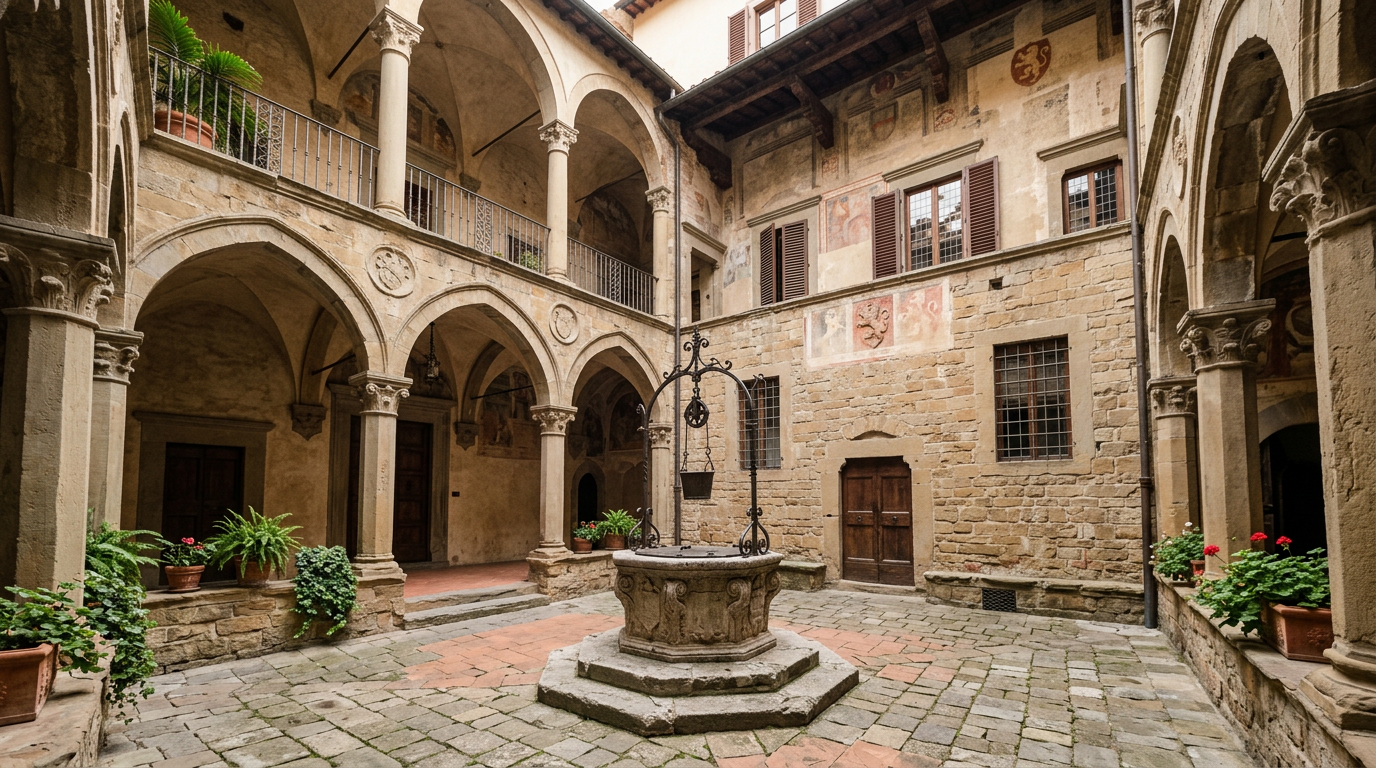
Visiting Palazzo Davanzati in Florence: full guide
A medieval house that survived intact
Via Porta Rossa 13 is a short street connecting Piazza della Repubblica to the area near Ponte Vecchio. Along it stands Palazzo Davanzati, a 14th-century merchant’s palace that has never been significantly altered and now operates as one of Florence’s most instructive museums. On weekday mornings, it is frequently almost empty.
The building was erected in the second half of the 1300s for the Davizzi family, a clan of wool merchants whose wealth placed them among the middling tier of Florentine prosperity, well-off enough to build in stone, not wealthy enough to commission fresco cycles from leading artists. The palace passed through several owners. It takes its current name from Bernardo Davanzati, a 16th-century linguist and historian who occupied it and left a record of its contents.
What saved the building from Renaissance and later renovation was a series of financially limited owners who lacked the means or motivation to modernise. By the 19th century it had been subdivided into rental apartments. In 1904, Elia Volpi, an antiques dealer with scholarly instincts, bought the palace, cleared the subdivisions, and spent years furnishing it with medieval and early Renaissance objects collected from Tuscany. The Italian state acquired it in 1951. The restoration completed in 2009 stabilised the structure and the frescoes.
History of the Davizzi family and the palace
The Davizzi were active in the Florentine wool trade during the 13th and 14th centuries. Their commercial networks extended to northern Europe, where Florentine merchants had established trading offices in Bruges, Ghent, and London to buy raw English wool for processing in Tuscan workshops. The ground floor of the palace was designed around this commercial activity: wide ground-floor arches allowed the movement of bales, and a system of metal hooks in the ceiling provided attachment points for hoisting goods.
The palace’s structural logic follows the standard Florentine merchant model. Business on the ground floor. Family living quarters on the upper floors, protected by heavy doors and internal bolts. A private well shaft running from the courtyard up through each floor, allowing water to be drawn without descending to street level. A roof loggia for laundry, food drying, and family activities that required open air.
The construction technique is pietra forte, the sandy-brown sandstone quarried from the hills south of Florence that was used for most of the city’s medieval building stock. The stone was cut in large ashlar blocks and laid with minimal mortar. The facade, with its sequence of triple-arched windows, follows the standard Florentine palazzo typology of the period.
What the rooms contain
The Sala Madornale on the piano nobile is the building’s most significant space. Its walls carry a fresco cycle depicting La Châtelaine de Vergy, a French courtly romance of the early 13th century that was widely circulated in Italy by the late 1300s. The frescoes date from approximately 1350. They are among the very few surviving secular narrative fresco cycles in medieval Florentine domestic architecture, the others have been lost to renovation, flood, and fire over the centuries. The colours have faded but the narrative sequence is legible.
The second-floor rooms contain a bedroom with a canopied bed of the kind used in prosperous 14th-century households. The walls here show a different decorative programme: repeating patterns of parrots set against a geometric ground, derived from Islamic textiles that reached Florence through trade networks in the eastern Mediterranean. The choice was aspirational. Textiles from the Levant were expensive and fashionable.
The kitchen floor is the most practically informative part of the museum. The hearth is full-scale, the storage systems intact. You can understand how meals were produced: the supply of firewood, the placement of cooking vessels, the proximity of the well. The kitchen had no chimney in the modern sense; smoke was managed through openings in the ceiling and roof.
The private chapel is small and intimate, containing a painted altarpiece suitable for daily private devotion. The display cases throughout the palace hold ceramics, embroidered textiles, carved wooden cassoni, and glassware, many collected by Volpi from different sources, not original to the building, but selected to represent the material culture of the period.
Opening hours, prices, and practical information
Palazzo Davanzati is open Tuesday through Sunday. Monday is the closing day. Morning sessions run from 8:15 to 13:30. Guided tours of the upper floors depart at 10:00, 11:00, and 12:00; each tour lasts approximately 45 minutes and must be booked at the entrance on the day, as advance online booking is not typically available for these slots.
Afternoon sessions operate on selected days; the schedule changes seasonally and is published on the official museum website (museumflorence.com). The museum closes periodically for maintenance. Check before travelling.
Entry in 2026 costs €6 for adults. EU citizens aged 18–25 pay €2. Visitors under 18 enter free. On the first Sunday of each month, all Italian state museums including Palazzo Davanzati admit the public without charge. The museum is included in the Firenze Card, the 72-hour city pass sold at major museums and online for approximately €85.
Photography without flash is permitted throughout the building. Audio guides are available in Italian and English for a small supplement at the ticket desk.
How to reach the museum on foot
The address, Via Porta Rossa 13, is central enough that no public transport is necessary from anywhere in the historic core. From Piazza della Signoria, walk west along Via delle Terme or Via del Proconsolo, then north into Via Porta Rossa. The walk takes under seven minutes.
From Ponte Vecchio, cross and walk north along Via Por Santa Maria, then bear left onto Via Porta Rossa. Six minutes at a normal pace. The entrance is unassuming: a stone arch at street level between the two restored ground-floor openings, with a small museum sign.
From Oltrarno, the walk crosses Ponte Vecchio and adds roughly three minutes. There is no need for a taxi or bus from any central point in Florence.
Why the museum is worth prioritising
Florence’s great museums, the Uffizi, the Accademia, the Bargello, present the apex of artistic production: works made for churches, great families, and civic bodies. Palazzo Davanzati presents something the apex museums cannot: the physical space of ordinary wealthy life in 1350. The proportions of a bedroom, the weight of a bolt on a door, the height at which a fresco was painted relative to a person standing below it.
The secular fresco cycles alone justify the visit. Most visitors to Florence spend days looking at religious paintings without encountering a single surviving example of the private decorative painting that once covered the walls of every prosperous household in the city. These frescoes are the exception that illuminates what has been lost everywhere else.
The absence of queues is significant in practical terms. A visit to Palazzo Davanzati on a Tuesday morning takes ninety minutes and requires no advance booking. The same morning at the Uffizi, without a pre-booked ticket, is effectively impossible between March and October.
Where to stay
Palazzo Davanzati is eight minutes on foot from Ponte Vecchio, the bridge that connects the north bank to Oltrarno. A morning visit to the palace followed by lunch in the Oltrarno neighbourhood requires no transport and no planning. For visitors based in that neighbourhood, De’ Medici is a guesthouse in Oltrarno well-positioned for this kind of itinerary, where the two banks of the city are equally accessible.