Oltrarno evening walks in Florence: local guide
Oltrarno after the museums close
The Uffizi closes at 22:00 in summer, but the process of emptying the historic centre begins earlier. By 19:30, the tour groups that spent the afternoon in the Boboli Gardens have boarded their coaches. The souvenir stalls on Ponte Vecchio are pulling down their shutters. The streets north of the Arno are beginning the transition from organised mass tourism to restaurant pre-dinner crowding.
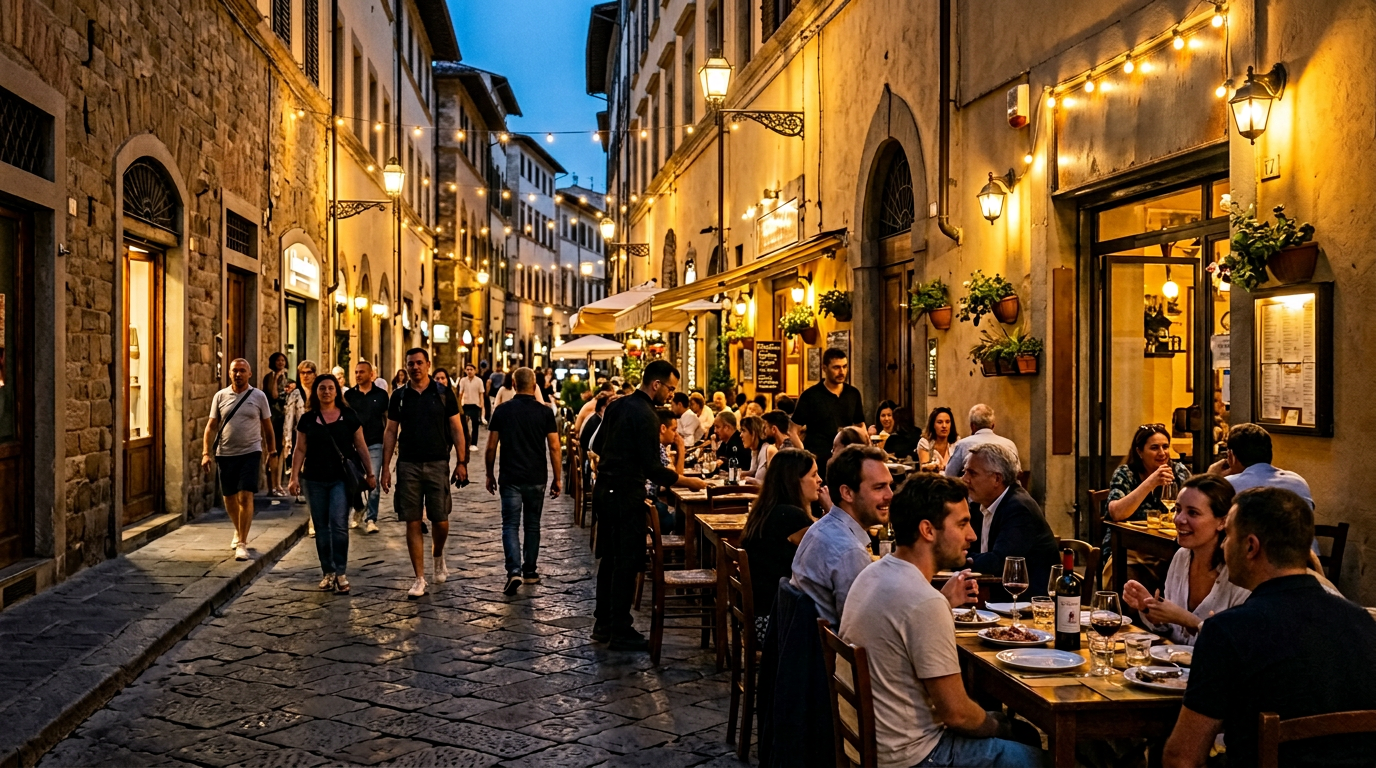
Oltrarno, the neighbourhood south of the Arno, undergoes a different transformation. As the day visitors leave, the residential population re-emerges. People who live here return from work. The bars that cater to local regulars begin filling. Children appear in the piazzas. The noise level rises by a third, but the character of the noise changes, it becomes more conversational and less transactional.
This is the best time to walk in Oltrarno. The neighbourhood covers roughly two square kilometres between Ponte Vecchio to the east and Porta San Frediano to the west. You can walk it end to end in twenty minutes. The density of worthwhile streets, squares, and stopping points means that a well-planned evening walk can occupy two or three hours without strain.
The main walking route from east to west
Begin at Piazza dei Mozzi, on the south bank just east of Ponte alle Grazie. The piazza is quiet and slightly austere, bounded by two large 13th-century palaces and the beginning of the hill road to San Miniato. It receives almost no tourist traffic in the evening.
Walk west along Via dei Bardi. This is one of the oldest inhabited streets in Oltrarno, a long, slightly curved road lined with Renaissance palaces that were the homes of prominent Florentine families from the 13th century onwards. The Capponi, the Bardi, and the Mozzi all had significant presences here. The street is narrow and the buildings rise four or five floors. In the evening, upper-floor windows are open, and you hear the sounds of cooking and conversation from inside.
At the end of Via dei Bardi, turn south along Via Guicciardini toward Piazza de’ Pitti. The Palazzo Pitti facade, 170 metres wide, the largest palace in Florence, is lit at night and almost free of visitors by 20:00. Stand in the piazza and look at the scale of it. The current building is a 16th-century enlargement of a 15th-century structure. The Boboli Gardens, behind and above the palace, extend for 45,000 square metres up the hillside.
Continue west along Sdrucciolo de’ Pitti and turn into Via Maggio. This is the most architecturally homogeneous street in Oltrarno, a sequence of grand 16th and 17th-century palaces that were built as the neighbourhood became fashionable after Cosimo I moved the ducal court to Palazzo Pitti in 1550. Today Via Maggio is lined with antique dealers and restoration workshops. In the evenings it is quiet and slightly melancholy, as good streets in Italian cities often are.
Piazzas worth stopping in
Piazza Santo Spirito is the social and practical centre of Oltrarno. The square is roughly rectangular, enclosed on one side by Brunelleschi’s basilica of Santo Spirito, on the other three sides by residential buildings of various periods. The basilica facade, unusually plain for a Renaissance church, Brunelleschi deliberately avoided decorative marble, is lit at night by a single overhead light source that gives it a cool, precise quality.
From late afternoon until midnight, the square is occupied continuously. Bar tables fill the terrace sections. A small market operates several mornings a week. On summer evenings, the Comune sometimes organises outdoor cinema screenings on the south end of the piazza. None of this is curated or managed. It is simply what happens when a functioning neighbourhood square serves its actual residents.
Piazza della Passera, three blocks south of Via Maggio, is harder to find and worth the effort. A small, irregular square formed by the meeting of several medieval lanes, it is surrounded by four or five bars and restaurants and lit by a single lamp. The name is Florentine dialect for sparrow, derived from an 18th-century popular legend. The square has no particular architectural distinction. Its quality is entirely social: at 21:00 on a Tuesday, it feels like a private living room.
Piazza Tasso, in the western part of Oltrarno, is a larger square with a more neighbourhood character and less tourist traffic than Santo Spirito. It has a playground, a bar, and a small supermarket. In the evening it is used by families from the surrounding streets. This is not a destination square but a functional one, which makes it interesting in a different way.
Bars and wine stops worth knowing
Volume, on Piazza Santo Spirito 13, has operated since the early 2000s as a bookshop-bar hybrid. The aperitivo runs from 18:00 to 21:00 and includes a table of snacks with the price of any drink. A glass of vermentino or a Negroni costs €5–6. The books are a mix of Italian and English titles, mostly on art, architecture, and Italian culture.
Enoteca Fuori Porta, at Via Monte alle Croci 10, sits just outside Porta San Miniato at the eastern end of Via San Miniato. The outdoor tables are set under and beside the medieval gate arch. The wine list runs to over 600 labels, with strong representation from Tuscany, Piedmont, and the Marche. A glass of Morellino di Scansano from a good producer costs €5–7. A glass of aged Brunello di Montalcino from a classified year costs €12–18.
Il Santino, on Via di Santo Spirito 60, is a wine bar and cichetti counter operated by the Cibreo group. The focus is on Tuscan producers, with particular attention to natural and low-intervention wines. Glasses start at €4. The food is cicchetti-style, small plates of charcuterie, aged cheese, and seasonal vegetables. The room is narrow and fills quickly on weekday evenings.
Rasputin on Via dei Serragli is a straightforward neighbourhood bar with plastic furniture and a large summer terrace. Beer starts at €3.50. The clientele is almost entirely local. Nobody is performing anything for anyone. It is the kind of bar that is impossible to create deliberately.
How to time the evening properly
Florentines do not eat dinner at 19:00. In the neighbourhood restaurants of Oltrarno, 19:30 is when the tourists eat. The locals begin arriving at 20:00 and the room fills between 20:30 and 21:00. If you want to eat alongside residents rather than ahead of them, make your reservation for 20:30 or later.
The aperitivo window is 18:00 to 20:00. This is when bars are at their most active and the street life of the neighbourhood is densest. Spending this window at a table in Piazza Santo Spirito or walking through Via dei Serragli and Borgo San Frediano gives you the Oltrarno evening at its most characteristic.
After dinner, the streets are quiet enough for walking but not empty. The Lungarno Torrigiani on the south bank, between Ponte Vecchio and Ponte alle Grazie, is particularly pleasant after 22:00 in summer. The river is visible below, the lights of the north bank are reflected in the water, and the crowds have gone.
Where to stay
The evening walk described here begins and ends in Oltrarno. Every piazza, bar, and street mentioned is within fifteen minutes on foot of the neighbourhood’s residential core. A base that puts you inside this geography, rather than connected to it by taxi or bus, changes the quality of the experience entirely. De’ Medici is a guesthouse in Oltrarno, situated so that an evening walk through the neighbourhood begins at the door.