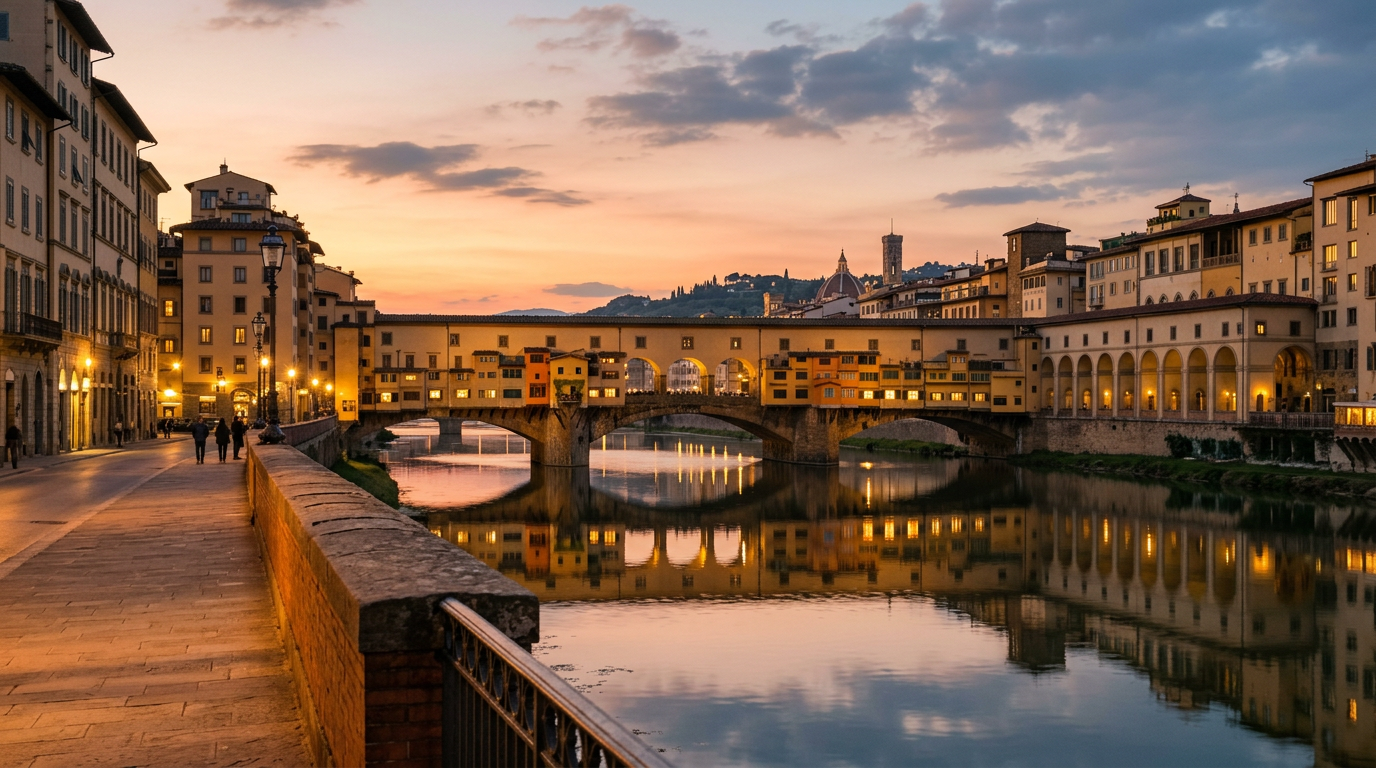
Florence bridges: history, character and what to see
Why Florence’s bridges matter
The city exists where it does because of the Arno. The river, which descends from the Apennines east of Florence and drains into the Ligurian Sea near Pisa, was both an obstacle and a resource. The Roman settlement established at the crossing point around 59 BCE grew because the Via Cassia, one of the main trunk roads of the Roman network, required a reliable ford or bridge at this latitude.
That original crossing, near the site of the present Ponte Vecchio, determined the geometry of everything that followed. Streets, property lines, the placement of the Forum, the arc of the medieval walls, all radiate from the decision to cross the Arno at this specific point. Understanding the bridges is, in this sense, understanding the reason Florence exists.
The Arno is not a gentle river. Its flow is highly variable: in summer it can drop to a depth of less than a metre across much of its Florentine section, while in a wet autumn it can rise six to eight metres in twenty-four hours. The flood of November 1966, which deposited mud up to six metres deep in parts of the city centre and damaged or destroyed tens of thousands of artworks, was the most catastrophic in living memory. Similar events were recorded in 1333, 1557, and 1740. Every bridge in Florence is, structurally speaking, a response to the threat of that recurring violence.
Ponte Vecchio: the old bridge and its occupied structure
The current Ponte Vecchio was completed in 1345. It replaced a bridge of the same name destroyed by the flood of 1333, which the Florentine chronicler Giovanni Villani described as tearing through the city with the force of a military assault. The 1345 reconstruction was in stone rather than wood, a deliberate decision to build something the river could not easily destroy.
The bridge is 95 metres long and 32 metres wide. Its three wide arches have a low profile that minimises the disruption of the water flow, a lesson extracted from the 1333 disaster, when debris accumulation against the piers of upstream bridges contributed to the collapse. The structural logic is sound: Ponte Vecchio has survived every subsequent Arno flood, including 1966, without structural failure.
Shops have occupied the bridge since the medieval period. They were initially occupied by butchers, fishmongers, and tanners, trades that generated organic waste conveniently disposed of directly into the river. In 1593, Ferdinando I de’ Medici cleared these occupants and reserved the bridge spaces exclusively for goldsmiths and jewellers. The decision was partly aesthetic, the Vasari Corridor, built in 1565 above the shops to connect Palazzo Vecchio to Palazzo Pitti, passed directly over the bridge and Cosimo I’s successors found the butchers’ smell incompatible with courtly movement, and partly commercial, as the jewellery trade was more lucrative and more prestigious.
In August 1944, the retreating Wehrmacht demolished every bridge in Florence except Ponte Vecchio. The reason for the exception has been debated for eighty years. The most persistent explanation credits the German consul Gerhard Wolf with delaying the demolition order; a competing account attributes Hitler’s personal intervention during his 1938 Florence visit. Neither version is fully documented. What is documented is that Ponte Vecchio was intact when Allied forces entered the city on 11 August 1944, and that both approach streets were reduced to rubble to impede crossing regardless.
Ponte Santa Trinita and the reconstruction
Ponte Santa Trinita, 250 metres west of Ponte Vecchio, is the most formally accomplished bridge in Florence. The current structure was designed by Bartolomeo Ammannati and completed in 1569 under Cosimo I. The design, three extremely flat elliptical arches that distribute the structural load in a way that appeared nearly impossible to contemporary engineers, is sometimes attributed to Michelangelo’s influence, though no autograph design survives. The geometry of the arches was mathematically derived; Ammannati’s structural innovation was to build arches that were lower than any Florentine bridge had attempted before.
The bridge was destroyed by the German demolitions of 4 August 1944. The reconstruction, carried out between 1948 and 1957 under Riccardo Gizdulich and Emilio Brizzi, was an attempt at exact replication using original stone recovered by dredging the Arno. The four allegorical statues of the seasons at the bridge ends, originally carved by Pietro Francavilla for the 1608 bridge, were recovered from the river. The head of the Spring figure was missing until February 1961, when a dredging operation recovered it from the riverbed near the centre of the original bridge span.
The reconstruction remains controversial among architectural historians. Purists argue that a faithful copy of a destroyed original is a historical falsification. Pragmatists argue that a precise reconstruction using recovered original materials is the most honest available response. The debate has not been resolved, and Ponte Santa Trinita remains both a beautiful bridge and a contested object.
The other crossings
Ponte alla Carraia, the westernmost of the central bridges, has been rebuilt five times since its initial wooden construction around 1218. The current bridge, in reinforced concrete with a stone facing, was built in 1948 after the 1944 demolition. It has no architectural distinction but plays an important functional role: it carries the heaviest pedestrian and bicycle traffic of any Arno crossing, as it connects the Via dei Fossi antique district on the north bank to Piazza Nazario Sauro and the western Oltrarno on the south.
Ponte alle Grazie, immediately east of Ponte Vecchio, was built in 1237 under Podestà Rubaconte da Mandello, it was for centuries known as Ponte Rubaconte. The medieval bridge had seven arches and hosted a small oratory dedicated to Our Lady of Graces, for which it takes its current name. The original structure was destroyed in 1944. The current bridge, a single-span concrete structure completed in 1957, is purely functional.
Ponte San Niccolò, at the eastern end of Oltrarno, is a Liberty-style iron suspension bridge completed in 1903. It was the only Florence bridge not destroyed in 1944, as it lay outside the central defensive perimeter the Germans were trying to block. It connects the San Niccolò neighbourhood on the south bank to the Viali di Circonvallazione on the north.
The best viewpoints and light conditions
Photography and observation of the bridges depend heavily on the position of the sun and the time of day. Ponte Santa Trinita viewed from the south bank, looking north toward the city, is best lit in the late morning between 9:30 and 11:30 from March through October. The three arches frame the medieval towers on the north bank.
The classic view of Ponte Vecchio, with the bridge and its overhanging buildings reflected in the Arno and the Oltrarno hills behind, is shot from Ponte Santa Trinita looking east. The best light for this angle is late afternoon in autumn and winter, when the sun drops into a position that illuminates the western face of the bridge from 15:30 onwards.
The view from Lungarno Torrigiani on the south bank, the stretch of riverside between Ponte Vecchio and Ponte alle Grazie, presents the entire north bank from the Uffizi loggia to the Bargello tower. Walk it at 8:00 in July or August. The rising sun is behind you, the facades of the north bank are fully lit, and the embankment is nearly empty.
Piazzale Michelangelo at 105 metres elevation gives the panoramic view of all the central bridges in sequence. The best time is 30 minutes before sunset in September, when the light angle is low and slightly amber and the hills behind the city are still visible. Go at 6:30 am in summer if you want the panorama without the crowds.
Where to stay
Every walk across the Arno begins and ends at a bridge. The south bank, where Oltrarno begins, is the departure point for the most important visual experiences the city’s waterway offers. From a base in the neighbourhood, the bridges are not destinations, they are the daily infrastructure of movement between the two halves of a city that divides itself by a river. De’ Medici is a guesthouse in Oltrarno, from which Ponte Vecchio and Ponte Santa Trinita are both within a ten-minute walk.