Porta Romana Florence: history and what to see nearby
The gate at the end of Via Romana
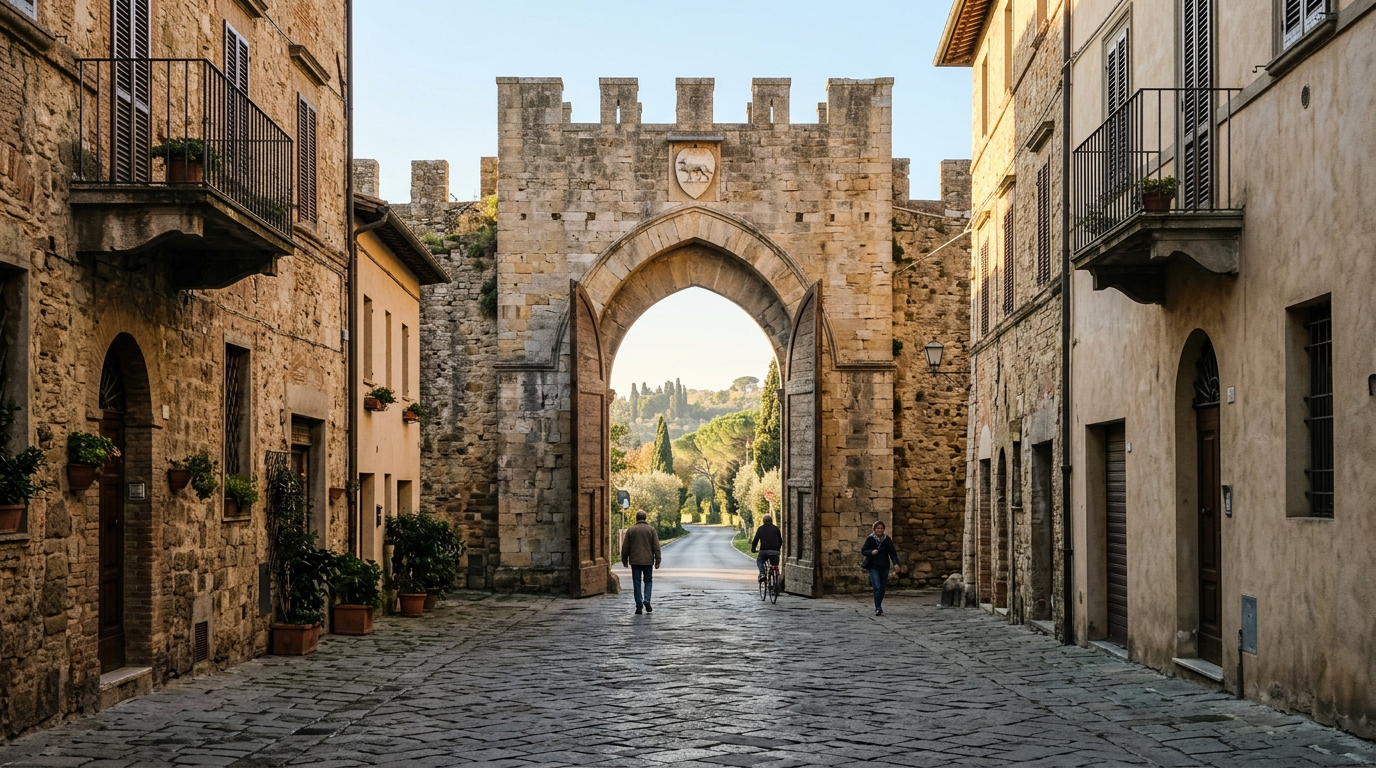
Via Romana runs due south from Piazza de’ Pitti, passing the Boboli entrance, crossing Piazza Tasso, and terminating at Porta Romana, a distance of approximately 850 metres. The gate is visible from the piazza on clear days: a large brown-stone arch blocking the southern exit of the street, flanked by shorter arches and topped by the worn remnant of a Madonna fresco.
Porta Romana is the best-preserved medieval city gate in Florence. Of the fifteen gates in the third circuit of walls, begun in 1284 and largely complete by the 1330s, only Porta Romana and Porta San Miniato survive in anything close to their original form. Most of the others were demolished during the urban expansion of the 1860s and 1870s, when the new Italian state removed the medieval walls to build the ring road boulevards that now define the boundary between the historic centre and the 19th-century city.
The gate’s survival is partly topographical. It stands at the end of one of the main southern axes of the city, anchoring the street grid in a way that made demolition impractical. It is also partly the result of the gate being repurposed as a ceremonial entrance rather than a defensive liability, which gave successive administrations reason to maintain it rather than remove it.
Construction: the third circuit of Florentine walls
Florence enclosed itself within three successive circuits of walls as the city’s population grew. The first circuit, probably dating from the Roman period, was small and close to the river. The second circuit, built in the 11th and 12th centuries, incorporated the expanding medieval town. The third circuit, begun under a civic decision of 1284, enclosed an area roughly three times larger than the second, a planning decision based on projections of growth that the Black Death of 1348 interrupted permanently.
The third circuit ran approximately 8.5 kilometres and enclosed roughly 630 hectares. The southern section, on the Oltrarno side, was built to a higher military specification than the northern sections because the southern approaches were considered more vulnerable to overland attack from Siena and the routes leading to Rome. Porta Romana, the main southern gate, was constructed in 1326 at full specification.
The gate is built in pietra forte, the standard sandstone of Florentine medieval construction, quarried from the Boboli area and the hills east of the city. The central arch measures approximately 6 metres in width and 7 metres in height. The total depth of the gateway passage, the thickness of the wall section through which the road passes, is approximately 8 metres, designed to accommodate a portcullis mechanism, the portcullis itself, and a second closing barrier at the inner end.
Evidence of the portcullis groove is visible in the stonework on both sides of the arch interior. The iron mounts that held the windlass mechanism have been removed, but the slots in which they sat remain. The flanking towers, which rose to approximately 15 metres above the wall walk on either side of the gate, were demolished in the 16th century when the Grand Duchy invested in a new system of artillery-resistant fortifications on the higher ground above the city.
What remains of the medieval walls
The full circuit of the third walls has almost entirely disappeared. The section that survived longest was the southern stretch on the Oltrarno side, protected by the parallel development of Viale Francesco Petrarca and the private gardens of the case coloniche that backed onto the wall. Sections of this wall survive as boundary features: garden walls, retaining walls, and rear building facades in the streets west of Via Romana between Porta Romana and Porta San Frediano.
Walking the streets immediately inside the former wall line, Viale dei Colli, Via di Camaldoli, Via dell’Erta Canina, reveals the original topography. The ground rises toward the south, which was the reason the walls on this side were built lower and more massive: the attacker approaching uphill had an advantage of elevation that mass construction partially compensated.
The bastions added by the Grand Duchy in the late 16th century, including the Bastione di San Giorgio above San Niccolò (designed by Michelangelo in 1529), were meant to provide artillery platforms at elevations commanding the approaches that the medieval walls could not adequately cover.
The neighbourhood inside the gate
Piazza della Calza, immediately inside Porta Romana on the city side, takes its name from the Compagnia della Calza, a Renaissance festive association of young noble men who organised jousts, banquets, and theatrical performances. The company met in the oratory adjacent to the square, which still stands and is used occasionally for concerts and cultural events by the Fondazione Cardinale Elia Dalla Costa.
The area between Porta Romana and Piazza Tasso is one of the least visited sections of Oltrarno. It is a working neighbourhood, dominated by residential buildings of the 19th and early 20th centuries, a few artisan workshops, a pharmacy, and a small supermarket. The Istituto Statale d’Arte, a school of applied arts with a curriculum covering traditional and contemporary craft disciplines, occupies a campus on Via Romana near the gate. The institute draws students from across Tuscany and has a long connection to the neighbourhood craft tradition.
Via Romana itself, running north from the gate, offers several buildings of minor architectural interest that are consistently absent from standard tourist guides. A 17th-century palazzo at number 17 retains its original rusticated ground floor. A small tabernacle in a niche at the corner of Via Maffia contains a 19th-century painting of the Madonna that neighbourhood residents still maintain with fresh flowers.
How to reach Porta Romana on foot from Oltrarno
The most direct route from Ponte Vecchio takes approximately fifteen minutes. Cross the bridge and walk south along Via Guicciardini. Pass Piazza de’ Pitti without turning into it. At the end of the piazza, the street becomes Via Romana. Continue south, passing the Boboli Garden entrance wall on your right, through Piazza Tasso, and on to the gate.
From Piazza Santo Spirito, the route is slightly shorter and avoids Via Guicciardini. Walk south along Via Sant’Agostino, which becomes Via Maffia at the crossing with Via dei Serragli. Continue south to Piazza Tasso, then onto Via Romana to the gate. Total walking time: about twelve minutes.
From Piazzale Michelangelo, the route descends west and south. Follow the footpath down through the parks above San Miniato, or take bus 12, which stops at both Piazzale Michelangelo and Porta Romana. The bus journey takes approximately eight minutes. Walking takes twenty to twenty-five minutes on good paths through the hillside gardens.
The gate passage is open at all times. There is no entry fee and no barrier. Walking through the arch from the city side to the Roman road beyond, particularly on a morning in October when the low sun strikes the stonework of the inner face, gives an impression of the gate’s original scale that no photograph captures.
Where to stay
Porta Romana sits fifteen minutes on foot south of the Oltrarno neighbourhood centre. The walk from a guesthouse in Oltrarno to the gate and back covers the most genuinely residential, least tourist-processed part of the south bank, the streets between Piazza Santo Spirito and the old city boundary. De’ Medici is a guesthouse in Oltrarno, and the route to Porta Romana passes through the streets that define the neighbourhood’s authentic character.