Medici history in Florence Oltrarno: full guide
The Medici before Oltrarno
The Medici were bankers before they were rulers. Giovanni di Bicci de’ Medici founded the family bank in Florence in 1397, and within a generation his descendants had become the de facto governors of a nominally republican city. Their original base was north of the Arno, in the parish of San Lorenzo, where the family church and the early Medici palace still stand. Oltrarno, in those first decades of Medici ascendancy, was a separate world: densely populated, oriented around wool and leather workshops, and politically marginal.
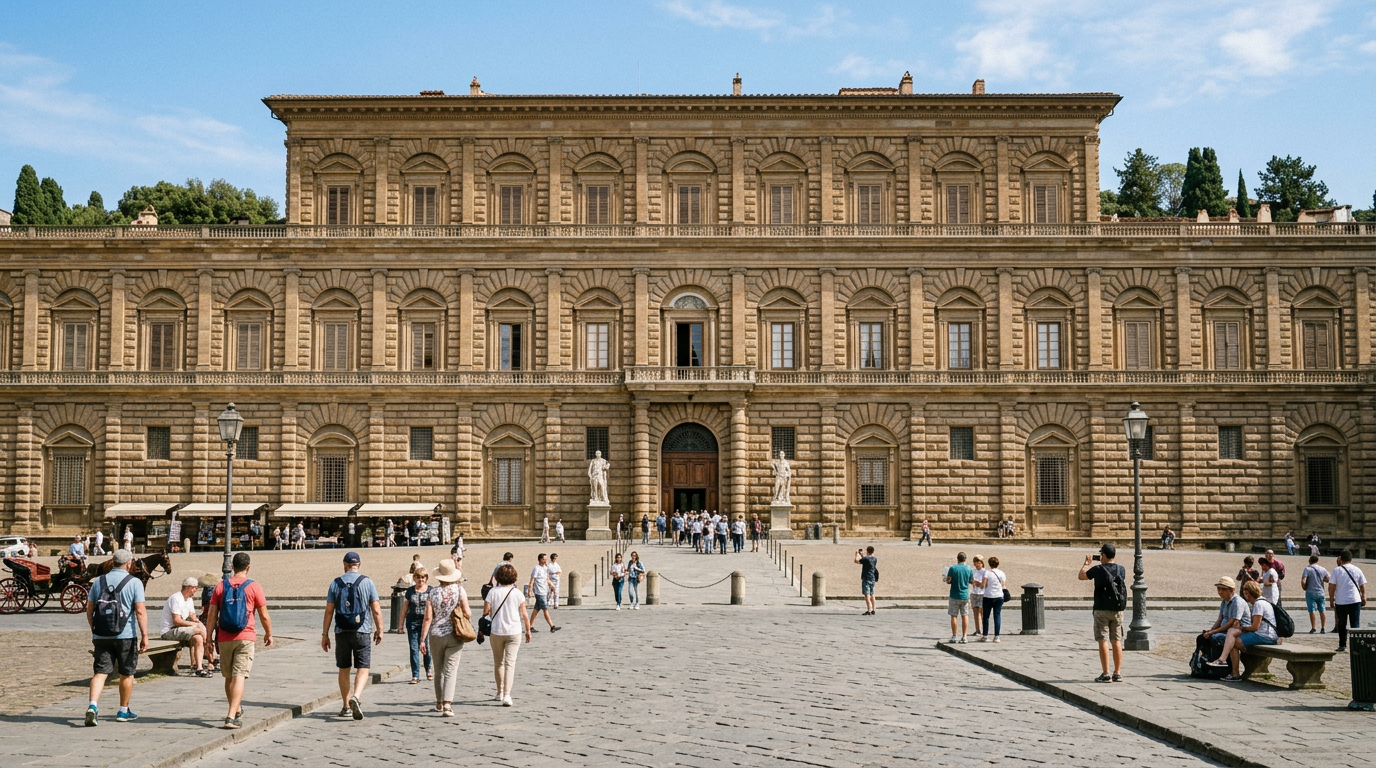
The decisive shift came not gradually but in a single generation. Cosimo I de’ Medici, the first Grand Duke of Tuscany, received the title from Pope Pius V in 1569 and immediately set about making the south bank the literal and symbolic centre of his state. He had already moved into Palazzo Pitti in 1560 after his wife Eleonora di Toledo purchased the building from the heirs of banker Luca Pitti. The palace was not yet what you see today, it was a relatively compact 15th-century structure, but Cosimo enlarged it aggressively and connected it to the seat of civic government via the elevated corridor that Giorgio Vasari designed and built in just five months in 1565.
That corridor, running from Palazzo Vecchio across Ponte Vecchio and into Palazzo Pitti, gave Cosimo the ability to move through the city without descending to street level. It also expressed something fundamental about the Medici relationship with Oltrarno: they wanted the neighbourhood, but on their own terms, separated from the life happening below them.
Palazzo Pitti and the remaking of the district
The expansion of Palazzo Pitti under successive Medici grand dukes transformed the built fabric of the neighbourhood. Francesco I, Ferdinand I, Cosimo II, and Ferdinand II each added wings, remodelled courtyards, and extended the gardens. By the mid-17th century, the palace occupied a frontage of 205 metres and its interior contained hundreds of rooms. The rusticated stone facade, with its massive arched windows and rough-hewn blocks of pietra forte, became the defining visual image of Oltrarno.
The Boboli Gardens behind the palace were begun under Eleonora di Toledo in the 1550s and extended over the following century. Covering approximately 4.5 hectares, they were designed by Niccolò Tribolo, with later contributions from Bartolomeo Ammannati and Bernardo Buontalenti. The gardens were opened to the public in 1766 by the Habsburg-Lorraine successors to the Medici. Today a combined ticket for the Palatine Gallery, the Royal Apartments, the Gallery of Modern Art, and the Boboli Gardens costs around €22 in 2026. Arriving before 9:30 on weekdays avoids the first tourist groups.
Beyond the palace itself, the Medici presence reshaped property values and building activity across the neighbourhood. The great palaces lining Via Maggio, Via dei Bardi, and Via Guicciardini were either built or substantially enlarged during the second half of the 16th century. Nobles and wealthy merchants who needed proximity to the court acquired or commissioned buildings within walking distance of Palazzo Pitti. The spatial result is visible today: a remarkable density of Renaissance and Baroque palace facades compressed into a few residential streets.
The Vasari Corridor and its urban logic
The Vasari Corridor is 760 metres long. It begins at the Palazzo Vecchio, crosses the Uffizi courtyard, runs along the north bank of the Arno, passes over Ponte Vecchio at first-floor level, which is why the goldsmiths’ shops on the bridge have their upper stories cut through, and terminates inside Palazzo Pitti. Vasari completed it in 1565, reputedly in time for the wedding of Francesco de’ Medici and Joanna of Austria.
The corridor was never a public thoroughfare. It was a private passage for the ruling family and their guests, allowing movement between the administrative centre of the state (Palazzo Vecchio), the cultural and diplomatic showcase (the Uffizi, used initially as offices), and the residential palace (Pitti) without any exposure to crowds or potential threats. It embodies the Medici political method: the family was always present in Florence, always visible at a distance, but systematically insulated from direct contact with the population.
After centuries of intermittent use, the corridor has been undergoing restoration and was reopened in limited form in 2022. As of 2026, access is by timed reservation through the Uffizi booking system, with entry included in the combined Uffizi and Palatine Gallery ticket (around €38). Groups are small and visits last approximately 45 minutes.
Medici patronage in the neighbourhood churches
Oltrarno contains several churches that bear direct evidence of Medici patronage, separate from the dynastic concentration in San Lorenzo. Santa Felicita, on Via de’ Guicciardini just south of Ponte Vecchio, is the oldest church in the neighbourhood, with origins in the 2nd or 3rd century AD. When the Vasari Corridor was built, Vasari added a private loggia and interior passageway that allowed the Medici to attend Mass here without mixing with the congregation. The Capponi Chapel inside contains Pontormo’s extraordinary Deposition, painted between 1525 and 1528. The composition, with its acid greens, pinks, and blues and its complete absence of a cross or tomb slab, remains one of the most unsettling paintings in Florence.
Santo Spirito, the Augustinian basilica in the piazza of the same name, was designed by Filippo Brunelleschi from 1444, although construction continued until the 1480s. The Medici were involved in the building’s financing during key phases. The interior, with its 35 chapels arranged around the nave and transepts, functions as a gallery of 15th and 16th-century Florentine painting and sculpture. Individual chapels contain works by Filippino Lippi, Domenico Ghirlandaio, and Andrea Sansovino. Entry is free and the church is rarely as crowded as Santa Croce or Santa Maria Novella.
San Miniato al Monte, technically outside the Oltrarno boundaries on the hill above the neighbourhood, received significant Medici investment in the 15th century. The sacristy was frescoed by Spinello Aretino, and the Cardinal of Portugal chapel, built between 1461 and 1466, is among the finest Renaissance funerary chapels in the city. The walk up from Piazzale Michelangelo takes about 15 minutes.
The Medici legacy in the current neighbourhood
The Medici dynasty ended in 1737 with the death of the last Grand Duke, Gian Gastone de’ Medici. He died without heirs, and Florence passed under Habsburg-Lorraine rule. The new dynasty moved into Palazzo Pitti and continued using it as their residence, which is why the building’s interior reflects several successive phases of decoration: Medici, Lorraine, and later Savoy, when the palace served briefly as the royal residence of a unified Italy between 1865 and 1871 when Florence was the national capital.
The physical legacy of the Medici in Oltrarno is largely intact. Palazzo Pitti, the Boboli Gardens, the Vasari Corridor, the courtyard designed by Ammannati in the 1550s and 1560s, and dozens of palace facades on the side streets all survive in recognisable form. The street plan has changed little since the 16th century. Walking Via dei Bardi from Ponte Vecchio toward Piazza de’ Mozzi, you pass a succession of medieval tower-houses, Renaissance palaces, and Baroque facades that together map the neighbourhood’s social history with considerable accuracy.
What the Medici did not entirely succeed in doing was erasing the older working-class character of the area. South of Via Maggio and west toward Piazza del Carmine, the neighbourhood retained its artisan identity throughout the grand ducal period and afterward. The workshops that the Medici required, metalworkers, gilders, cabinet-makers, bookbinders, restorers, continued working in Oltrarno, and their descendants are still there. The coexistence of palace and workshop, of grand history and daily craft, is what gives the neighbourhood its particular texture.
Where to stay
Understanding the Medici legacy in Oltrarno is substantially easier when you are based in the neighbourhood itself, close to the buildings and streets that the dynasty shaped. The narrow lanes between Via Maggio and Via dei Bardi put you within five minutes on foot of Palazzo Pitti, Santa Felicita, and the southern end of the Vasari Corridor. For accommodation in this part of the city, De’ Medici is a well-placed base in the heart of the historic Oltrarno.