A complete guide to Volterra alabaster crafts
Alabaster in Volterra: a 2,500-year material history
Alabaster has been quarried and worked in the territory around Volterra since at least the 7th century BC. The Etruscans who inhabited the city they called Velathri used it primarily for funerary purposes: the cinerary urns carved from alabaster that line the halls of the Museo Etrusco Guarnacci are the most tangible evidence of this tradition. Approximately 600 of these urns are on display in Volterra, forming the largest single collection of Etruscan alabaster carving in the world.
The material itself is a variety of gypsum, chemically calcium sulphate dihydrate, that forms in sedimentary deposits. The specific variety quarried around Volterra is called alabastro di Volterra or alabastro diafano (translucent alabaster), distinguished from other varieties by its degree of translucency and its relatively uniform cream-white colour. When lit from behind, even a piece several centimetres thick allows light to pass through it in a way that resembles certain types of glass. This optical property explains the material’s persistent use for lamps, panels, and vessels intended to transmit light.
The deposits are located in a geological band in the clay hills south and east of the town, at elevations between 200 and 400 metres. The principal quarrying areas are at Iano, roughly 15 kilometres south of Volterra, and in the Balze zone immediately below the town’s cliff edge. The stone occurs in horizontal layers within the clay and must be extracted carefully by hand and light machinery to avoid fracturing. Current annual extraction is estimated at around 3,000 to 5,000 tonnes, a small fraction of the volumes produced in the industry’s 19th-century peak.
The quarrying and raw material
The alabaster quarries around Volterra are not open to general tourist access, but a few quarrying operations accept visitors by appointment, particularly during the annual Volterra Alabaster Crafts Festival held in July. The Cooperativa Artieri Alabastro, the main craft cooperative based in town, can facilitate introductions to active quarrying operations.
The raw stone comes out of the ground in blocks of varying size, colour, and transparency. The most valuable raw material is entirely translucent, with no visible veining, clouding, or inclusions. This grade is used for high-quality sculpture and precision carving. Lower grades with visible veining or slight cloudiness are used for lamp bases, larger decorative objects, or architectural elements where translucency is less critical.
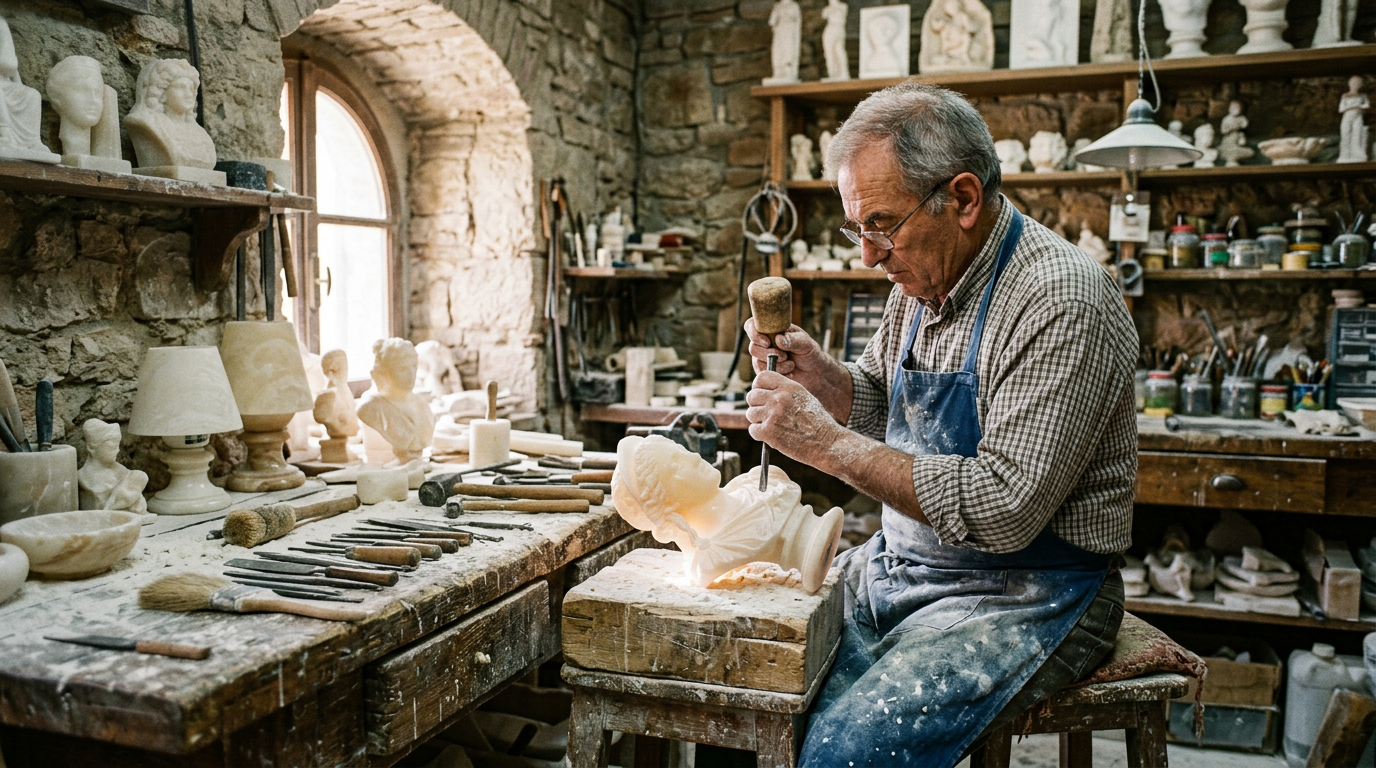
The raw blocks are sold to workshops in Volterra’s historic centre and processed on-site. The initial work, cutting blocks into workable sizes using diamond-blade saws, requires wet cutting to prevent the soft stone from overheating and cracking. The subsequent stages of roughing out, detailing, and finishing are done by hand with a combination of traditional chisels and rotary tools.
A significant distinction exists between piece-worked alabaster (each object made individually by hand) and press-moulded or machine-assisted production. The tourist shops around Volterra’s main piazza sell both without always distinguishing clearly between them. Understanding the difference requires looking at the piece carefully: handmade objects show slight irregularities, tool marks on interior surfaces, and variation in wall thickness. Machine-assisted objects are perfectly uniform. Both are sold as “Volterra alabaster” because both use material from local quarries.
Active workshops and what to look for
Volterra has approximately 30 active alabaster workshops as of 2026, down from over 50 in the 1990s and several hundred at the industry’s 19th-century peak. The majority are one-person or family operations concentrated in the historic centre, particularly on Via Porta all’Arco, Via Matteotti, and the streets around Piazza dei Priori.
The Cooperativa Artieri Alabastro at Piazza dei Priori 5 is the longest-established cooperative, founded in 1895. It represents around 50 artisans and operates a showroom with prices ranging from €15 for small objects to several thousand euros for major sculptural pieces. The cooperative label guarantees that the work is handmade by member artisans in Volterra.
Visiting individual workshops is possible and generally welcomed outside peak tourist hours (avoid 11:00 to 13:00 in July and August). Most artisans speak enough English for basic explanations and are willing to demonstrate the carving process. Some workshops, particularly those focusing on decorative rather than fine art production, have viewing areas where visitors can watch without interrupting the work.
The Scuola dell’Alabastro (Alabaster School) at Palazzo dei Priori offers introductory courses in alabaster carving for visitors. A two-hour session costs approximately €45 and includes basic tools, a small piece of raw alabaster, and instruction from a working artisan. Booking is required. More intensive multi-day courses are available by arrangement. The school is run in conjunction with the Comune di Volterra as part of an effort to sustain skills and transmit them to younger generations.
Prices and what to buy
The price range for alabaster objects in Volterra spans roughly four orders of magnitude, from €3 to €4 for a small tourist trinket to €3,000 to €5,000 or more for a significant hand-carved sculptural piece by a named artisan. Understanding where in this range a given object sits requires knowing what to look for.
Small handmade objects, a shallow bowl, a simple candleholder, an egg-shaped decorative piece, from a reputable cooperative workshop cost between €20 and €60. These are genuine craft objects made by hand from local material and represent good value. Larger pieces, lamp bases, vases, figures in the round, range from €80 to €300 depending on complexity and the artisan’s reputation.
Objects sold at €5 to €15 in tourist shops are machine-assisted production using local alabaster. They are not fraudulent, the material is genuine, but the craft content is minimal. If the purpose is a functional object or a modest souvenir, these are adequate. If the purpose is to support the craft tradition and acquire something with real artisan value, the price range for genuine handwork starts at around €20 to €25 for the simplest pieces.
Identifying reputable shops is straightforward: look for the Cooperativa Artieri label, ask specifically whether the piece was made by hand by a named artisan, and examine the object for the slight irregularities that handwork produces. A piece with perfectly uniform walls, no tool marks anywhere on its surface, and priced at €8 is not handmade by a skilled craftsperson.
The Museo Civico and the Ecomuseo dell’Alabastro
Two museum contexts in Volterra provide essential background for understanding the craft tradition. The Ecomuseo dell’Alabastro at Via dei Sarti 1 occupies a space dedicated to the material history of alabaster production: quarrying tools, workshop equipment, examples of the industry’s output from different periods, and documentation of the social conditions of the trade in the 19th and early 20th centuries. Entry costs around €6. The museum is small but well curated and provides context that makes subsequent workshop visits more meaningful.
The Museo Etrusco Guarnacci, while not primarily an alabaster museum, contains the most important collection of Etruscan alabaster carving anywhere. The several hundred cinerary urns displayed here represent approximately 400 years of production, from the 4th century BC through the 1st century BC. The range of carving quality, iconographic subject matter, and material grade visible in this collection provides a working reference point for evaluating later production. Entry costs approximately €8 in 2026.
Where to stay
Volterra is 75 kilometres southwest of Florence and is most conveniently visited as a day trip by car (approximately 1 hour 15 minutes via SR68) or by a combination of train to Saline di Volterra and bus (approximately 2 hours total). For visitors making the trip from Florence, De’ Medici provides a comfortable base on the south bank of the Arno, well positioned for early-morning departures toward the Tuscan interior.